How to Schedule a Summer HVAC Tune-Up Before Winter Rush
Technicians get booked out fast once temperatures drop. Parts flagged during inspections may be on backorder. What would have been a $100–$300 scheduled summer HVAC tune-up, per Lennox, turns into an emergency call with after-hours rates if anyone's available at all. This guide exists to help you avoid that outcome.
Late summer into early fall is the window. That's the last stretch where a pre-season heating visit has enough lead time to find a problem, source a part, and fix it before winter demand peaks. ENERGY STAR puts it plainly: contractors get busy once winter arrives, so pre-season scheduling is the practical workaround. Poor air circulation and dirty components can cut a system's heating efficiency by up to 15 percent, a figure confirmed by both ENERGY STAR and Salmon HVAC, meaning a neglected system is already costing money every month it runs.
This guide covers when to book, what gets checked, what you can do yourself right now, and what the real cost of waiting looks like.
What waiting costs: efficiency, safety, and warranty risk
Video of the Day
Efficiency and bills
A system losing up to 15 percent efficiency doesn't just fail sooner. It runs longer every cycle, delivering uneven room temperatures and inflating utility bills across an entire heating season. Salmon HVAC notes that preventive maintenance reverses many of those efficiency losses, with results that show up as shorter run times, more consistent heat distribution, and lower energy consumption. KD Mechanical identifies the specific levers: clean coils, a calibrated thermostat, and clear air filters each reduce how hard the system has to work to deliver the same result. Together, they translate to energy savings that compound across months of heavy use.
Carrier adds a less-discussed benefit. Maintained systems circulate cleaner air, reducing indoor dust and allergens across months of winter operation when windows stay shut and the system runs continuously.
The winter breakdown scenario
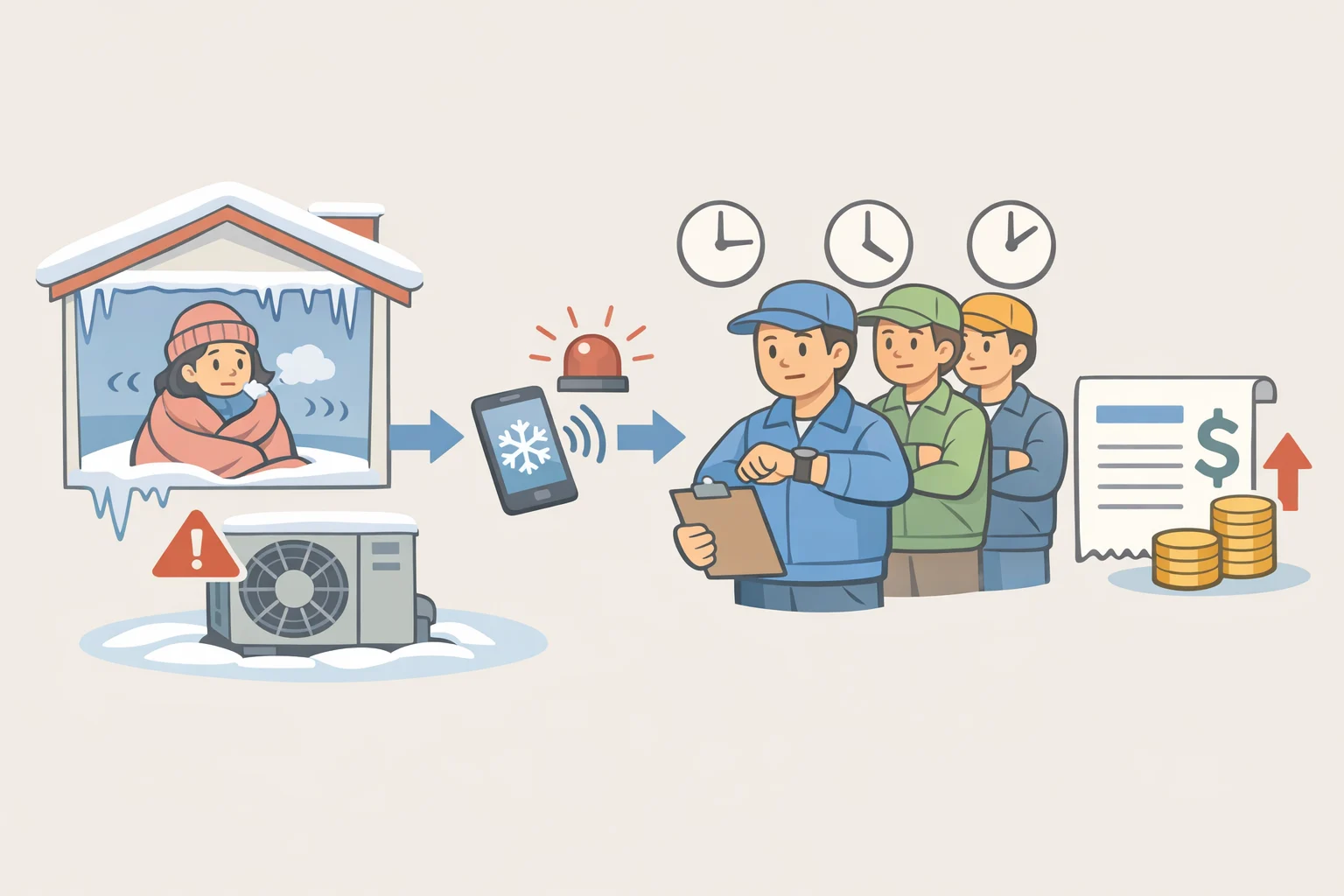
Dirty coils, aging capacitors, and worn components often hold through fall. They tend to fail during periods of peak demand, when every technician in the area is already dispatched and parts may be days out. Salmon HVAC describes the pattern directly: routine issues that are easy to resolve with lead time become emergencies carrying premium pricing, service delays, and whatever parts happen to be in stock locally.
KD Mechanical puts the contrast in concrete terms. A worn belt or failing capacitor caught at a scheduled pre-season visit gets replaced at standard rates on a flexible timeline. The same component failing in January means emergency fees, possible multi-day waits, and no say in the scheduling.
Safety and warranty exposure
Furnace inspections surface carbon monoxide leaks and gas line problems that produce no visible warning signs during warmer months. KD Mechanical confirms that technicians test for dangerous gas leaks, secure loose wiring, and verify that all safety switches function correctly as part of a standard pre-season visit. These checks have no equivalent in a spring AC appointment.
One thing easy to overlook: most HVAC manufacturers require documented proof of regular professional maintenance to honor warranty claims. KD Mechanical notes that skipping a service cycle can render a system ineligible for coverage, including failures caused by a manufacturer defect rather than anything the homeowner did wrong. A dated service record is simple protection against that outcome.
Video of the Day
Step 1: Identify your system, then know your booking target
One decision point before scheduling anything. The right service frequency depends entirely on what kind of system you have.
If you have a central furnace and a separate air conditioner: these are two distinct systems with two separate service calendars. Spring handles the AC; late summer into early fall is the heating window. One professional visit per system, per year, is the baseline. Don't conflate this visit with the spring AC appointment they serve different purposes and cover different components.
If you have a heat pump: Salmon HVAC is direct on this point. Heat pumps run year-round and should be inspected twice annually spring and late summer because continuous operation accelerates wear across both heating and cooling cycles. The late-summer visit covers both end-of-cooling-season review and winter heating prep simultaneously. If you've only been booking one annual visit for a heat pump, you're likely under-maintaining it.
If your system is making unusual sounds or you smell gas: skip the scheduling and call a technician today. Salmon HVAC is clear that grinding, squealing, rattling, or unexplained smells are not pre-season maintenance issues they're current problems that worsen under the sustained demand of winter operation. A tune-up appointment is not the right vehicle for an active mechanical problem.
Step 2: Do these three things before the technician arrives
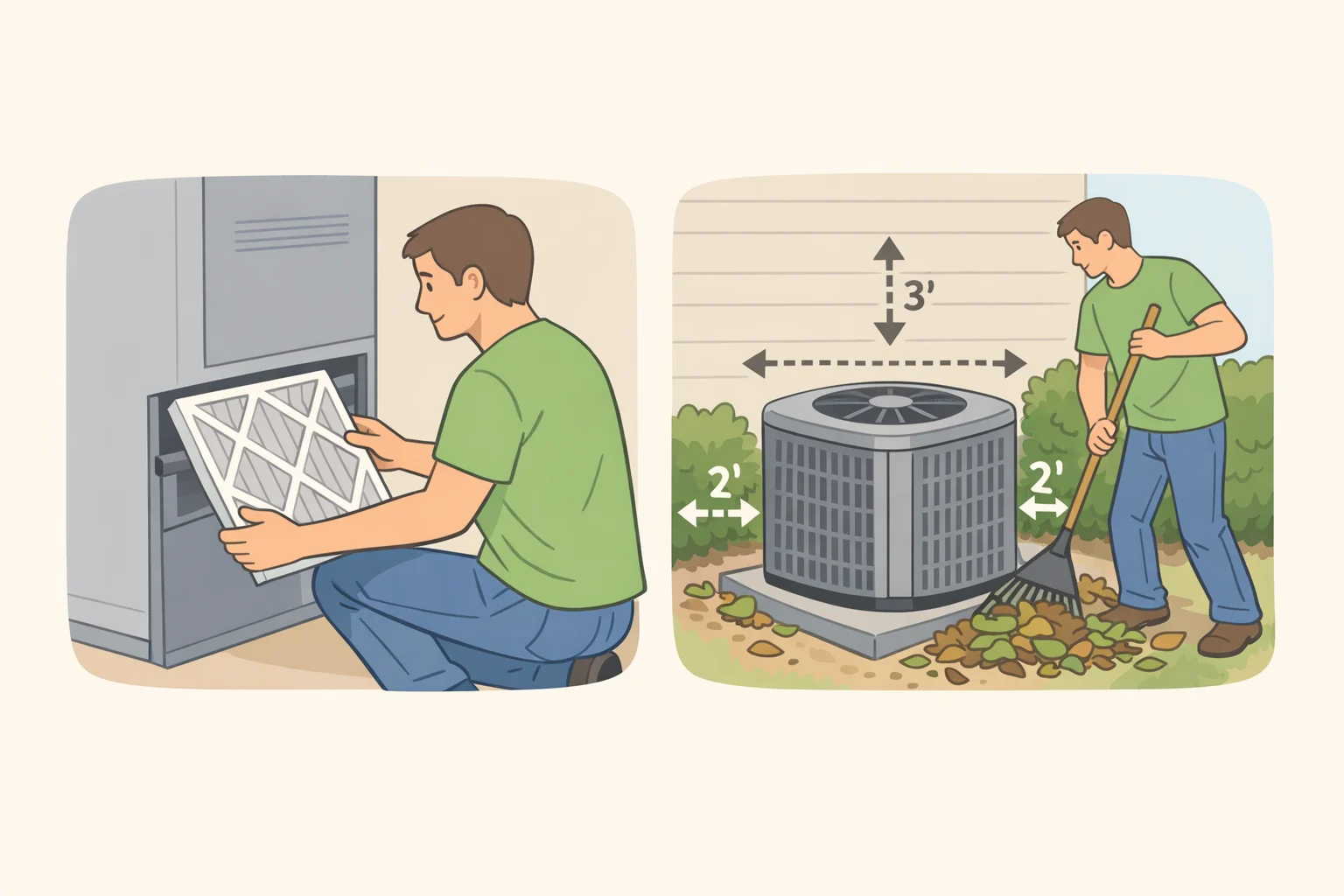
These are actions for today, not the morning of the visit.
1. Check and replace the air filter. Pull it out and look at it. ENERGY STAR recommends monthly filter inspections for furnaces, heat pumps, and central AC units a clogged filter restricts airflow, raises energy costs, and can cause early equipment failure. Carrier recommends replacement every one to three months depending on household conditions. If it's visibly grey or packed with debris, replace it before you do anything else.
2. Clear two feet of clearance around the outdoor unit. Remove stored items, overgrown vegetation, and accumulated debris. Carrier recommends maintaining that clearance perimeter and rinsing condenser coils gently with a garden hose not a pressure washer to remove built-up grime. This applies to heat pumps and mixed systems too, since the outdoor unit handles both cooling and heating functions and benefits from a clean starting point before the technician arrives.
3. Write down anything unusual you've noticed. Rooms that run cold or hot relative to others, cycles that seem longer than they used to, any new sounds. Salmon HVAC identifies inconsistent temperatures as a common indicator of restricted airflow, ductwork problems, or incorrect thermostat settings all conditions that worsen under winter load. That written list is practical diagnostic information, not a vague complaint.
One hard boundary applies across all of the above. Refrigerant handling, gas combustion systems, electrical components, and specialized airflow testing are not homeowner territory. Salmon HVAC notes that refrigerant work carries legal certification requirements independent of complexity. These tasks require a licensed technician, full stop.
Step 3: Book now and know what the visit should cover
When to schedule your HVAC inspection before winter
Book several weeks before extreme temperatures arrive, not after the first cold night. Salmon HVAC notes that service companies have more flexible availability in the weeks leading up to high-demand seasons, and that booking lead time matters specifically because a problem discovered during the inspection may require a follow-up visit for parts that could be on backorder. ENERGY STAR makes the same point from the contractor side: availability collapses once heating season is underway.
A professional heating tune-up typically runs 60 to 90 minutes, per Lennox. The constraint isn't the homeowner's calendar it's technician availability, which tightens fast once fall temperatures drop.
What to ask when you call
Most homeowners book an appointment without knowing what they're actually purchasing. Before confirming, ask:
- What system types do you service? (Confirm they handle your specific equipment furnace, heat pump, or combined system)
- Is this visit inspection-only, or does it include tune-up tasks like cleaning and lubrication?
- What documentation will you provide after the visit?
- Does the quoted price include filter replacement, coil cleaning, and any minor adjustments or are those billed separately?
- If the inspection finds a part that needs replacement, what's your typical follow-up timeline?
Carrier draws a useful distinction here: an inspection is diagnostic it assesses condition and identifies problems while a maintenance visit includes hands-on tasks like cleaning, filter replacement, and component calibration. Some quotes cover only the former. Know which one you're booking before you schedule.
What a qualified technician should cover
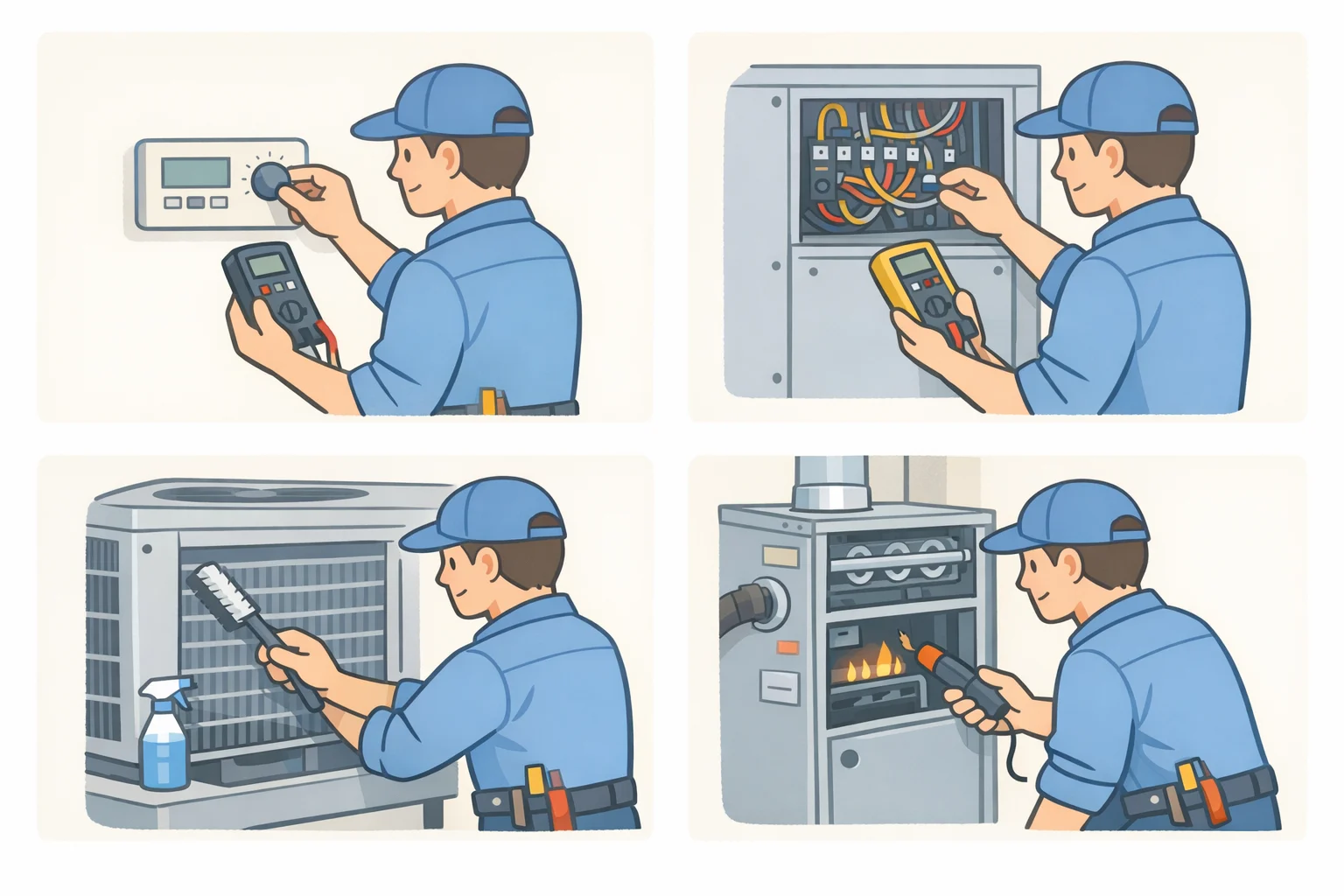
A thorough visit covers four areas. Any quote or service agreement that doesn't address all of them, as applicable to your system, warrants a follow-up question.
For most systems:
- Mechanical inspection and lubrication: Full component inspection for worn or damaged parts; lubrication of motors, belts, and bearings. KD Mechanical notes that worn components identified during a scheduled visit can be replaced at standard cost; the same components failing mid-winter mean emergency rates and potential backorder delays.
- Calibration and controls: Thermostat calibration to ensure accurate temperature response; electrical connections inspected and tightened. An uncalibrated thermostat forces the system to run longer than necessary on every cycle a small error with a season-long cost.
- Filter assessment: Replacement or inspection of air filters to confirm proper airflow and reduce indoor contaminants.
For heat pumps and cooling-side systems:
- Airflow and coil cleaning: Cleaning of both condenser and evaporator coils; drain line clearing to prevent water damage and microbial growth. Poor air circulation and dirty components are common contributors to the up-to-15-percent efficiency loss cited by ENERGY STAR and Salmon HVAC.
Furnace-specific safety checks:
- Gas line integrity, carbon monoxide leak detection, and safety switch confirmation. KD Mechanical is direct: a furnace that sat idle through summer can develop combustion issues that produce no warning signs until the system runs under sustained demand. These checks have no equivalent in a heat-pump or AC-only service call.
Ask for written documentation of everything checked. Date of service, components assessed, anything flagged or replaced. That record is both warranty protection and a performance baseline that lets future technicians spot deteriorating trends before they become failures.
Book this week
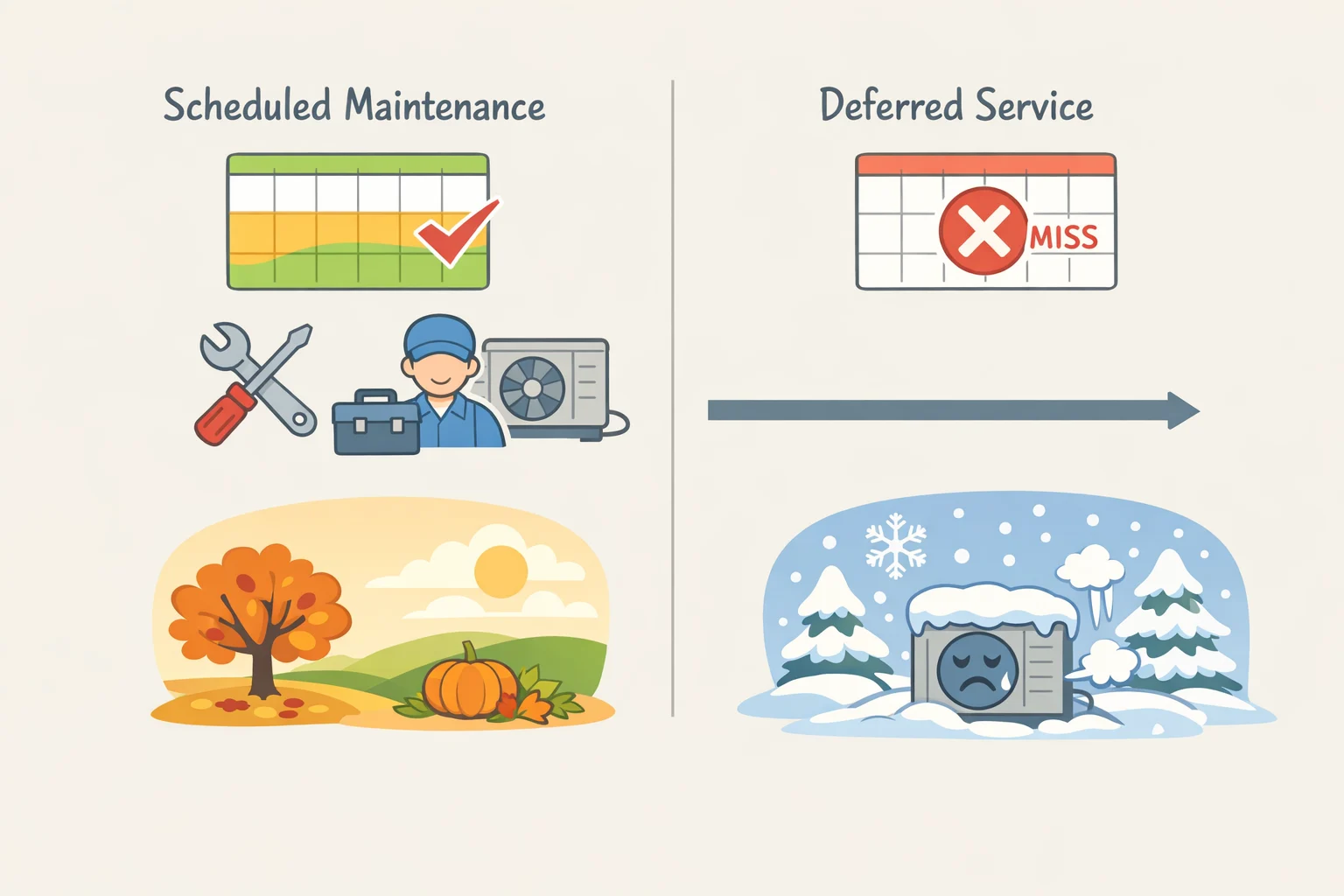
Lennox recommends twice-yearly inspections spring for cooling, fall for heating as the standard maintenance cadence. The next easy window after this one sits on the other side of peak-season backlogs and cold-weather demand.
Furnaces last roughly 15 to 20 years; central AC systems around 10 to 15 years, per Salmon HVAC. A single skipped pre-season visit won't kill a system. But skipped visits compound: worn parts stay worn, efficiency losses accumulate, and the probability of a midwinter failure grows with each season of deferred care.
The choice is straightforward. A $100–$300 scheduled visit with flexible timing and lead time to order any needed parts, or a January breakdown with emergency rates, possible multi-day delays, and for furnaces specifically safety risks that only surface under sustained heating load, as both KD Mechanical and Lennox confirm. Book before demand spikes, and you give yourself time to fix whatever the inspection finds on a normal schedule, at normal rates.