How to organize a junk drawer that actually stays useful
Lastree Lemene has a theory about why junk drawers turn into disaster zones, and it starts with the name. "Junk drawers are more of a utility drawer," says Lemene, owner of Ready Set Declutter. "If we think of them as a junk drawer, it is going to just always end up [in] chaos" (House Beautiful, earlier this summer). Call it junk and it gets treated like junk. Call it a utility drawer and suddenly it has a job to do.
Figuring out how to organize a junk drawer starts with that mental shift, but it doesn't end there. Most junk-drawer problems, as one organizing guide puts it, aren't really storage problems at all; they're too-much-stuff problems, too many objects crammed into too little space (Jessica Millers, three weeks ago). The fix isn't getting rid of the drawer. It's turning it into a defined storage zone where small items have an actual home, without letting that zone swallow the whole drawer (Jessica Millers, three weeks ago). Marie Potter, a professional organizer based in British Columbia, offers the cleanest test for whether any of this is working: if you can find what you're looking for in 15 seconds or less, the system is doing its job (House Beautiful, earlier this summer).
What follows is a method, not a makeover: how to decide what earns a spot in the drawer, how to sort it into zones that make sense, and how to keep the whole thing from sliding back into chaos three weeks later.
What to put in a junk drawer (and what to leave out)
Video of the Day
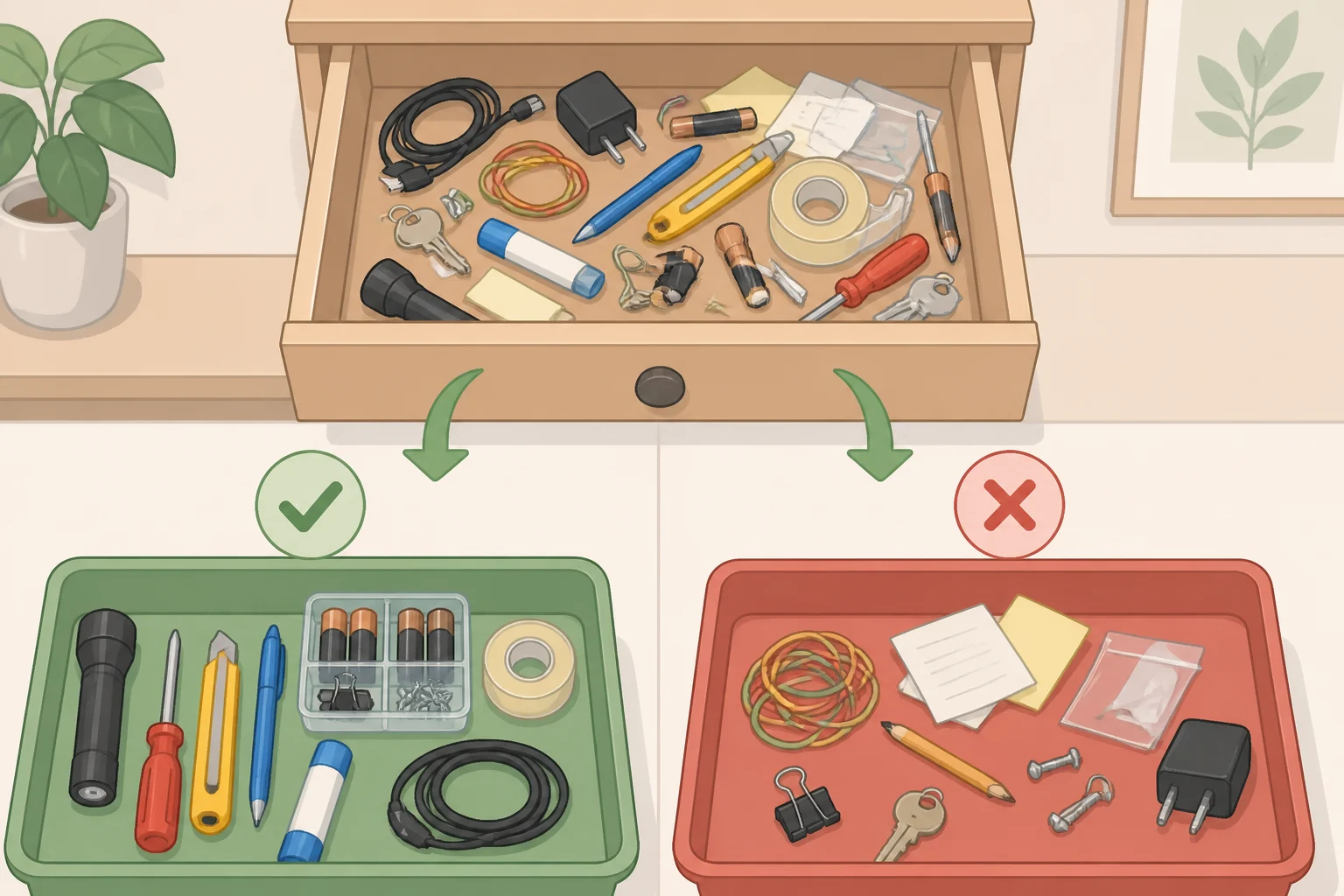
Ask several organizers what belongs in a junk drawer and the lists converge fast: scissors, tape, pens, rubber bands, small screwdrivers, and spare keys show up again and again as the junk drawer essentials that solve small household problems on the spot (Jessica Millers, three weeks ago; Pioneer Woman, earlier this year). These are the items you reach for without thinking, which is exactly the point.
Potter organizes her own drawer around five categories: writing instruments, "keep-togethers" like elastic bands and clips, electronics, hardware, and a small allowance for what she calls "mystery bits" (House Beautiful, earlier this summer). Five categories, not fifteen. That restraint turns out to matter more than any individual item on the list.
Knowing what to put in a junk drawer also means knowing what to reject. Full tool collections, craft supplies, important documents, medication, and valuables all need a different address entirely (Jessica Millers, three weeks ago). Pioneer Woman's list of repeat offenders gets more specific about the stuff that sneaks in anyway: expired coupons, old receipts, loose change, chargers with no identifiable device, and dead batteries that leak and roll (Pioneer Woman, earlier this year). An item earns drawer space because it's small, used regularly, and needed near that spot in the house, not because it lacks a home anywhere else.
For anyone starting from scratch, here's a shorthand for how to stock a junk drawer without overthinking it:
- Scissors, tape, and a pen or two for everyday tasks
- One or two small screwdrivers and a measuring tape
- Rubber bands, twist ties, and a few small hooks
- A handful of batteries, kept together and away from metal objects
- One spare key, clearly identified, not a mystery collection
- A small, bounded space for the stuff you haven't sorted yet
Video of the Day
How to organize a junk drawer in five steps
-
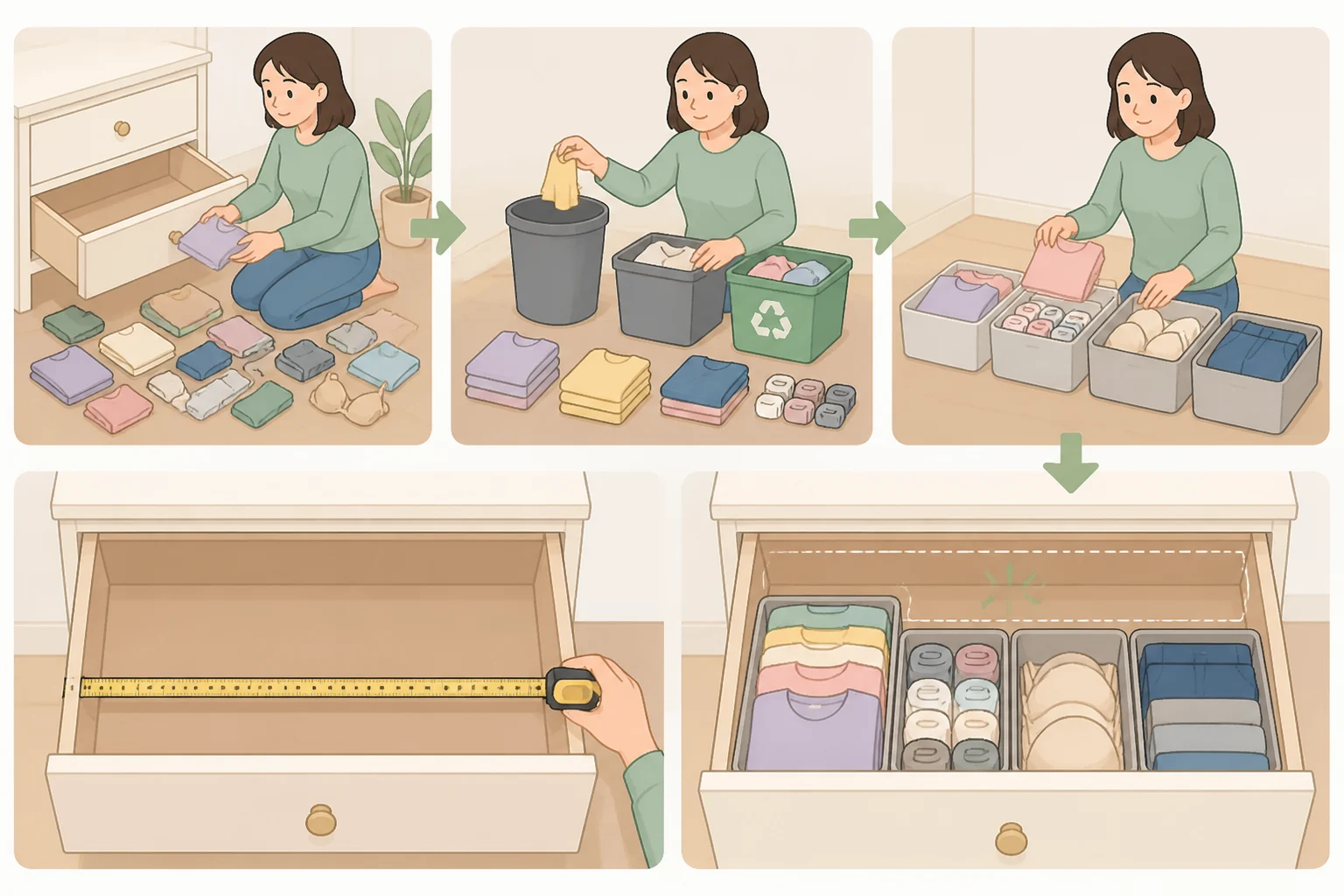
Empty the entire drawer onto a counter. Don't sort around the clutter. Spreading everything out is the only way to actually see what's accumulated and evaluate it honestly (Jessica Millers, three weeks ago).
-
Throw out the obvious junk first. Dried-out pens, broken items, expired coupons, duplicates. Laura McHolm, cofounder of NorthStar Moving Company, suggests asking blunt questions here, like whether anyone genuinely needs 1,000 rubber bands (House Beautiful, earlier this summer). Most people don't, and the drawer gets noticeably lighter in this step alone.
-
Group what's left into five or six broad categories. Resist the urge to create fifteen micro-categories for every type of object; that tends to make the system harder to maintain rather than easier (Jessica Millers, three weeks ago). A few items sharing space is fine. The goal is function, not a perfectly labeled taxonomy.
-
Measure before you buy dividers. Get the drawer's width, depth, and height, then choose organizers that fit, rather than picking a pretty tray first and hoping it works. Adjustable dividers tend to outperform one large fixed tray because they flex around whatever you actually own, not some generic assortment (Jessica Millers, three weeks ago).
-
Leave 10 to 15 percent of the drawer empty. This is Potter's rule of thumb, and it's not about precise math so much as breathing room, which makes items easier to spot and easier to put back where they came from (House Beautiful, earlier this summer).
Notice what's missing from that list: a specific product recommendation. Dividers, trays, and small bins all work, but only once the drawer has been measured and the contents sorted first, not before (Jessica Millers, three weeks ago; House Beautiful, earlier this summer). The editing does the heavy lifting. The organizer just holds the result in place.
How to create junk drawer zones that work
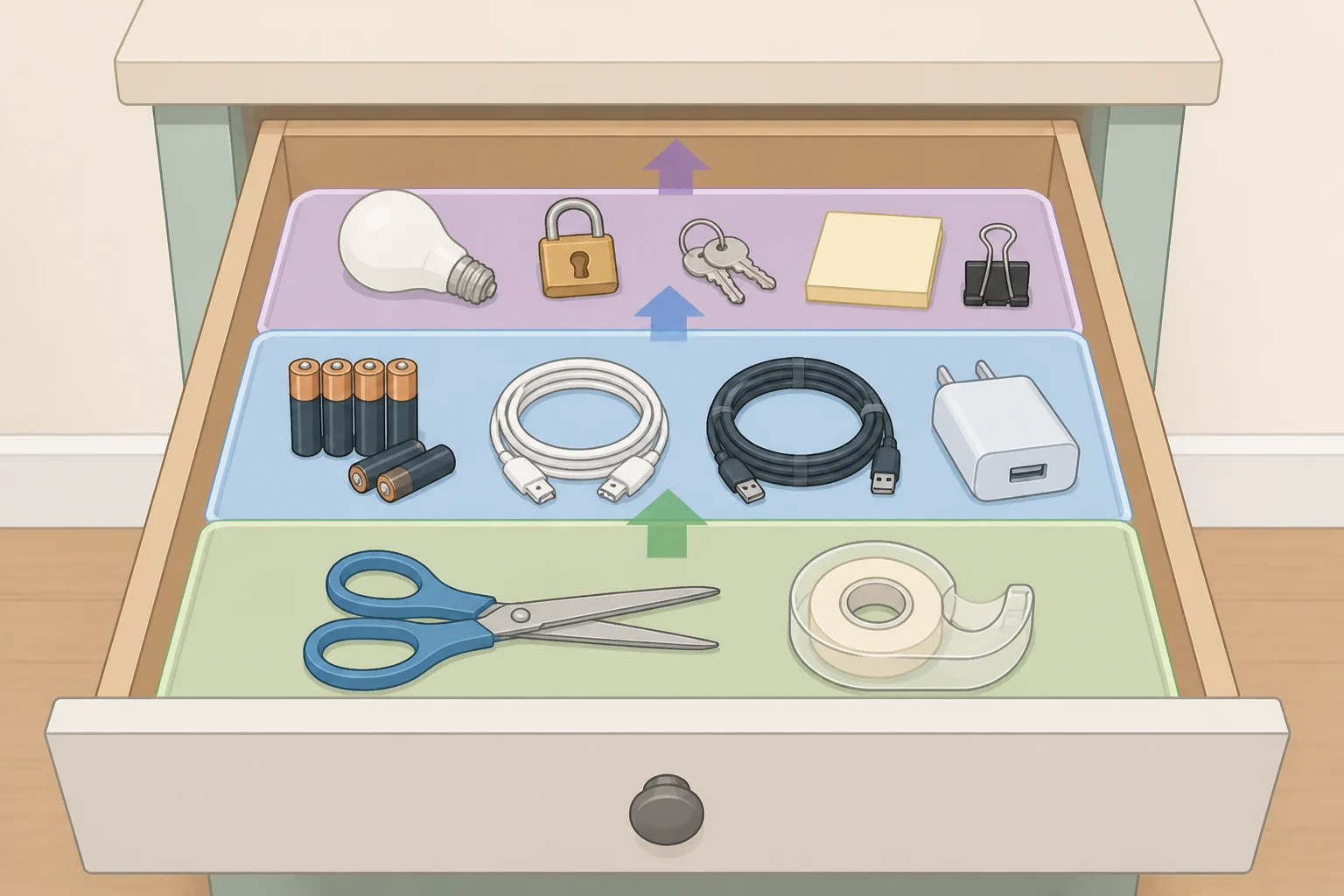
Nowhere does zoning matter more than in the kitchen, where the junk drawer usually lives and counter clutter is the thing you're trying to avoid in the first place. An organized kitchen junk drawer depends as much on placement as it does on categories: everyday items like scissors, pens, and tape go toward the front, batteries, cords, and hardware occupy the middle, and backups or rarely used items go toward the back (Jessica Millers, three weeks ago). Organize around how the drawer actually gets used, not how it looks on day one.
Batteries deserve their own enclosed zone, separated from metal objects like coins or paper clips that can create a short if contact is made, and damaged or leaking batteries should follow manufacturer disposal guidance rather than sitting loose in a drawer (Jessica Millers, three weeks ago). It's a small rule, easy to skip, and the main reason batteries end up rolling into every other compartment in the drawer.
Cords get the same scrutiny. A container full of unidentified cables doesn't belong in the drawer; if a cable can't be matched to a specific device with a real use, it's worth asking whether it needs to stay at all (Jessica Millers, three weeks ago). "Might need it someday" is how a drawer ends up with four chargers for devices nobody owns anymore.
As for Potter's fifth category, the "mystery bits" allowance is deliberately small, and that's the whole point of it. Left unchecked, a catch-all section expands until it becomes, as one organizing guide puts it, the junk drawer inside the junk drawer (Jessica Millers, three weeks ago). A defined catch-all gives the system flexibility without letting every category spread into the next one.
Keeping junk drawer organization from falling apart
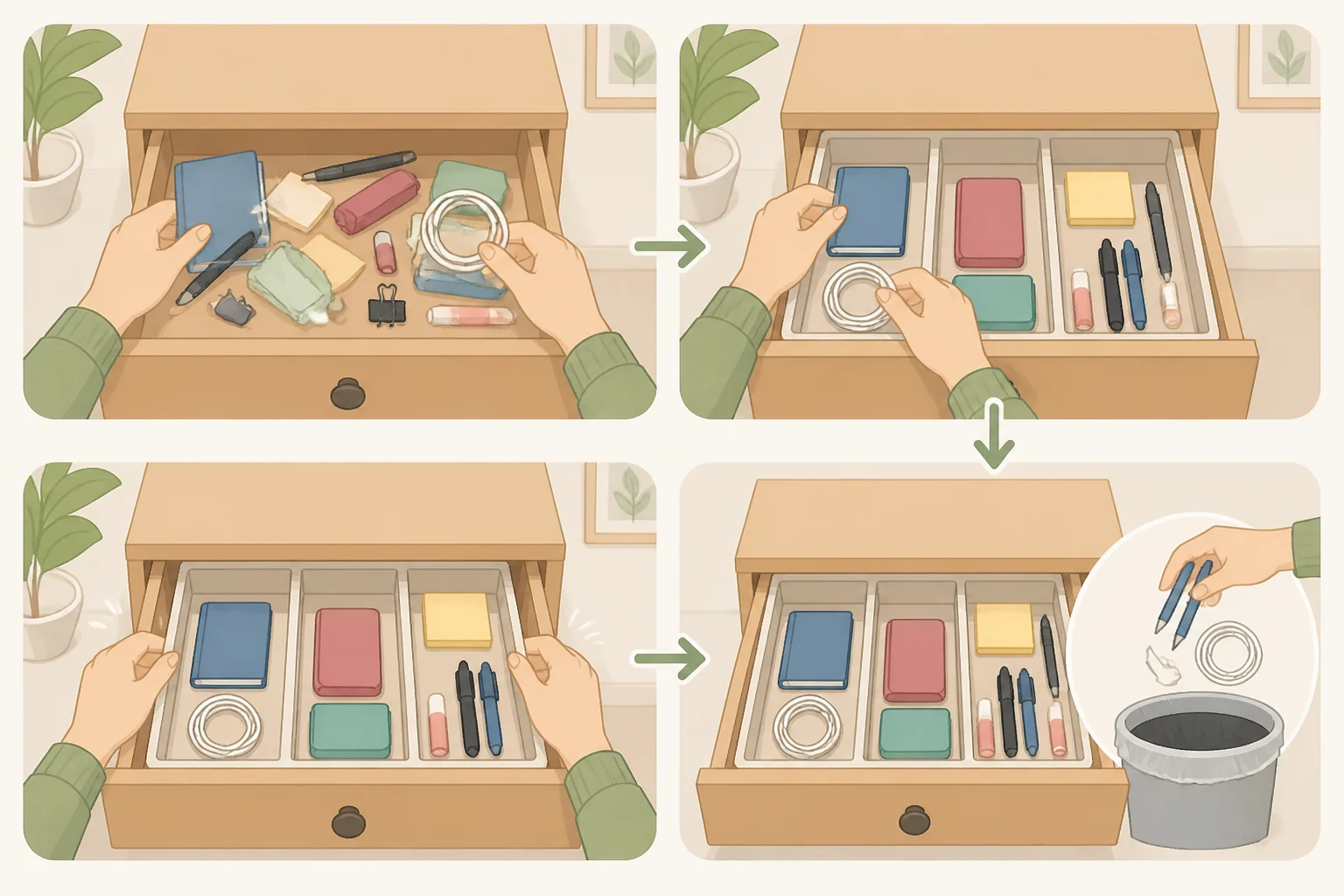
Long-term junk drawer organization comes down to two habits: a reliable edit test and a short, recurring reset. Potter applies her own logic in reverse from the retrieval test: if the drawer resists opening in the first place, that's the clearest sign the system has drifted. "If you can't open the drawer, then that means you need to go and do a serious edit," she says (House Beautiful, earlier this summer). A category that no longer closes properly isn't a storage problem, it's an editing problem.
A simpler habit comes at this from a different angle: pair a one-in-one-out rule with a five-minute purge once a month, rather than waiting for the drawer to reach crisis mode (Practical Home Guides, earlier this year). How often a reset is actually needed is genuinely household-dependent, and Lemene treats the feeling itself as the real trigger: "When it starts getting junky, that's kind of your sign that things that don't belong there are starting to pile up" (House Beautiful, earlier this summer). Neither approach is wrong. The cadence should match how fast a given drawer actually fills up, not a calendar someone else set.
When a reset is due, it doesn't need to eat an afternoon. A five-minute pass covers the essentials: pull out anything that's drifted in from elsewhere, return items to their zones, straighten the dividers, toss trash and duplicates, and check whether the catch-all section needs a permanent home for anything sitting in it (Jessica Millers, three weeks ago). Labeling the zones helps too. Lemene recommends it specifically as a way to remind people where things live, which keeps the drawer from sliding back into a dumping ground between resets (House Beautiful, earlier this summer).
The actual test
None of this requires buying the right organizer or hitting some perfect category count. A junk drawer earns its keep by keeping small, everyday items off the counters and out of the way, provided it has defined categories and a limit on how far any one of them can spread (House Beautiful, earlier this summer). One organizing guide puts the real standard about as simply as it can be put: the best junk drawer isn't the one that looks flawless after a two-hour overhaul, it's the one where the scissors turn up without a search, and go back just as easily when the job is done (Jessica Millers, three weeks ago).
So skip the inspection in week one. Open the drawer again after a week of ordinary use instead, and look at which zone has already started overflowing. That's the category that needs editing, not a bigger container.