How to Keep Spiders Out of Your Bedroom: 6 Causes and Fixes
A spider on the ceiling above your bed doesn't mean you've let the place go. If you've been asking why are spiders in my bedroom in the first place, extension entomologists point to a handful of specific, fixable conditions, not poor housekeeping, and none of them require an ultrasonic gadget or a garlic clove on the nightstand. Figuring out how to keep spiders out of your bedroom starts with understanding what's actually pulling them in, then closing off each pathway one at a time.
Insect prey is a major draw for spiders that end up indoors; cut off their food supply and much of the incentive to stick around goes with it (NPIC). Clutter gives spiders places to hide undisturbed, while cracks around foundations, doors, and windows are the entry points that let them in to begin with (NPIC). If sightings are climbing this time of year, that's largely seasonal: in Colorado, funnel web spiders are the most common home invaders in late summer and early fall as cooling temperatures push them toward shelter (CSU Extension), while in Utah, male hobo spiders roam indoors looking for mates from August through October (USU Extension).
What follows covers the six conditions that actually attract spiders to a bedroom, a fix for each one, and what to do about a spider that's already crawling across the wall. The approach leans on cleaning, sealing gaps, and changing habitat, with pesticides only as a narrow, last-resort step.
What attracts spiders to your bedroom?
Video of the Day
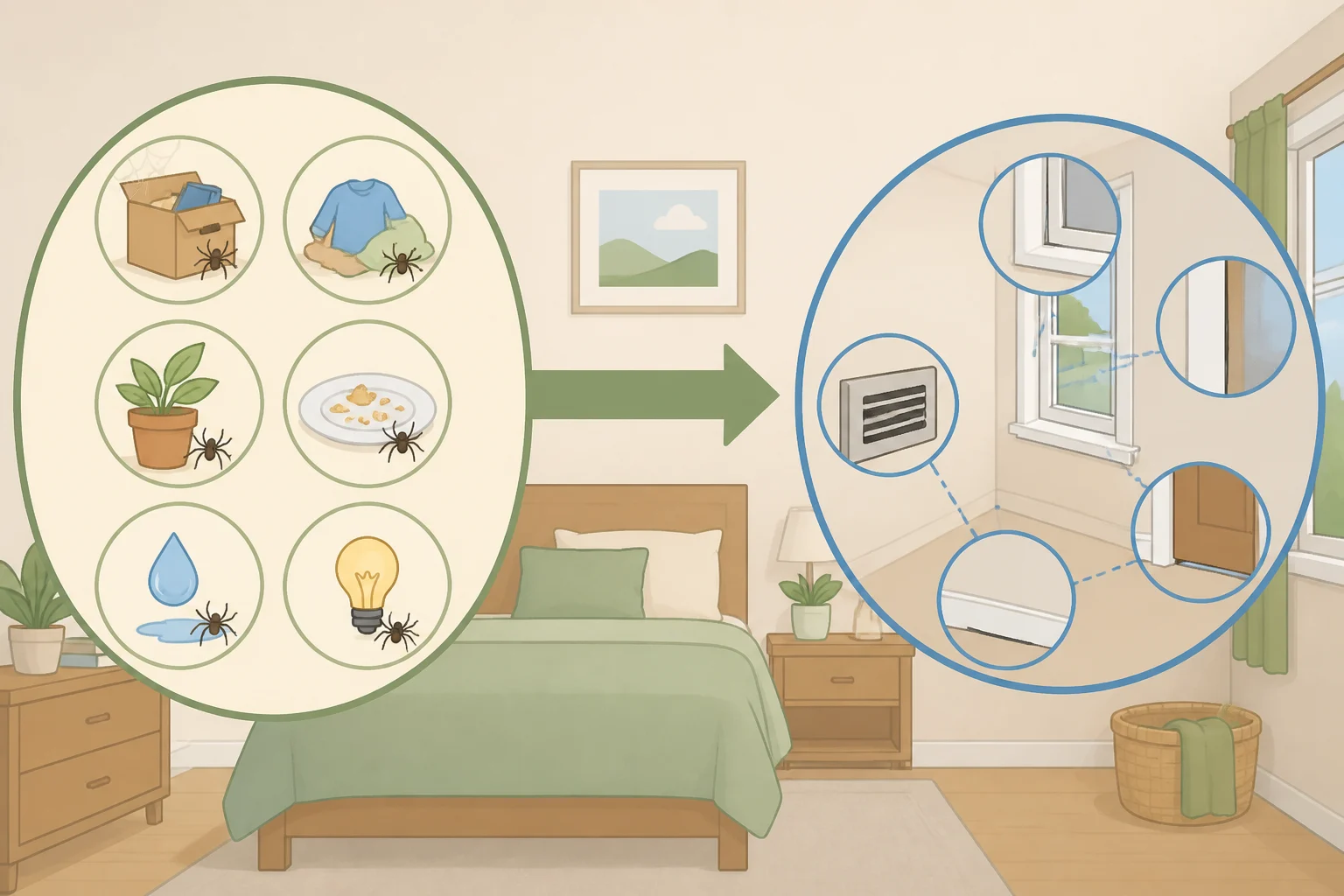
Six conditions show up again and again in extension guidance on indoor spiders, and they double as the core bedroom spider prevention tips worth acting on before trying anything else. The research behind them describes indoor spider habitat generally, covering basements, crawl spaces, and living areas, rather than bedrooms specifically. The fixes below apply those same principles to bedroom windows, closets, furniture, attached bathrooms, and the exterior walls nearby.
1. Insect prey. Spiders are predators, and a bedroom only looks like a hunting ground if there's something to hunt. Household insects are the actual food source, and eliminating that supply limits how many spiders find a reason to move in (NPIC; CSU Extension).
Patch torn window screens, wipe up crumbs, and don't let water sit in a sink or a humidifier tray. Handle the bugs, and the spiders that eat them have a lot less reason to stay.
2. Clutter and floor piles. Boxes, laundry piles, and general debris give spiders places to hide undisturbed, which is why clutter reduction shows up repeatedly in extension guidance as a control measure (NPIC; CSU Extension). Utah's extension office adds a specific warning for hobo spiders: wandering spiders can get trapped in clothing, bedding, or shoes left on the floor, which can lead to a defensive bite if someone grabs the item without checking it first (USU Extension).
Clear out under-bed storage, keep the closet from turning into a permanent stack of boxes, and get clothes and shoes off the floor.
3. Dark, undisturbed corners. Not every bedroom spider cares about darkness, but some of the species most likely to set up shop indoors do. Widow spiders build webs near the ground in dark, undisturbed spots, and indoors that means behind furniture or under a desk (CSU Extension); the barn funnel weaver, a species that occasionally wanders into homes, shows the same preference for quiet, undisturbed corners (UMN Extension).
For those species, the fix is disturbance and light. Colorado State's guidance on widow spiders recommends brightening darkened corners, through furniture rearrangement or added lighting, as a way to make those spots less appealing for web-building (CSU Extension). Move furniture occasionally, and don't let one corner of the room sit untouched for months.
4. Moisture nearby. Spiders turn up most often in kitchens, bathrooms, and basements, the rooms where moisture tends to collect (CSU Extension), and extension guidance broadly recommends controlling humidity in dark, damp parts of the house (NPIC). A bedroom with an attached bathroom or a slow leak nearby can pick up some of that same moisture.
Fix leaks promptly, don't let damp towels or laundry sit in a hamper for days, and run a dehumidifier if the room or an en suite tends to stay humid. This isn't spider-specific advice so much as the general moisture control extension offices already recommend for pest prevention.
5. Gaps around windows, doors, and the foundation. This is one of the main entry routes. Spiders get inside through cracks and crevices around the foundation, or through doors and windows that don't seal tightly (NPIC), and Colorado State's guidance says nearly the same thing: caulking those gaps is how migration into the home gets cut off (CSU Extension).
Seal the cracks, make sure windows and doors fit snugly, and repair any torn screens (NPIC). Utah's extension office, drawing on hobo spider research, adds a few specifics that hold up anywhere: replace worn door sweeps, install weather-stripping on exterior doors, and keep window screens in good repair (USU Extension).
6. Outdoor lights, vegetation, and debris near the house. What happens outside the bedroom window matters too. Porch and exterior lights draw in the insects spiders feed on, and shrubs planted flush against the house block the sun and airflow that would otherwise keep that zone less hospitable (NPIC). Wood piles, rocks, and old boards stacked near the foundation are common outdoor harborage sites for the same reason (CSU Extension).
Switch exterior bulbs near bedroom windows to yellow or sodium-vapor versions, which attract fewer insects, trim shrubs back so sunlight and air can reach the gap between plant and wall, and clear debris away from the foundation line (NPIC; CSU Extension).
None of these six fixes require a spray can, and most cost nothing more than an afternoon of cleaning and a tube of caulk.
Video of the Day
How to get rid of a spider already in your room
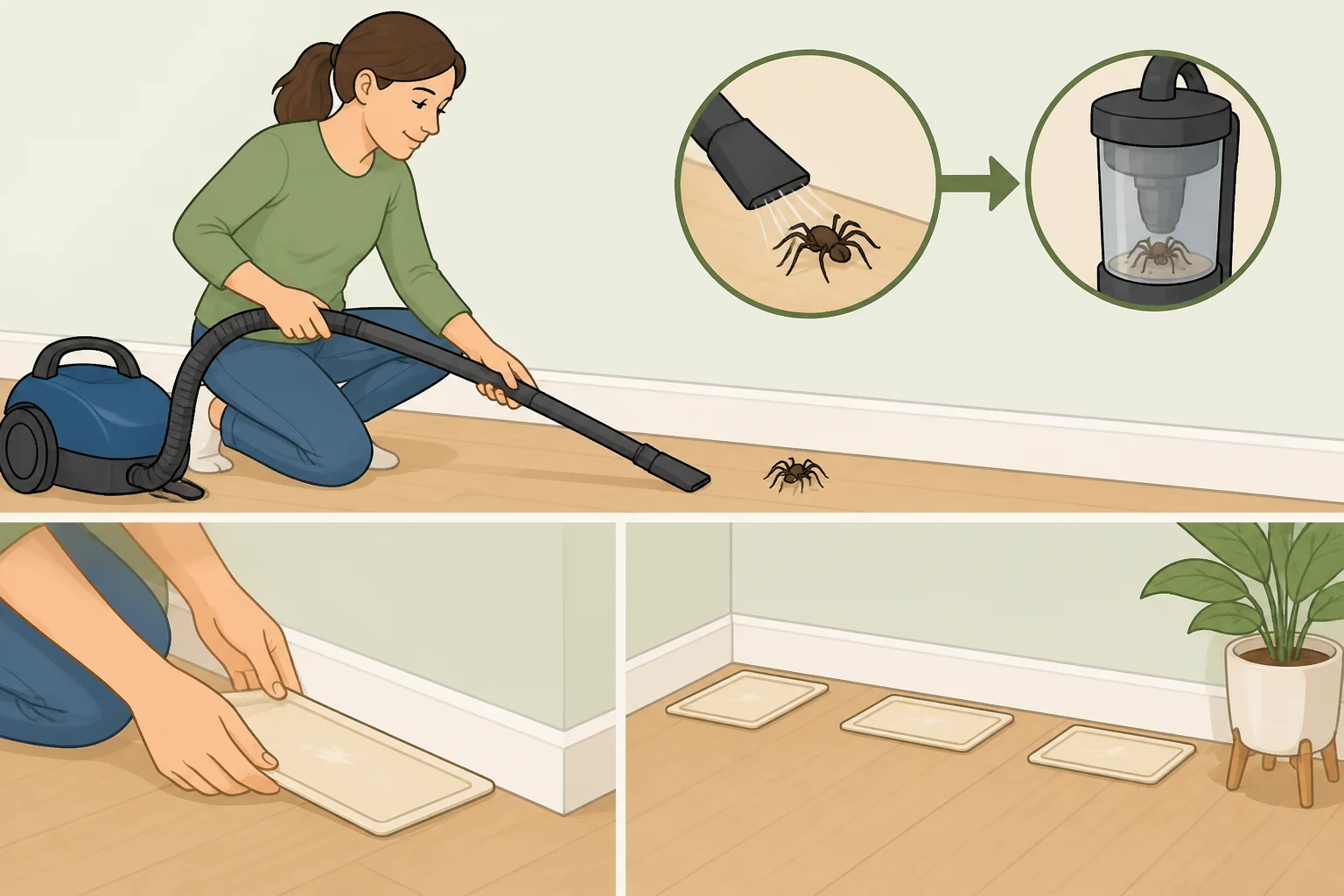
Prevention takes time to pay off, which doesn't help much with the spider currently sitting on the ceiling. Four steps handle that situation directly.
Vacuum it up. Removing spiders, webs, and egg cases with a vacuum, rather than leaving webs in place, is the first recommended move when one turns up (NPIC; CSU Extension). For widow spiders specifically, CSU recommends wearing heavy gloves and crushing or vacuuming the web and spider together rather than trying to relocate it (CSU Extension).
Set out sticky traps to check whether it's a one-off. Cardboard sticky traps placed along baseboards and under furniture, kept out of reach of kids and pets, catch wandering spiders and reveal whether there's ongoing activity or just a stray visitor (NPIC). Utah's extension office recommends the same approach for hobo spiders, suggesting up to two traps per room during the August-through-October peak (USU Extension).
Skip the folk remedies. Colorado State's guidance on widow spiders is direct on this point: spiders don't perceive or respond to chemical repellents like garlic or mock orange, or to ultrasonic devices, and selling such products as spider control is considered fraudulent under Colorado law (CSU Extension).
Treat pesticides as a last, narrow step, not the plan. If sealing gaps and cleaning up haven't solved a persistent problem, a residual pyrethroid applied directly to known harborage spots, corners and baseboards rather than sprayed broadly across a room people sleep in, can help (CSU Extension). NPIC adds an important limit here: residual pesticides indoors may knock back the other insects spiders feed on without actually delivering long-term spider control (NPIC). Whatever gets used should be labeled for indoor use and applied exactly as the label directs, starting with the lowest-toxicity option that will do the job (NPIC). CSU is explicit that pesticides alone, without habitat changes, won't solve the problem, and that foggers probably have little effect on spiders at all (CSU Extension).
Most spiders found indoors are harmless and reluctant to bite; extension entomologists describe them as unaggressive, even docile (USU Extension; UMN Extension). A bite generally can't be identified from symptoms alone, especially once the mark has faded, so if one happens, capture the spider only if it's safe to do so and get it identified through a local extension office (NPIC; USU Extension). Contact Poison Control at 1-800-222-1222 or see a doctor if symptoms get worse (NPIC).
Getting the order right
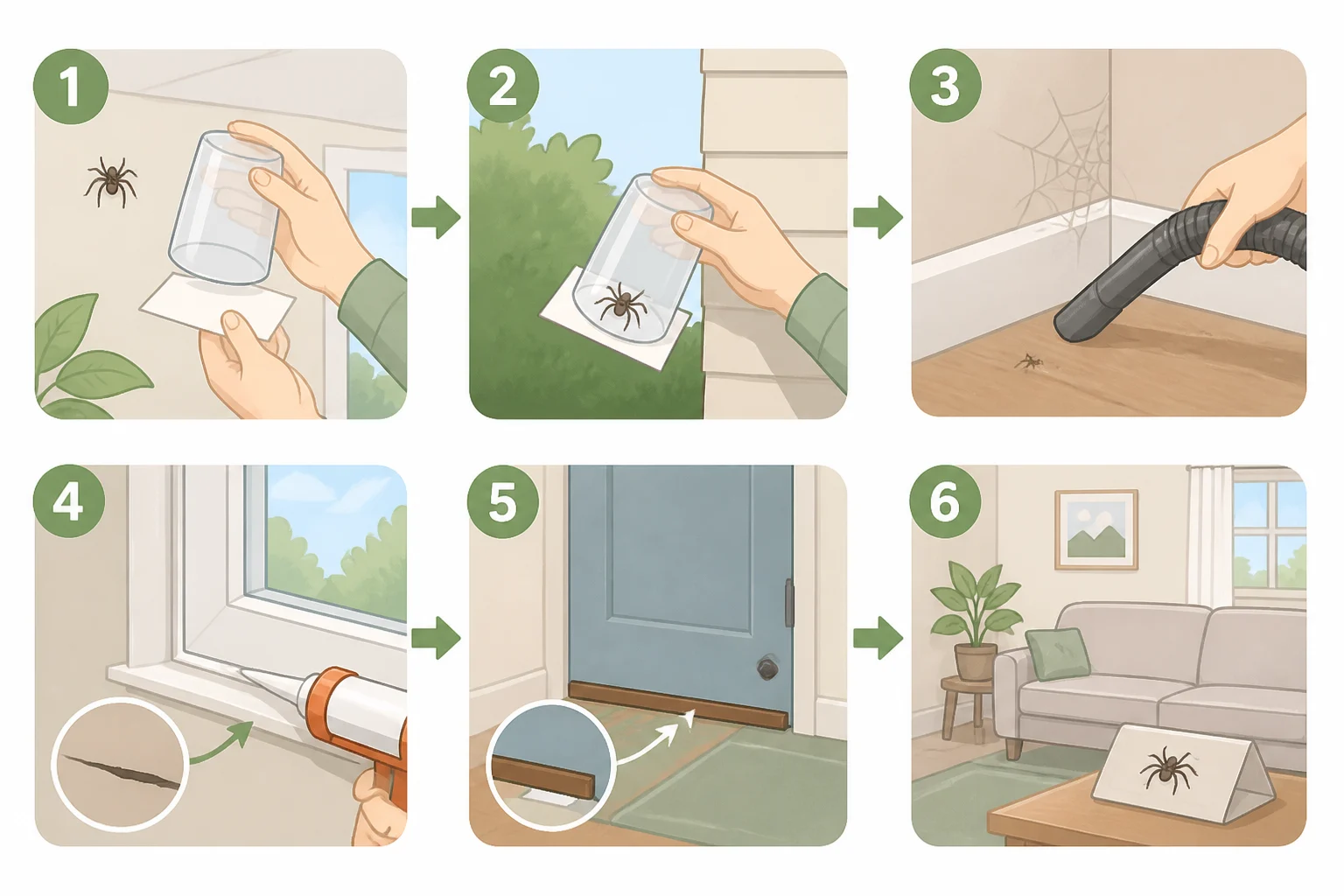
If bedroom sightings are becoming a pattern, work through the fixes in sequence rather than tackling everything at once:
- Remove or safely trap the spider that's currently in the room.
- Inspect and seal windows, doors, screens, and foundation gaps, since a spider can walk straight past every other fix if there's still a way in (NPIC; USU Extension).
- Clear floor clutter and remove any webs already in place.
- Cut down insect prey and outdoor shelter, including exterior lighting and vegetation touching the house.
- Monitor with sticky traps before considering treatment. If traps continue to catch spiders after gaps are sealed and clutter is reduced, that's the point to look at a targeted, indoor-labeled pesticide, not the first move.
Indoor encounters often become more common in fall. In Colorado, funnel web spiders peak in homes during late summer and early fall as temperatures drop (CSU Extension), and in Utah, hobo spider sightings rise from August through October as males search for mates (USU Extension). Working through this checklist now, rather than after the sightings pile up, is what keeps an occasional spider on the ceiling from turning into a recurring problem.