Household Items to Get Rid of First, Per Pro Organizers
Before anything else: pick one room. Block out 20 to 30 minutes of uninterrupted time. Don't attempt the whole house in a day.
The household items to get rid of are rarely the ones you use daily. They're the duplicates sitting in a drawer you never open, the specialty gadgets bought during an optimistic phase, the clothes that fit someone you used to be, the inherited objects you'd feel guilty releasing. Professional organizers see this pattern constantly. Matt Paxton, who spent 15 seasons on Hoarders and now hosts Filthy Fortunes on Discovery, describes the most consistent obstacle as guilt: people preserve things from deceased loved ones out of loyalty, hold onto belongings for adult children who never asked for them, and keep items they haven't touched in years because letting go feels like a betrayal of something (AARP).
Professional organizers at Essential Organizing offer a more forgiving frame: clutter isn't a moral failure. It's "a decision you haven't had time to make." The goal of the process is identifying what matters to you now, not preserving every artifact of who you were (Essential Organizing).
Research published in 2024 in the Journal of Consumer Research, drawing on 35 in-depth interviews with people trying to declutter their homes across Germany and Switzerland, found that clutter persists specifically when people can't approach their possessions with the detachment needed to make clear decisions. Separately, participants in a 2022 Frontiers in Sustainability study on decluttering practices reported seeking mental freedom, peace of mind, and psychological relief as their primary motivations for starting the process.
The system that follows is built from professionals' advice. It moves from easiest to hardest, because that sequencing matters more than most people expect.
Step 1: Start with duplicates and common household clutter to get rid of
Video of the Day
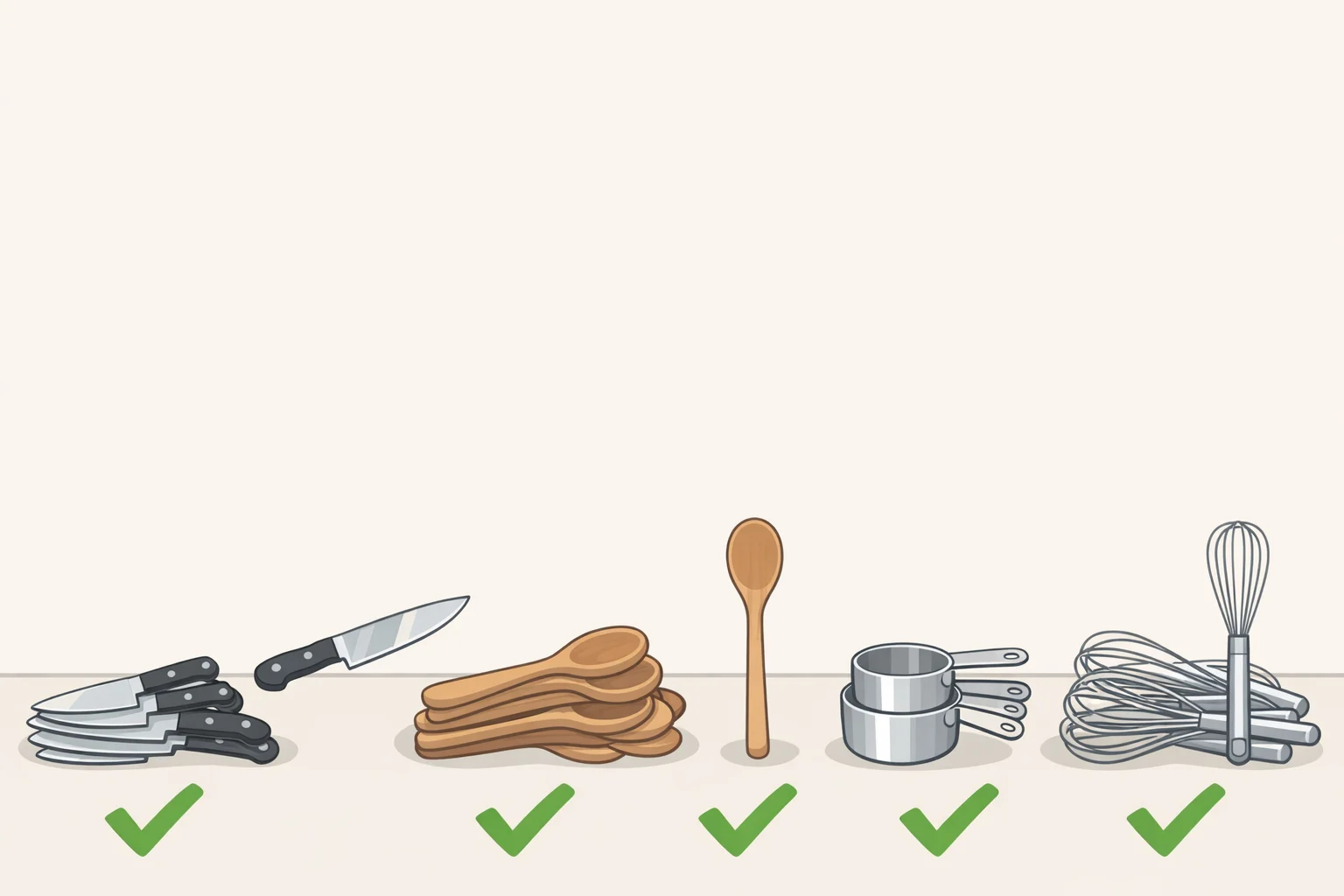
This is the category with the lowest emotional friction and the fastest visible results. Start here.
Paxton's method is simple: one room at a time, one decision at a time. "Once you get moving, it gets easier. Progress is contagious," he told AARP. The momentum from early easy wins is functional, not motivational theatre. You're building decision-making capacity before hitting the harder stuff.
The move that wastes the most time, in Paxton's experience: shuffling clutter from one drawer to another instead of actually releasing it. "Organizing clutter instead of just letting it go," he says, "is just wasting time" (AARP). Essential Organizing recommends sorting by category before making any keep-or-go calls: pulling every mug, every vase, every spatula into one visible pile makes overaccumulation obvious in a way that item-by-item sorting never does. Clients routinely discover they have far more of something than they realized (Essential Organizing).
Specific targets in this category:
- Duplicate kitchen utensils. Paxton's rule: "Got five spatulas? Keep one" (AARP)
- Excess mugs, vases, platters, and serving pieces accumulated through gifts, moves, and forgotten purchases
- Hyper-specific tools used rarely: Paxton's example is the grapefruit spoon. "You don't need a grapefruit spoon if you eat one grapefruit a year" (AARP)
- "Someday" gadgets the appliances from a cooking phase, a fitness phase, or a hobby that didn't take hold (AARP)
If you have more than one of something and the extras are sitting unused, keep the best version and release the rest. And don't move the duplicates to a different drawer or closet. That's shuffling. If you're not releasing it, you're keeping it.
Video of the Day
Step 2: Cut items kept for who you were, not who you are
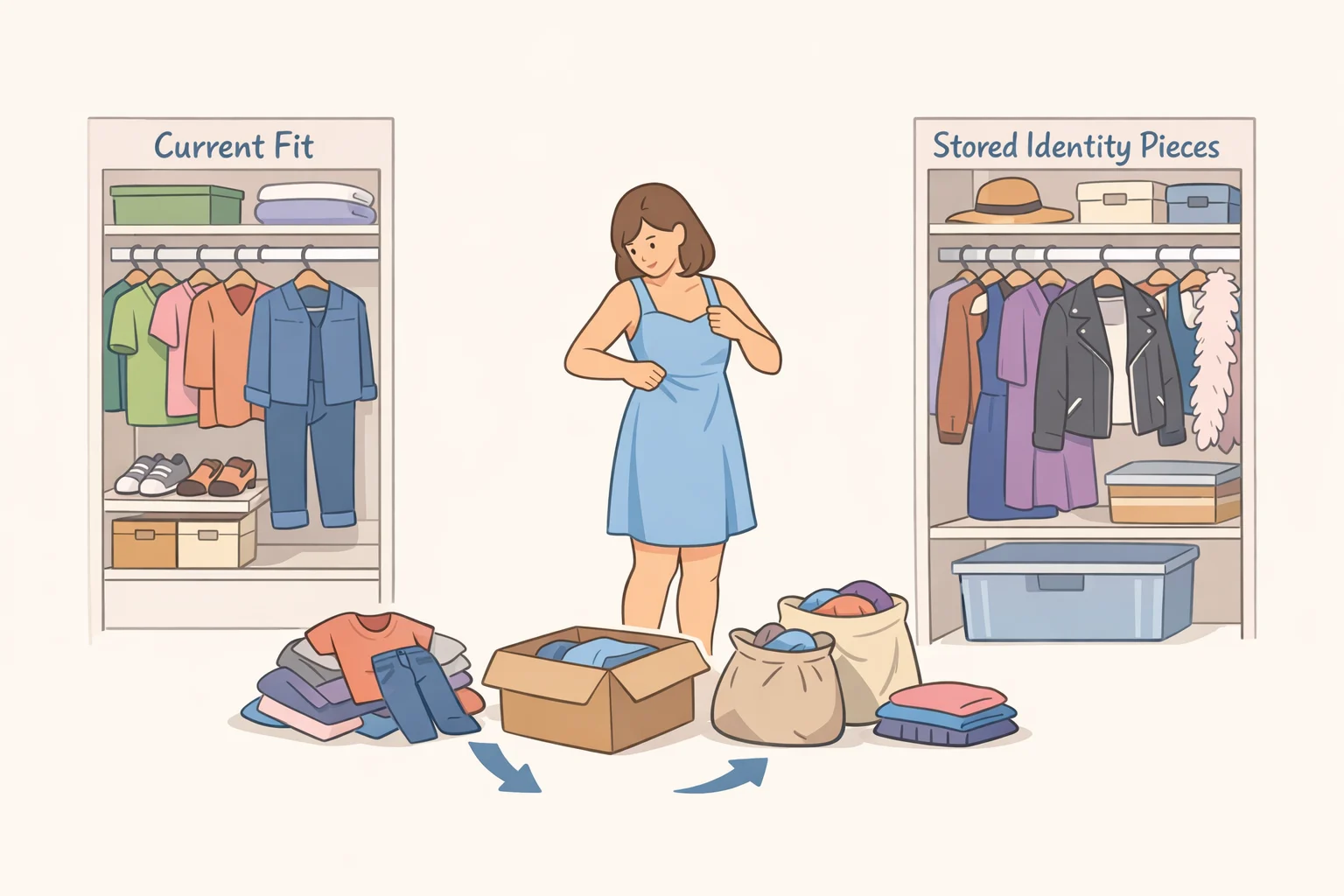
Closets are the emotionally loaded part of any house. Paxton is direct about why: "They're full of versions of ourselves, jobs we once had, bodies we once lived in, familiar smells we miss, seasons that mattered" (AARP). The obstacle is never the clothing itself. It's the identity attached to it.
The 2024 Journal of Consumer Research study supports this: clutter holds on precisely where emotional attachment blocks clear-eyed assessment. People aren't failing to decide; they're failing to detach enough to decide clearly.
Paxton documents another consistent mistake here: waiting for motivation before starting. Motivation doesn't work that way. "You have to be the reason it starts," he says (AARP). Action creates the motivation, not the other way around.
Specific items to address:
- Clothes that no longer fit in size or in lifestyle. Paxton's instruction: "If it doesn't fit, let it go" (AARP)
- Shoes and jackets unworn for more than a year, including expensive ones that feel wrong to release (AARP)
- Work attire from a career that ended or changed substantially
- Gear for hobbies that are genuinely finished
The test: put it on. Does it fit your actual body and your actual current life? For sentimental clothing from a deceased loved one, Paxton's framework is to keep one genuinely meaningful item and donate the rest. "It's OK to keep one sweater as a positive memory, but you can donate the rest," he says. The memory doesn't live in the full wardrobe (AARP).
Step 3: Clear out paper, décor, and what to declutter first in your home storage areas

These categories are easy to overlook because nothing in them is actively in your way. That's exactly why they accumulate.
Paper and documents. Paxton's fourth-week focus is old manuals, outdated files, and stacks of accumulated mail: keep only what's genuinely necessary, and shred anything with personal identifying information before discarding (AARP). Physical appliance manuals are an easy category to clear entirely for most households.
Décor. Surface clutter is one of the most overlooked problem areas. Paxton recommends reducing decorative items enough that what remains can actually be seen and enjoyed. For pieces with sentimental value, photograph them before releasing. The image preserves the memory; the object doesn't have to (AARP).
Storage areas. Basements, attics, garages, and off-site storage units deserve their own logic: you're already living without everything in them. Consumer Reports recommends a direct test for anything in storage: ask yourself why you still need it. Paxton is blunter about paid storage units specifically: monthly fees to store items you never use are, in his words, "a colossal waste of money" (AARP).
For borderline items in any of these categories, Consumer Reports offers a clean threshold: if something costs $20 or less and takes under 20 minutes to replace, it can go without creating meaningful regret.
Step 4: Handle the hard cases sentimental items, maybes, and inherited belongings
![Illustration of a storage box labeled 'Maybes - donate on [date]' with a calendar reminder, representing the process of sealing undecided household items until the six-month mark](https://cdn.technologyadvice.io/articles/11801/inline-463d829c86dc31e99d68c822b141a368.webp)
Save this step for last. The decision-making work done in steps one through three makes these conversations easier.
For the maybes. Essential Organizing's method: box up anything you can't decide on, write a date six months out on the box, and donate the sealed box when that date arrives without reopening it. If you didn't go looking for something across six months, the answer is clear (Essential Organizing). For anything borderline, apply the $20/20-minute test: if you genuinely needed this item in the future, could you replace it for under $20 in under 20 minutes? If yes, the cost of being wrong is low (Essential Organizing).
For inherited and sentimental objects. Paxton's question, the one he asks every family he works with: "What do you want your loved ones to inherit, boxes or stories?" Most people, he finds, want to pass down meaning rather than volume (AARP). His recommendation is to identify a small number of truly meaningful items, what he calls your "top five legacy-list items," and release the rest. The constraint forces clarity about what actually carries weight (AARP).
For items held "for the kids." Saving belongings for adult children who haven't asked for them is one of Paxton's listed common mistakes. Before boxing something up for a future recipient, ask them directly whether they want it (AARP).
On timing: Paxton favors short daily sessions of 20 minutes to build momentum without burnout. Essential Organizing recommends blocking at least four hours at a stretch to generate visible progress (AARP; Essential Organizing). Paxton's approach suits people who need to ease in. Essential Organizing's suits people who need to see a meaningful result to sustain the effort. Neither is wrong.
Where the items go: a practical exit plan
The goal here is to prevent bags of released items from sitting by the door for three weeks.
Decide on a donation destination before you start sorting, not after. Having a specific recipient in mind makes it easier to release useful items during the sort itself. Essential Organizing notes that imagining your extra kitchen supplies in someone else's home, specifically someone transitioning out of homelessness, changes the calculus on letting go.
Don't donate broken, stained, or genuinely unusable items. Goodwill averages roughly $2 million per year in trash-removal costs for goods that arrive unsellable (Consumer Reports). Damaged items should be recycled or discarded.
For items with resale value, Consumer Reports highlights Facebook Marketplace for fast local sales. Freecycle, with more than 5,000 local groups worldwide, connects items to people who specifically want them at no cost to either party. For large volumes or mixed-quality loads, Consumer Reports points to services such as The Junkluggers, which sorts for donation and recycling before disposing of what remains, as a legitimate option for anyone who wants to outsource the logistics entirely (Consumer Reports).
What changes after a systematic pass
Paxton's consistent observation across thousands of homes: the result after 30 days won't be perfect, but the house will feel "less heavy, less frustrating." People find themselves spending less time managing their possessions and more time actually living in the space (AARP).
Research published earlier this year in the Journal of Sustainability Research, based on qualitative interviews with 15 professional tidying consultants in Japan, found that after reducing their possessions, often by half to two-thirds, the consultants stopped keeping unnecessary stocks and defaulted to using what they already owned. The same research cautions that this shift toward more deliberate consumption isn't automatic. It tends to hold when it aligns with values the person already holds rather than emerging purely from the act of clearing space.
Pick one room. Pull everything in one category into a pile. Put a box by the door for the maybes. Start with duplicates. The rest follows from there.