What Recycling Symbols on Plastic Containers Mean
Flip over a plastic tub and there's a triangle stamped into the bottom, a number sitting inside it. It looks like an instruction. It isn't. What recycling symbols on plastic containers mean has almost nothing to do with your curbside bin: the number is closer to a chemist's shorthand for what a container is made of than a promise about what happens to it next.
That number-in-a-triangle system, known formally as a resin identification code, was created in the 1980s by the plastics industry to sort products by chemical composition, not to certify that an item is recyclable (National Academies, 2025). The gap between those two things matters more than most people realize. Of the roughly 51 million tons of plastic waste U.S. households generated in 2021, only about 6% actually got recycled, according to a Greenpeace USA report cited by researchers at Arizona State University (Arizona State University, 2024).
Even people who study this for a living find the rules hard to keep straight. Michelle Shiota, a social psychologist at ASU who researches recycling behavior, put it bluntly: "Even I don't know all of that, and I've actually put a fair amount of time into trying to figure this out" (Arizona State University, 2024).
This explainer covers what the numbers 1 through 7 actually stand for, why the code alone can't tell you what your city will take, another labeling system readers may see on packaging, and a short sequence for deciding what to do with the container in your hand.
What the recycling triangle numbers actually identify
Video of the Day
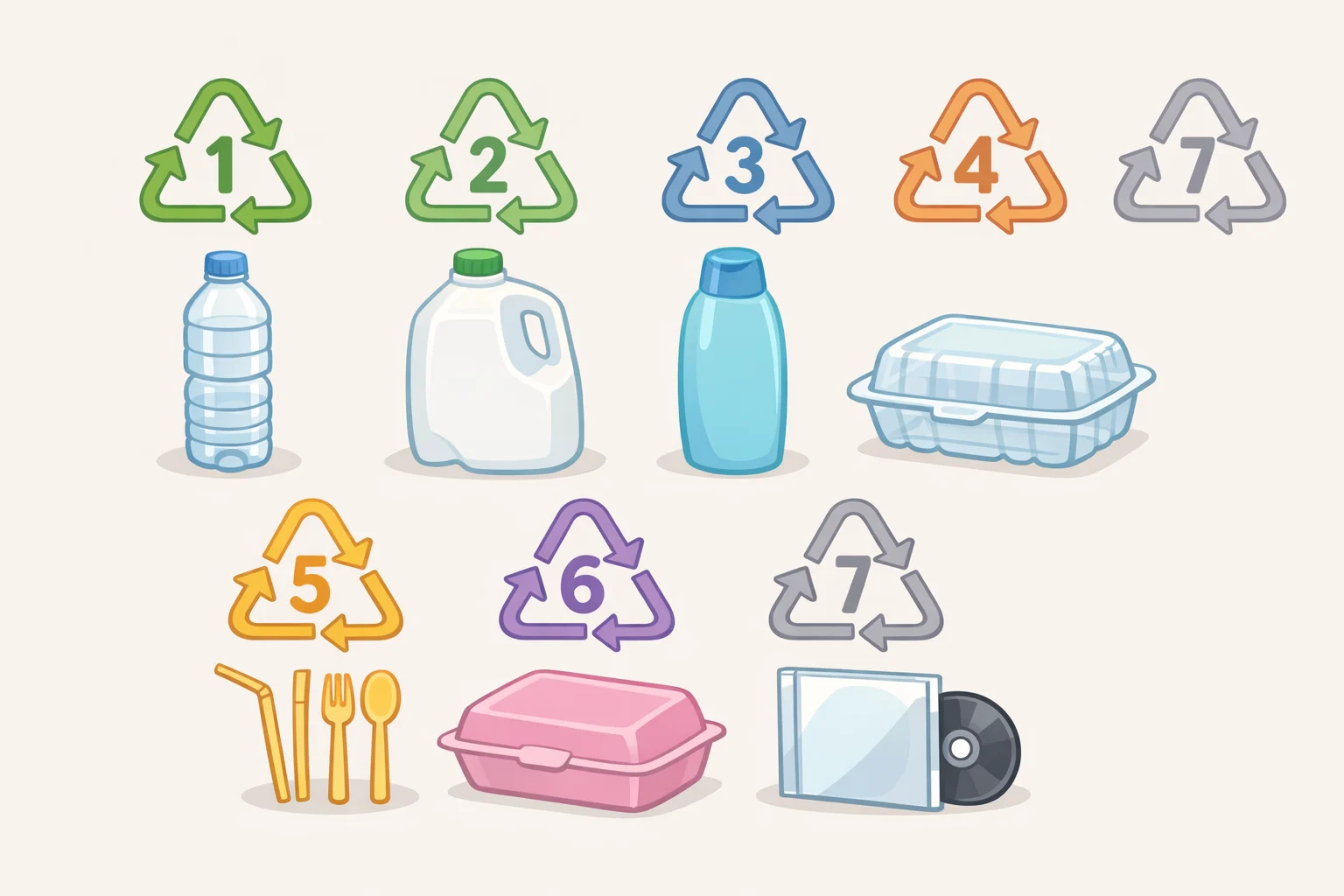
These codes have a formal name: resin identification codes, or RICs, developed by the plastics industry specifically to identify chemical composition (National Academies, 2025). Think of one as a fabric content label sewn into a shirt. It tells you what something is made of. It says nothing about how to launder it.
The codes use the chasing-arrows symbol, an internationally recognized recycling mark, which is exactly why a number inside a triangle reads as a green light (National Academies, 2025). They were only ever meant to flag plastic type and technical feasibility, not to greenlight disposal.
The seven resin identification codes, and the materials most often associated with each, break down like this:
| Number | Resin | Common examples |
|---|---|---|
| 1 | PET (polyethylene terephthalate) | Soda and water bottles |
| 2 | HDPE (high-density polyethylene) | Milk jugs, detergent bottles |
| 3 | PVC (polyvinyl chloride) | Rigid packaging and piping; rarely used in food containers |
| 4 | LDPE (low-density polyethylene) | Squeeze bottles, some plastic bags |
| 5 | PP (polypropylene) | Yogurt cups, bottle caps |
| 6 | PS (polystyrene) | Foam cups, disposable cutlery |
| 7 | Other | Plastics that don't fit categories 1–6 |
A resin number describes only the material family, not the whole package and not any particular city's rules. Whether a specific format, a tub versus its lid, gets collected depends on your local program, and whether it actually gets reprocessed depends on demand for that material downstream. A No. 5 yogurt cup and a No. 5 bottle cap can carry the same code and still face completely different fates once they hit the truck; the code doesn't determine whether the cap is accepted. The same caveat applies to plastic bags stamped with a No. 4, which, as covered further down, are commonly misplaced in recycling bins regardless of what number they carry.
Code 7, labeled "Other," is the catch-all of the group: it covers plastics that don't fall under the first six categories (National Academies, 2025). It doesn't map to one specific material the way the other six numbers do, so it's worth treating with extra skepticism rather than assuming it behaves like any of them.
That distinction played out in a real court case. Plaintiffs argued that the caps and labels on a line of bottled water weren't recyclable, which made the company's "100% Recyclable" claim misleading. The court dismissed the complaint, noting that federal guidelines allow an unqualified recyclability claim as long as the entire product, minus minor incidental components, is recyclable (The Regulatory Review, 2024). The case illustrates why a code on one component cannot answer questions about every part of a package.
Video of the Day
Three questions a resin code can't answer
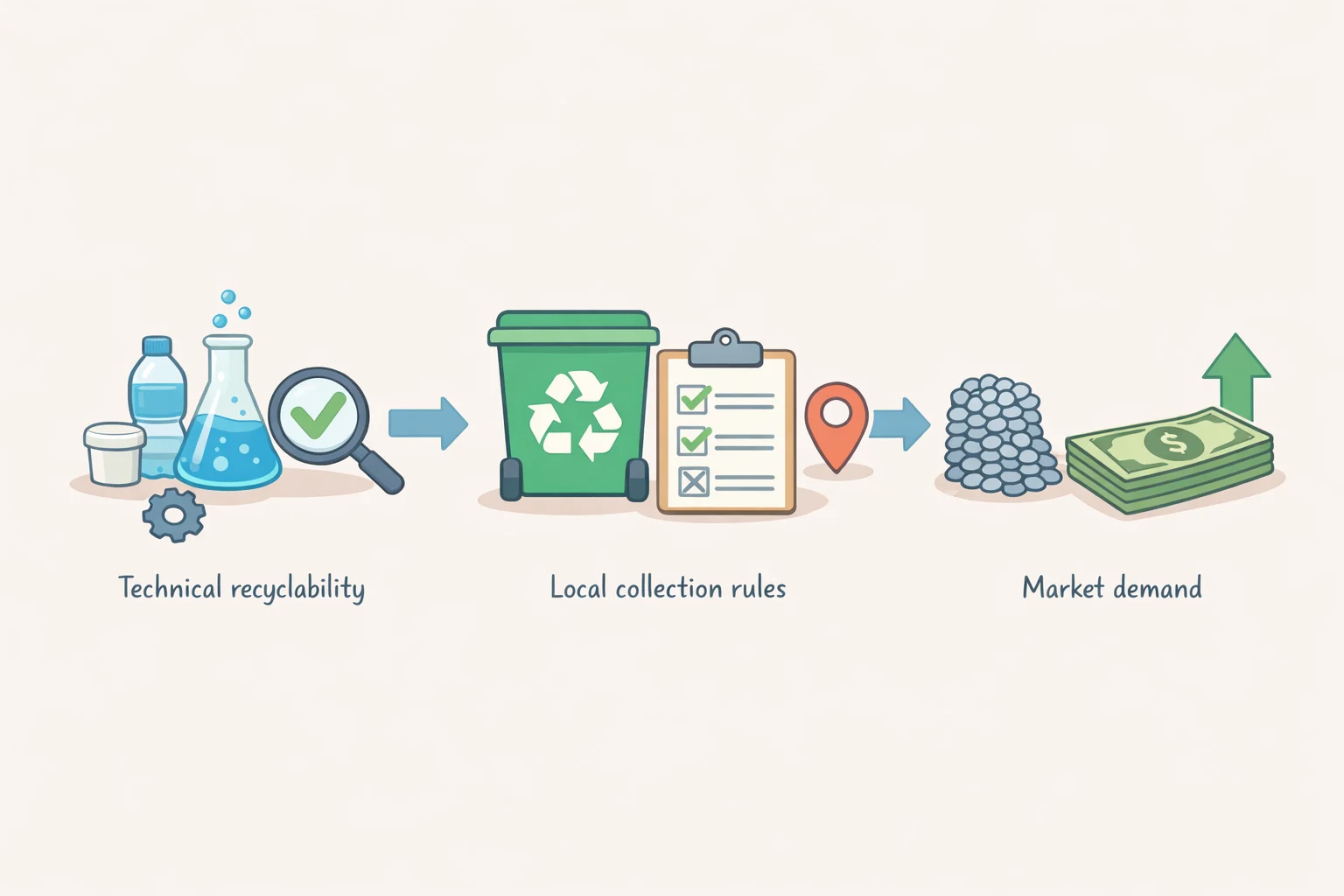
So are recycling symbols actually recyclable, in the sense that matters at the curb? That depends on three separate questions, and the triangle answers none of them by itself.
The first is whether the plastic is technically recyclable at all. Plastic has to be specifically designed and chemically processed to be reclaimed. The ASU sustainability team lists several everyday items, including plastic cutlery, straws, plastic-lined cups, chip bags, and bottle caps, among products that generally don't have a place in the recycling process, despite the common assumption that all plastic qualifies (Arizona State University, 2024). Acceptance for specific items still varies by program, so it's worth checking local instructions before assuming caps and lids are excluded everywhere.
The second is whether your local program actually collects it. Rajesh Buch, business development director for ASU's Walton Sustainability Solutions, points to the absence of any national standard: "We don't have a consistent recycling standard of what can be recycled and what can't be recycled" (Arizona State University, 2024). A facility may have the capability to sort a given resin and still choose not to collect it, because acceptance is a local operational call, not something dictated by the number on the package.
The third is whether anyone wants to buy the recycled material once it's collected. Facilities may have the capability to sort and reprocess a particular resin and still elect not to if market demand doesn't make it economically viable (The Regulatory Review, 2024). Regulators are still working through how to disclose that, since a "recyclable" claim can be technically true and still misleading in practice.
How2Recycle's own program updates show these three tests moving independently. Its January 2025 guidelines named two packaging formats with confirmed category changes: composite canisters with metal bottoms moved up from "Not Yet Recyclable" to "Check Locally" in the U.S., while aluminum and steel aerosol cans moved down from "Widely Recyclable" to "Check Locally" after new data showed fewer communities explicitly accept them than the program's threshold requires (GreenBlue/How2Recycle, 2025). The same update placed other formats under review or left them untouched: three-gallon buckets could be downgraded to "Not Yet Recyclable" pending further data, while HDPE and polypropylene squeeze tubes stayed at "Not Yet Recyclable" with no change at all (GreenBlue/How2Recycle, 2025). Four formats, four different outcomes, from a program that publishes semiannual guideline updates.
How2Recycle: a second label with its own limits
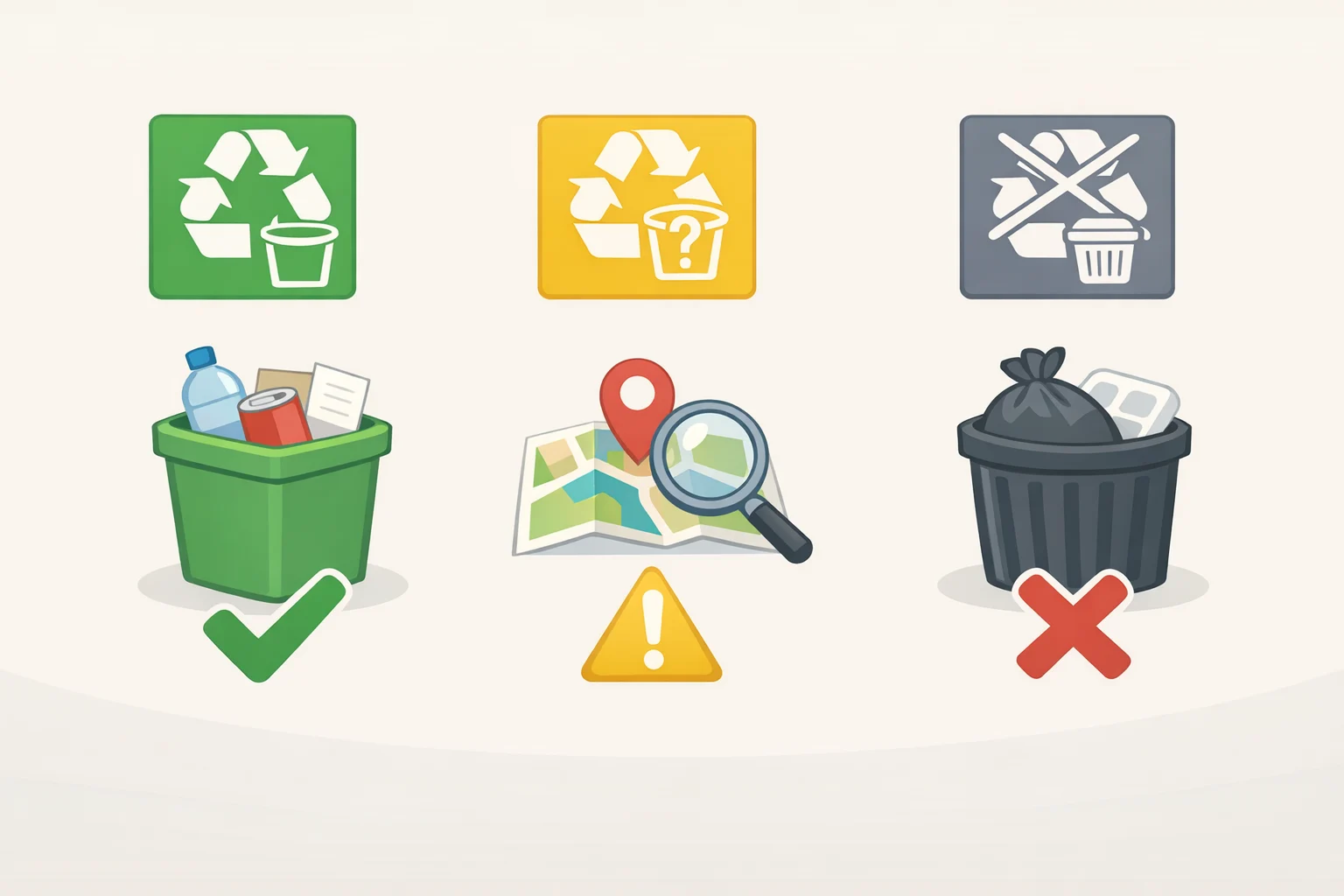
If a resin code answers "what is this made of," a newer label tries to answer the question people actually want answered: "what do I do with it." How2Recycle was born out of a Sustainable Packaging Coalition working group in 2012 and is now a project of GreenBlue, an environmental nonprofit. Its guidelines direct more than 800 member companies on how to label packaging using plain-language categories such as "Widely Recyclable," "Check Locally," and "Not Yet Recyclable" (GreenBlue/How2Recycle, 2025).
These labels move as real-world data changes, and not always in a hopeful direction. In the same update, polypropylene and PET beverage cups both remained at "Check Locally" rather than advancing, because current data didn't meet How2Recycle's bar for "Widely Recyclable" (GreenBlue/How2Recycle, 2025).
Here's the catch: How2Recycle is a project of a nonprofit, run for the benefit of its member companies, not a government agency, so its label amounts to guidance rather than a legal guarantee. Its own "Check Locally" category is essentially an admission that the label can't make the acceptance call for you; that decision still sits with your municipality or hauler.
The National Academies has floated the idea of the EPA supporting an expansion of standardized labels like How2Recycle, on the reasoning that they carry more real-world context than a resin number alone (National Academies, 2025). That's a policy option under discussion, not a settled standard, so don't expect it to replace the resin code on your packaging anytime soon.
What to do with the container in your hand
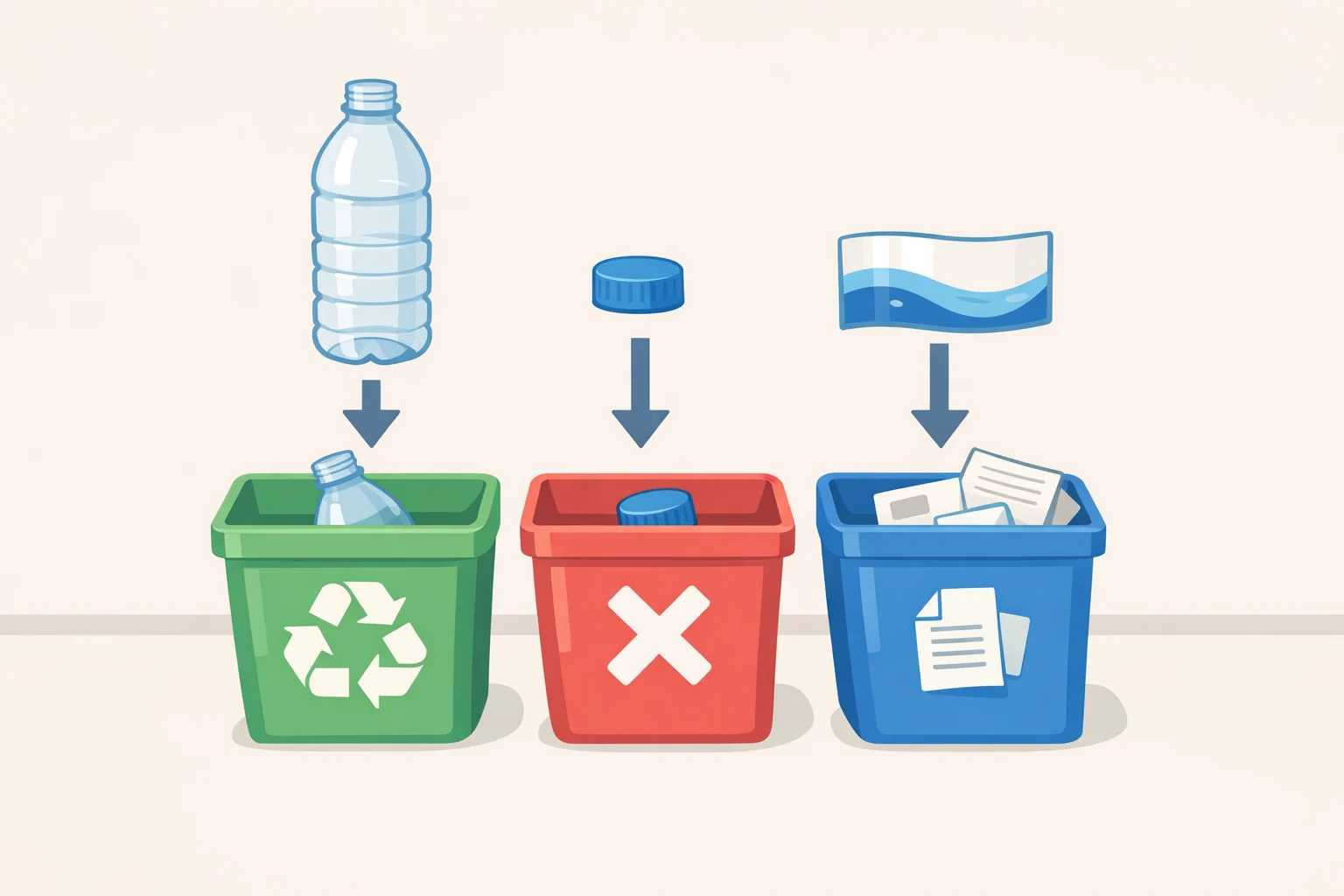
None of this is much use with a yogurt tub in one hand and a recycling bin in the other. Here is a practical sequence.
-
Look at the item as separate parts, not one object. A bottle, its cap, and any pump or liner may be different materials, the way the caps and labels in that bottled water case were. Check each piece, not just the body.
-
Check your city or hauler's current accepted-materials list, not the symbol. Rules vary sharply by jurisdiction. ASU researchers note that the Phoenix metro area alone has 28 municipalities running roughly 28 different sets of recycling standards (Arizona State University, 2024).
-
If it's accepted, keep prep simple. City of Phoenix guidance, typical of many municipal programs, asks that containers be clean, dry, and empty, and notes that "just a quick rinse is all you need" (Arizona State University, 2024).
-
When you're not sure, don't guess and toss. That habit has a name, wish recycling, and a 2019 waste-audit experiment found it running both directions at once. Waste consultant Chris Dooley described sorting through a conference room's bins afterward: "There was a lot of garbage that should have been recycled," and "a lot of items in recycling bins that didn't belong there" (Arizona State University, 2024).
A few repeat offenders are worth flagging, with the usual caveat that local rules vary. Plastic bags are the single most commonly misplaced item in recycling bins, and paper towels, tissue, and food scraps generally don't belong there either, though exact acceptance always comes down to the specific program (Arizona State University, 2024).
The number is only the starting point
The FTC announced plans to revise its Green Guides, the rules governing environmental marketing claims like "recyclable," in 2022 (The Regulatory Review, 2024). As of the 2024 analysis cited here, that revision was still unresolved, with the FTC, the EPA, and industry groups still debating how strict a "recyclable" claim should have to be before it counts as misleading (The Regulatory Review, 2024). Separately, the National Academies report says removing the chasing-arrows symbol from resin codes could reduce consumer confusion and help restore trust in on-package recycling information (National Academies, 2025). Neither change has landed yet, so don't expect the packaging in your kitchen to look any different soon.
Shiota attributes many of the mistakes people make with recycling to inconsistent local rules rather than carelessness or indifference (Arizona State University, 2024). Until those rules get simpler, the sequence that holds up is the one covered here: separate the item into its parts, check what your city or hauler currently accepts, and prep it the way they ask, clean, dry, and empty. The triangle on the bottom of the container was never the instruction. It's just the label for what's inside.