How to tell if bourbon is real Kentucky straight bourbon
Two bottles of bourbon sit side by side at the same price. One says "Small Batch Reserve." The other says "Kentucky Straight Bourbon Whiskey, Distilled by X, Aged 7 Years." One of those labels is telling you something enforceable. The other is mostly typography.
Knowing how to tell if bourbon is real Kentucky straight bourbon comes down to a handful of specific words. "Kentucky Straight Bourbon Whiskey" is not a style description or a marketing tier. It's a labeling designation under federal law, and TTB regulations explicitly prohibit spirits produced outside Kentucky from carrying it. The front label's fonts, imagery, and adjectives tell you what someone's marketing team wanted you to feel. The class and type designation tells you what the federal government is prepared to back up.
Those aren't the same information.
Bourbon law requires at least 51% corn and aging in new charred oak every time, and that produces recognizable results. Corn pushes the flavor profile toward sweet and creamy; mandatory new barrel contact produces deeper color and stronger barrel notes than spirits that reuse wood, per Pour Picks. The rules and the flavor are connected. But flavor alone won't verify the label, and that's what this guide is for.
What "Kentucky straight bourbon whiskey" actually means, word by word
Video of the Day
The phrase stacks four legal claims: Kentucky origin, straight aging standards, bourbon production rules, and whiskey classification, as American Whiskey Authority explains. Drop any one of them and the designation steps down to a lower tier.
"Bourbon" is the baseline. The mash bill must contain at least 51% corn, the spirit must be distilled to no higher than 160 proof, it must enter new charred oak at no higher than 125 proof, and it must be bottled at a minimum of 80 proof with nothing added except water to adjust proof, per The Bourbon Report. These are federal standards of identity under 27 CFR Part 5, Subpart C, not style suggestions.
"Straight" builds on that. Two years minimum in new charred oak, and a complete ban on added coloring, flavoring, or other spirits, per Pour Picks. A straight bourbon contains what came out of the barrel. Nothing else.
"Kentucky" locks in geography. To qualify for the full phrase, a spirit must have been both distilled and aged in Kentucky for a minimum of two years, per The Bourbon Report. Under TTB Ruling 54-416, "Kentucky Straight Bourbon Whiskey" sits in the same class of protected geographic designations as Cognac and Jamaica Rum. Spirits distilled outside the state cannot carry the phrase on a label.
Think of it as a series of progressively narrower gates. "Bourbon Whiskey" clears the first two. "Straight Bourbon Whiskey" clears a third. "Kentucky Straight Bourbon Whiskey" clears all of them, including one that can only be cleared inside state lines.
Video of the Day
How to read a bourbon label for Kentucky straight bourbon: three checkpoints
These run in sequence and take under a minute.
Checkpoint 1: Find the class and type designation
The class and type line is where the legal work happens. It's typically found on the front label, often in smaller type beneath the brand name. The tier structure matters.
"Bourbon Whiskey" covers production requirements only. "Straight Bourbon Whiskey" adds the two-year minimum and the no-additives rule. "Kentucky Straight Bourbon Whiskey" adds in-state distillation and aging, per The Bourbon Report. Each step up carries additional legal accountability; each step down removes some of it.
If the label doesn't carry the complete phrase "Kentucky Straight Bourbon Whiskey," the bottle doesn't qualify, regardless of what the front implies about heritage, craft, or Kentucky roots.
One more designation worth recognizing: Bottled-in-Bond. To carry it, a whiskey must come from a single distillery and a single distilling season, be aged at least four years in a federally supervised bonded warehouse, and be bottled at exactly 100 proof, per Pour Picks and American Whiskey Authority. The designation traces to the Bottled-in-Bond Act of 1897, which Pour Picks identifies as one of the earliest consumer protection laws in U.S. history. It was written precisely because, before it, label claims were unenforceable.
Checkpoint 2: Confirm who distilled it
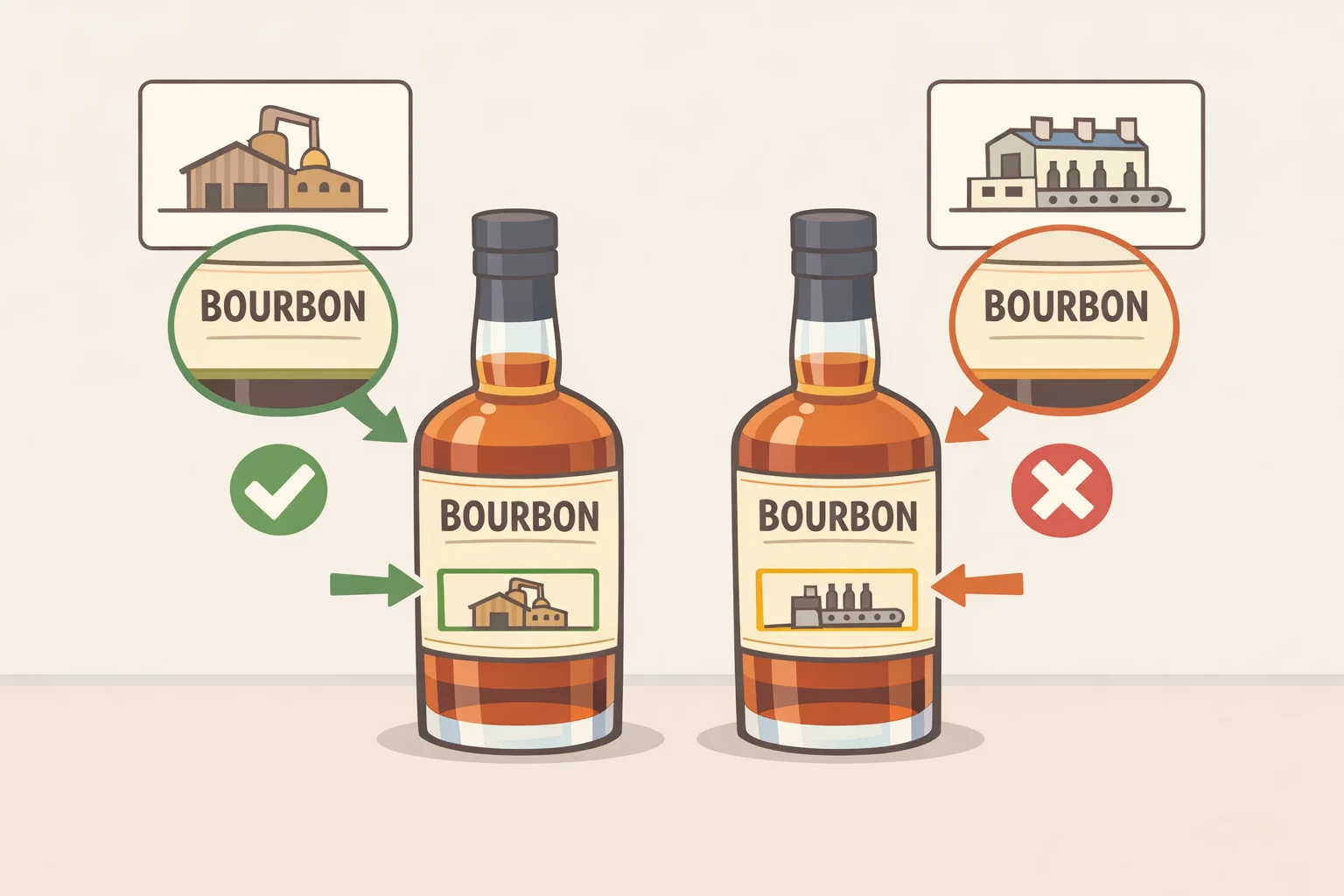
Three phrases describe production on bourbon labels. They are not interchangeable.
"Distilled by" is the only one with legal force: the entity named actually operated the still, as The Bourbon Report and American Whiskey Authority both confirm. "Bottled by" means only that the named entity filled the bottle; the whiskey could have come from anywhere. "Produced by" sits in a gray zone, functioning closer to marketing language than a verified production claim, a distinction the TTB's Beverage Alcohol Manual addresses directly, per American Whiskey Authority. As the late Julian Van Winkle put it: "Any fool with a funnel can bottle whiskey," quoted in The Bourbon Report.
TTB Ruling 54-416 requires labels to disclose the actual state of distillation whenever it differs from the address on the label. "Distilled in [State], Bottled by [Name]" on the back label is the classic sourcing signal. When a front label leans on a Kentucky address or Kentucky imagery but doesn't say "Distilled by," flip the bottle over.
Checkpoint 3: Read the age statement, or understand why there isn't one
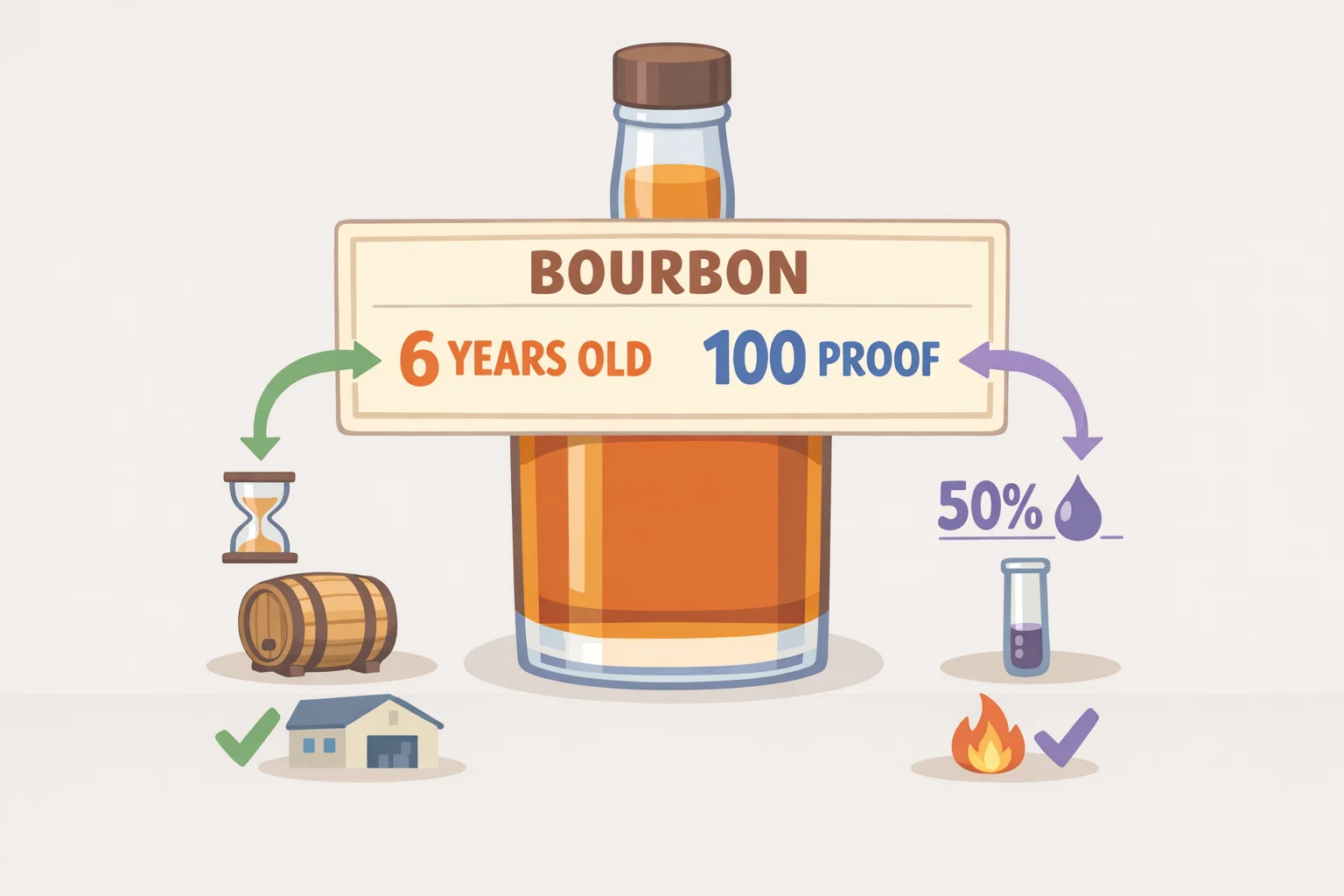
Any stated age on a straight bourbon is the age of the youngest barrel in the bottle. A floor, nothing more. Producers may understate but never overstate, per The Bourbon Report and American Whiskey Authority. "7 Year" means every barrel in the bottle is at least seven years old.
Straight bourbon aged under four years must carry an age statement; four years or older, it becomes optional, per Pour Picks. A "Kentucky Straight Bourbon Whiskey" with no printed age carries exactly one guarantee: the youngest barrel hit at least four years. No Age Statement (NAS) is neither a warning sign nor a prestige signal. It means you're relying on the blender's judgment rather than a printed number, as Pour Picks notes.
Proof is worth a glance too. Both proof and ABV must appear on the label, and proof is exactly twice the ABV, so 100 proof equals 50% ABV, per American Whiskey Authority. The number confirms the bottle meets the legal 80-proof floor, and if it reads exactly 100 proof alongside a Bottled-in-Bond claim, those two data points corroborate each other.
The checkpoints applied. A label reads "Kentucky Straight Bourbon Whiskey / Distilled by X Distillery, Louisville, KY / Aged 7 Years / 90 Proof." All three checkpoints clear: protected designation confirmed, in-state distiller verified, every barrel at least seven years old. Fully transparent.
Now consider a second bottle at the same price. The front reads "Small Batch Reserve." The class and type line, in small print, reads "Kentucky Straight Bourbon Whiskey," so the first checkpoint passes. But the production line reads "Bottled by Acme Spirits, Louisville, KY," and there's no age statement. The whiskey inside may be excellent. The label is doing less work.
Terms that sound like guarantees but aren't
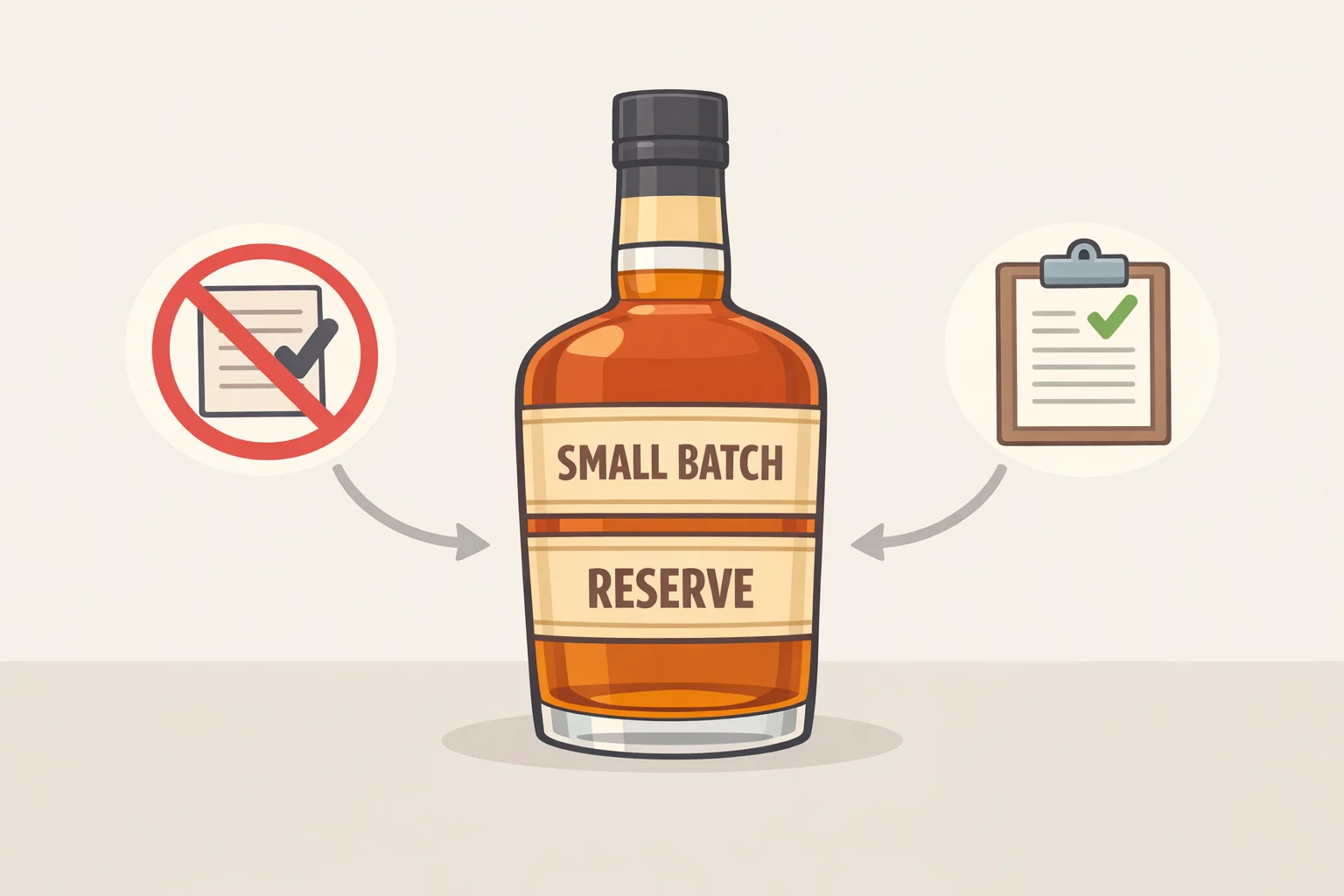
"Small Batch" is the most consequential unregulated term in bourbon. No legal definition exists for it, per The Bourbon Report. Brian Haara, author of Bourbon Justice, described the practical reality plainly: "Small batch has no precise, defined, legal meaning, and even in practice, it is almost meaningless. Some distillers or bottlers consider two to five barrels a small batch. Others use fifteen to twenty barrels. Still others use forty barrels or more," quoted in The Bourbon Report. A producer can print it on any bottle, any size, any source.
"Reserve," "Artisan," "Handcrafted," "Heritage," and "Carefully Selected" carry no regulatory weight either, per The Bourbon Report. Woodford Reserve, one of the most recognized bourbon labels in the world, cannot legally justify "Reserve" through any regulatory standard. That doesn't make it bad whiskey. It makes "Reserve" a font choice.
Regulated terms cost producers compliance; they have to earn them. Marketing terms cost only ink. When two bottles sit at the same price, the gap between what the legal language guarantees and what the decorative language implies is often precisely where margin lives.
What the label can prove, and what it can't
Three checkpoints confirm legal compliance and production transparency. They don't confirm you'll enjoy the whiskey, that it's priced fairly, or that it outperforms a bottle with a shorter designation. "Kentucky Straight Bourbon Whiskey" is an information guarantee, not a quality award.
A fully compliant label tells you the whiskey was distilled and aged in Kentucky for at least two years, contains no added coloring or flavoring, and met every federal bourbon production requirement. Those are verifiable facts, enforced by the TTB and unavailable to any out-of-state producer, per TTB Ruling 54-416 and The Bourbon Report.
What no label can tell you: whether the whiskey is well-made, whether the age suits your palate, or whether the price reflects what's in the bottle rather than what's printed on it. A bottle with every regulated box checked can still disappoint. A bottle with fewer designations can still be excellent.
Ignore the adjectives. Find the class and type line, check who distilled it, and read what the age statement actually says. Thirty seconds, three data points. Everything else is decoration.
For readers who want the regulatory text directly, it's in 27 CFR Part 5, Subpart C. Both The Bourbon Report and American Whiskey Authority publish field guides that track TTB labeling standards as they evolve.