The backwards shopping grocery list: a step-by-step guide
A backwards shopping grocery list starts in the kitchen, not the store. Instead of deciding what sounds good for dinner and then shopping for every ingredient from scratch, you inventory what's already in the pantry, fridge, and freezer, build meals around it, and shop only for what's missing. A growing number of budget-conscious households have picked up a habit Kiplinger calls "backwards shopping," essentially pantry-first meal planning turned into a repeatable weekly routine (Kiplinger, earlier this year).
The appeal isn't hard to understand. In a randomized experiment, shoppers who wrote an itemized list before a grocery trip bought fewer items than shoppers with no list at all (21.06 versus 25.69 items). A third group who only predicted how much they'd spend, without writing anything down, bought about as much as if they'd made no plan whatsoever (Journal of Consumer Behaviour, 2020). Separately, food-waste researchers estimate the average household throws away up to 32% of what it buys, at a cost of roughly $1,300 per adult per year (Consumer Reports, 2023).
Put those two facts side by side and pantry-first shopping looks like an obvious fix. It isn't quite that simple. No study in this research directly tested pantry-first planning against other list-making methods, so what follows treats it as an evidence-informed habit worth trying, not a proven system. What the research does establish clearly is that a written, itemized list changes behavior in ways a vague spending intention doesn't. This guide walks through building a list that way, starting from what's already paid for, and stays honest about where the evidence stops.
The evidence behind the backwards shopping strategy
Video of the Day
Pantry-first shopping means checking what's on hand before deciding what to buy, rather than planning meals first and then shopping for every ingredient as though the kitchen were empty (Kiplinger, earlier this year). The mechanism behind why this might work traces back to that same 2020 study: it's the specificity of a written list, not sheer willpower, that curbs purchases. Shoppers who wrote an itemized list bought less than a no-list control group, while shoppers who only estimated a dollar total performed no differently than that control group at all (Journal of Consumer Behaviour, 2020).
Worth naming the limit here. That study used undergraduates, average age 21 to 22, completing a virtual grocery trip on a retailer's website, not in-person shoppers across a broader population (Journal of Consumer Behaviour, 2020). It's a real effect in a narrow setting, not one confirmed at the checkout line of an actual supermarket. Pantry-first shopping applies the same logic of specificity, just built by subtraction: the list comes from what's missing from meals you can already partly make, rather than from what looks appealing in the aisle. That's the organizing idea behind everything below. The evidence supports the list. The pantry-first twist on it is a reasonable extension, not yet a separately tested one.
Video of the Day
How to make a grocery list from your pantry
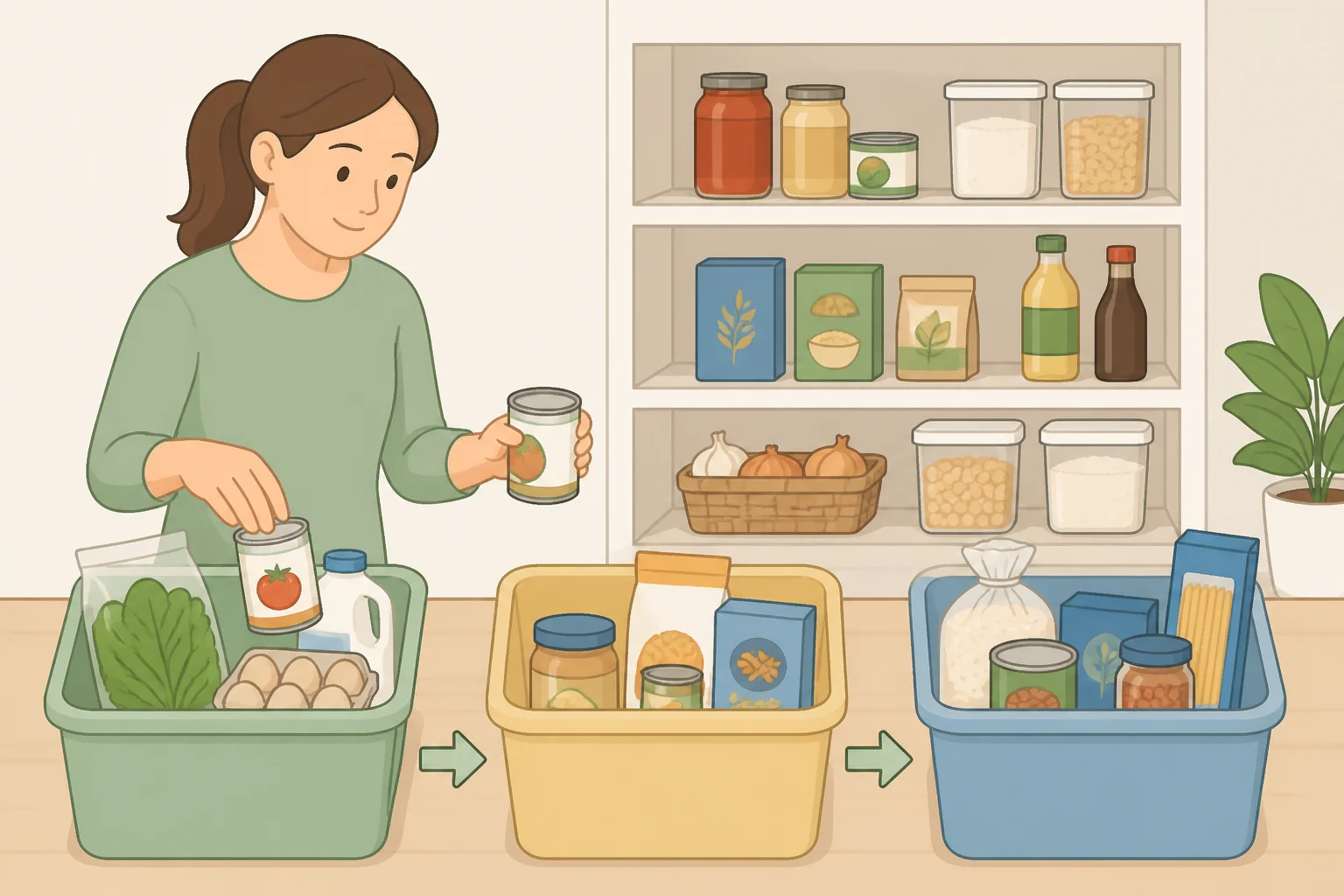
Building a pantry-first list takes a phone camera or a notepad and a rough sense of how many dinners get cooked at home most weeks. Here's the process.
-
Inventory your kitchen first. Photograph or jot down what's sitting in the pantry, fridge, freezer, and spice cabinet. Sort loosely into three buckets: use first (perishables already opened or close to spoiling), use soon (a few weeks of shelf life left), and shelf-stable (canned goods, grains, anything that can wait). Consumer Reports recommends this kind of pantry check specifically to avoid buying duplicates of things already in the cupboard (Consumer Reports, 2023).
-
Note your fixed replenishments. List staples that are genuinely running low, milk, coffee, bread, pet food, regardless of what meals get planned. Set a rough threshold for yourself, down to the last cup of coffee or half a loaf of bread, so this step doesn't turn into guesswork every trip. It keeps pantry-first meal planning from accidentally skipping essentials in the name of using up odds and ends.
-
Pick your scale. If most nights involve cooking at home, plan every dinner for the week, built first from the "use first" and "use soon" buckets. That extends Kiplinger's "3-meal rule" concept across a full week (Kiplinger, earlier this year). If the schedule is irregular, use the rule as originally described: build just three dinners from what's already home, and let those three meals define the entire gap list. That's the lower-effort default, and there's no obligation to plan a full week if that's not realistic. Either way, account for lunches and leftovers too, since a pot of rice or a roasted vegetable side rarely belongs to just one meal.
-
Sequence perishables across more than one meal. If a recipe uses half a bag of spinach on Monday, plan a second use later in the week, maybe as a side with a different protein. That kind of intentional reuse is exactly what Consumer Reports points to as a way to lower the odds produce gets forgotten in the crisper drawer (Consumer Reports, 2023).
-
Write the gap-only list. Once meals are mapped, the list should contain only what they and the staples require, nothing else. But treat it as a floor, not a ceiling. In the study behind the evidence above, shoppers who wrote a list still bought nearly twice as many items (20.54) as they'd predicted while writing it (11.19), and they reported buying more unplanned items than shoppers with no list at all (3.30 versus 1.72) (Journal of Consumer Behaviour, 2020). A list narrows a trip. It doesn't seal it shut. One planned discretionary item, a specific treat rather than "see what looks good," is a practical guardrail worth adding, not something the research has tested directly.
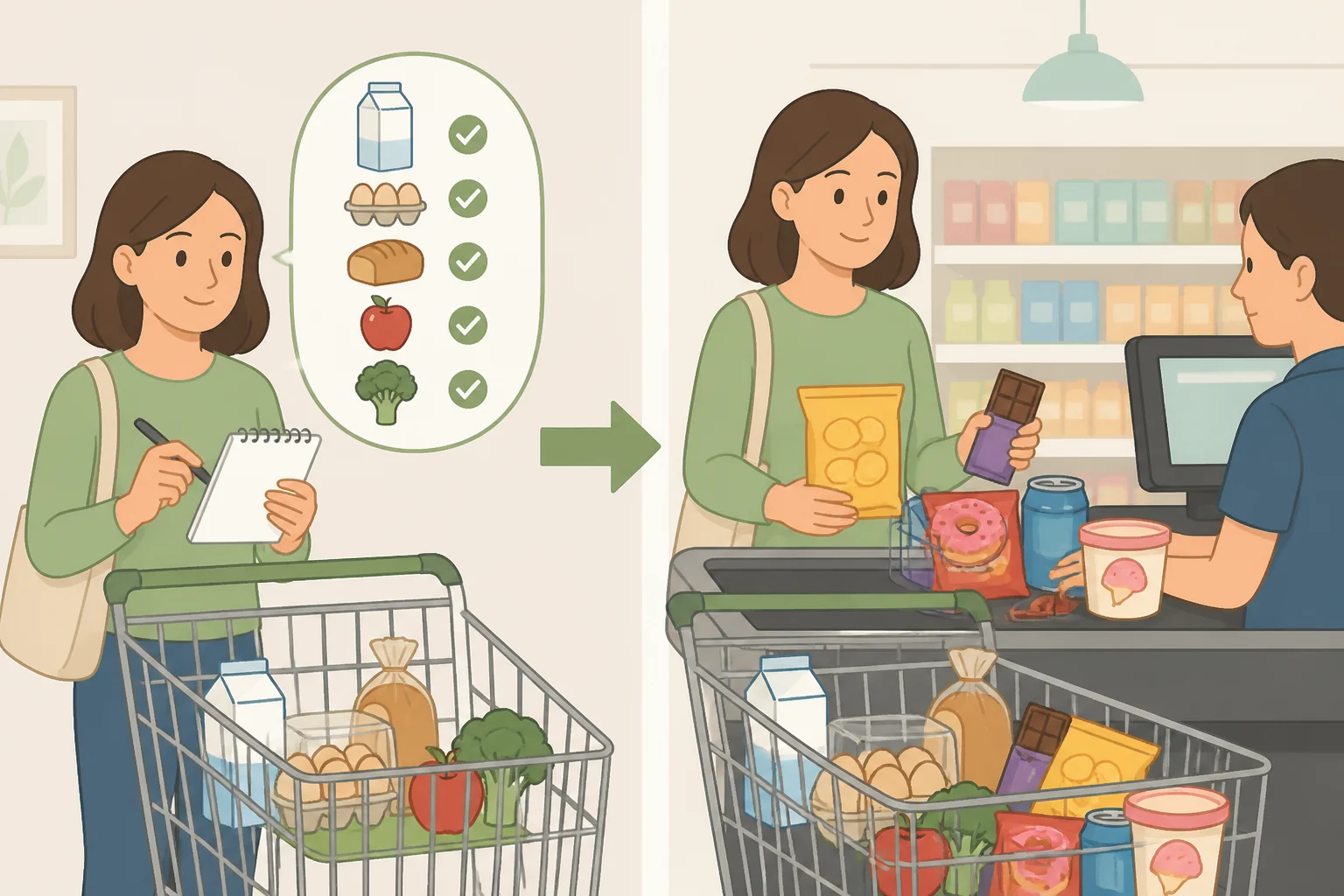
- Revise next week based on what's left over. After the trip, note what went unused. If the spinach still wilted despite the plan, that's information, not failure. Buy less of it next time, or route it into an earlier meal. Pantry-first planning works better as a habit tuned week over week than as a one-time system.
As an illustration of how the gap list comes together: an inventory turns up a pound of chicken thighs, some dry rice, a can of black beans, half a bag of spinach, and a couple of bell peppers. Three dinners follow. Chicken-and-rice bowls use the chicken, half the rice, and the spinach as a side. A black bean and rice skillet uses the rest of the rice, the beans, and the peppers. The third meal needs a protein since the chicken's gone, so it's built around tofu or eggs wrapped in tortillas, with shredded cheese and a fresh topping added there. The resulting gap list: tofu or eggs, tortillas, shredded cheese, one fresh topping, plus one discretionary item like a bag of chips.
What a grocery list to save money can and can't fix
Checking the pantry before shopping directly prevents duplicate purchases. That part is close to self-evident, and it's why Consumer Reports recommends it (Consumer Reports, 2023). Routing produce and proteins into a second meal targets the same waste pattern behind the food-loss estimates cited earlier (up to 32% of food bought, roughly $1,300 per adult a year), though no study in this research set has measured pantry-first planning's actual effect on that figure (Consumer Reports, 2023). It's a plausible mechanism, not a confirmed outcome.
What a grocery list to save money doesn't guarantee is a smaller total bill. In the larger list-writing study, list-writers bought fewer items than the control group, but the difference in total dollars spent wasn't statistically significant. A shorter list doesn't automatically mean a smaller receipt (Journal of Consumer Behaviour, 2020).
The category filling a gap matters more than the list format itself. Kiplinger notes meat, poultry, and seafood are commonly the priciest items in a cart (Kiplinger, earlier this year), so when a gap list calls for protein, swapping in beans or tofu is the decision that actually moves the needle on cost. In Consumer Reports' 2023 store checks, a can of store-brand black beans ran about 79 cents for roughly 3.5 servings, versus dried beans at $1.99 for about 13 servings, and 14 ounces of organic tofu ran $2.99 for 4.5 servings at one Northeast supermarket (Consumer Reports, 2023). Those are dated snapshots from specific stores, not current price guarantees, but the underlying logic, that protein choice swings cost more than list format does, still holds. The pantry-first process only creates the moment to make that swap. It doesn't make the swap for anyone.
Reduce unplanned grocery purchases by giving the trip a purpose
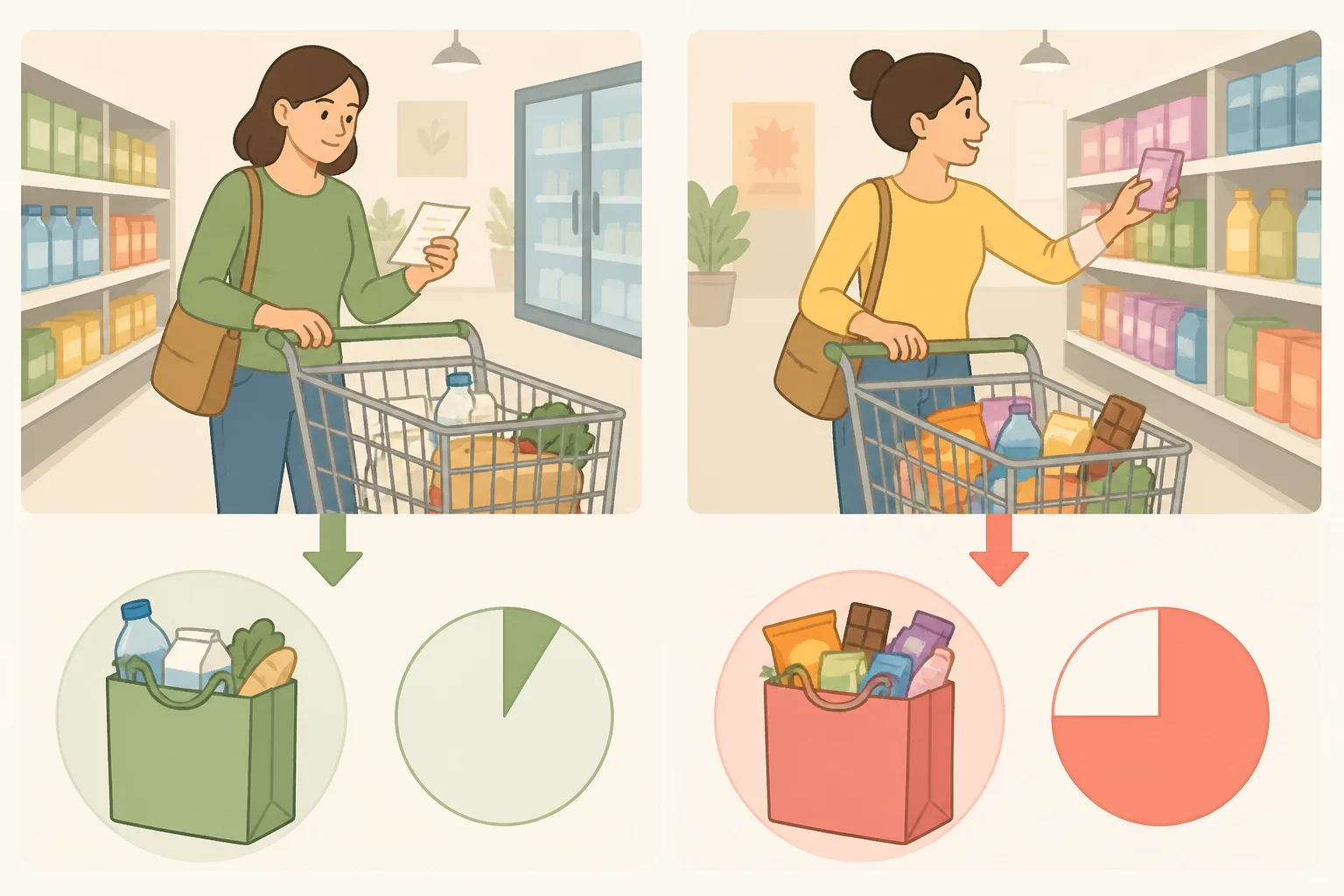
A gap-only list does more than specify what to buy. It gives a shopping trip a defined purpose, and that distinction appears to matter more than the common advice about not shopping hungry. A field study published three months ago, drawing on receipts from 323 shoppers and 3,819 individually coded items, found that browsing shoppers, those without a specific errand in mind, had nearly nine times the odds of making an unplanned purchase compared with shoppers on a defined, routine trip (OR 8.635). Hunger, by contrast, showed no significant link to unplanned purchases at the basket level (OR 1.019, p=.434) (field study). Shoppers on browsing trips simply had far higher odds of an unplanned purchase than shoppers on routine trips, regardless of how hungry they were.
There's one narrow exception. Hunger did predict impulse buys specifically in snacks and confectionery (OR 1.090, p=.001), an effect concentrated among younger shoppers (field study). Planning for that with one deliberate snack on the list, rather than leaving it to the aisle, covers the one category where hunger actually seems to matter.
A list also isn't a defense against store design itself. In interviews with twelve young-adult and family shoppers in Finland last year, participants described visual cues, mood, and fear of missing out as triggers for impulse buying, operating alongside whatever planning they'd done beforehand (Aalto University thesis, 2025). That's a small, qualitative sample, not proof those triggers override a list every time, but it's a reasonable prompt to treat the list as a script to follow through the store rather than just a memory aid left in a pocket.
Where to go from here
None of this adds up to a guarantee. Pantry-first planning hasn't been tested directly against other meal-planning methods, so the honest way to treat it is as a habit worth running for a couple of weeks, not a system to trust blindly. Try the inventory-and-gap-list process, track what gets bought outside the list separately from what's on it, and pay attention to which categories keep showing up unplanned. That's usually where the actual savings are hiding, in the protein aisle more often than in the length of the list itself.