How to clean a garbage disposal: steps to prevent odors
A disposal that smells bad usually isn't a citrus problem. Citrus can mask an odor without touching what's actually causing it, which is typically food residue clinging to the splash guard or lingering in the drainpipe just past the disposal (Consumer Reports), sometimes built up inside the grinding chamber itself (The Plumbing Directory). Learning how to clean a garbage disposal properly means clearing out that residue first, then using baking soda and citrus, with bleach reserved for households whose manual specifically allows it, to finish the job.
Alyssa Wiegand, a product manager at Moen, said in a Consumer Reports article updated in 2025 that most disposal odors trace back to gunk on the splash guard, a removable rubber part plenty of homeowners never think to take out and scrub (Consumer Reports). Food that never fully clears the drainpipe is the other common culprit, according to Wiegand, and it's the kind of smell that never shows itself but never quite goes away either (Consumer Reports).
This guide covers cleaning a disposal safely, deodorizing it with what's already in the kitchen, and figuring out how often to clean a garbage disposal based on how much cooking actually happens there.
Before you start
Video of the Day
None of this requires a hardware store trip, but a few things make the job faster and safer:
- A flashlight, to see how much buildup is actually inside before touching anything
- Rubber gloves
- A scrub brush or old toothbrush for the splash guard
- Baking soda, white vinegar, and ice
- A towel or small bucket for under the sink, in case anything drips while the guard is out
Keep hands out of the chamber the entire time. Every step below can be done without reaching inside.
Video of the Day
How to clean a garbage disposal safely, step by step
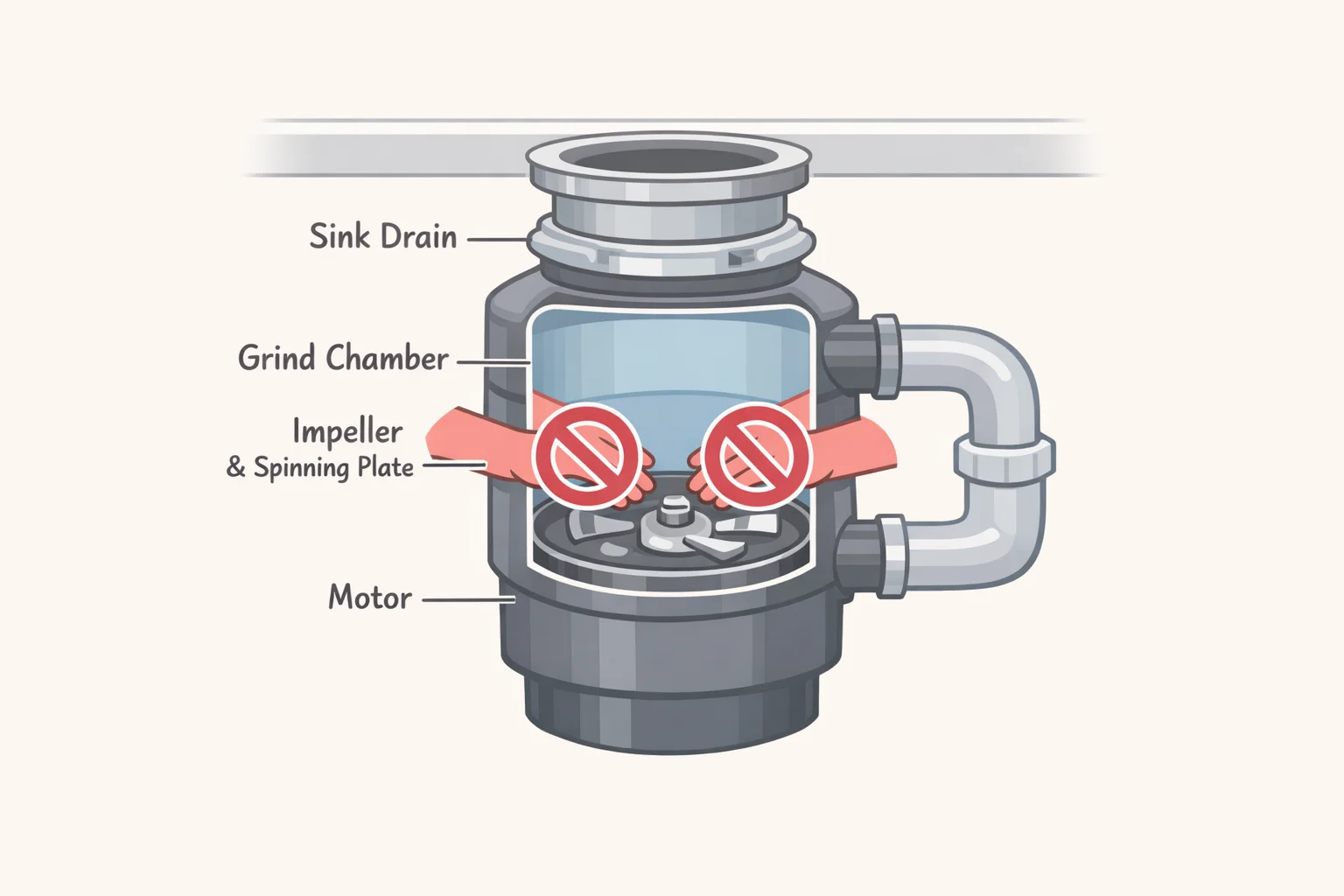
Garbage disposals don't have blades. They use a spinning impeller that flings food against a stationary grind ring (Consumer Reports). That doesn't make it safe to reach in. Manufacturers still warn against putting a hand inside, since an edge can nick a finger even without a proper blade (Consumer Reports).
1. Cut the power. Flip off the wall switch that controls the disposal, and unplug the unit under the sink if the cord is reachable. If there's no visible switch or plug, shut off the breaker instead. Then confirm there's no fork, spoon, or other object sitting in the chamber before doing anything else.
2. Remove and scrub the splash guard. Shine the flashlight into the opening first, then pop the rubber flap out by hand, working around the rim rather than reaching down into the disposal. Scrub it with warm water and baking soda. The Plumbing Directory notes splash guards are dishwasher-safe on most models, so the top rack works too, but check the manual if there's any doubt (Consumer Reports; The Plumbing Directory). If the guard doesn't come free with a firm, even pull, stop. Some models attach differently, and prying at it risks cracking the rubber. Check the manual instead.
3. Scour the chamber with ice. Consumer Reports lays out a specific sequence: drop six ice cubes into the chamber, add a tablespoon of baking soda and three thin lemon slices, then top with six more ice cubes. Run the disposal dry, without water, until the grinding stops, then flush with cold water for 30 seconds while the motor keeps running (Consumer Reports). Eric Schultz, InSinkErator's director of product management, told Consumer Reports that the ice and baking soda scour the grind mechanism while the lemon adds scent, and that a teaspoon of bleach can go into the same batch to target odor-causing bacteria (Consumer Reports). Treat that last ingredient as optional rather than standard: The Plumbing Directory warns that repeated bleach use damages rubber seals inside the disposal, so check the owner's manual before adding it, and never mix bleach with vinegar (The Plumbing Directory).
The Plumbing Directory also describes a simpler version of this same step: two cups of ice and half a cup of coarse salt, run with cold water the whole time instead of dry (The Plumbing Directory). If a model's manual recommends one approach over the other, follow that instead of guessing between them.
One piece of folklore worth clearing up: some advice claims ice sharpens a disposal's blades. Since disposals grind with an impeller and a stationary ring rather than blades, that idea is closer to habit than accuracy. What the ice actually does, per Consumer Reports, is scour loose food off the grind mechanism, not hone an edge that isn't there to begin with.
How to clean and deodorize a garbage disposal
Cleaning and sanitizing aren't the same job. Cleaning removes dirt and organic buildup, typically with hot water and soap, while sanitizing goes further and reduces bacteria to safe levels, usually with diluted bleach, hydrogen peroxide, or white vinegar (Iowa State University Extension). The fizz treatment below works as a cleaning and deodorizing step. Nothing in the research behind it shows it sanitizes the disposal the way a dedicated bleach solution would.
The standard treatment: pour half a cup of baking soda into the disposal, follow with a cup of white vinegar, and let it fizz. How long to wait varies by source. Iowa State Extension and N.C. Cooperative Extension both call for roughly 10 to 15 minutes, while The Plumbing Directory says 5 to 10 minutes is enough (Iowa State University Extension; N.C. Cooperative Extension; The Plumbing Directory). Ten minutes falls inside all three ranges, which makes it a reasonable default.
The flush afterward gets described differently too. Iowa State recommends flushing with boiling water, N.C. Cooperative Extension just says hot water, and The Plumbing Directory specifies about 30 seconds of hot water once the fizzing settles (Iowa State University Extension; N.C. Cooperative Extension; The Plumbing Directory). That hot-water flush is a deliberate departure from grinding food, which should always use cold water.
Citrus earns a real spot in this routine, not just a scent. The Plumbing Directory recommends grinding a quartered lemon or orange with cold water as a finishing step once the fizz and scour work is done, while N.C. Cooperative Extension describes lemon peels themselves as useful for cleaning the disposal (The Plumbing Directory; N.C. Cooperative Extension).
The bleach question
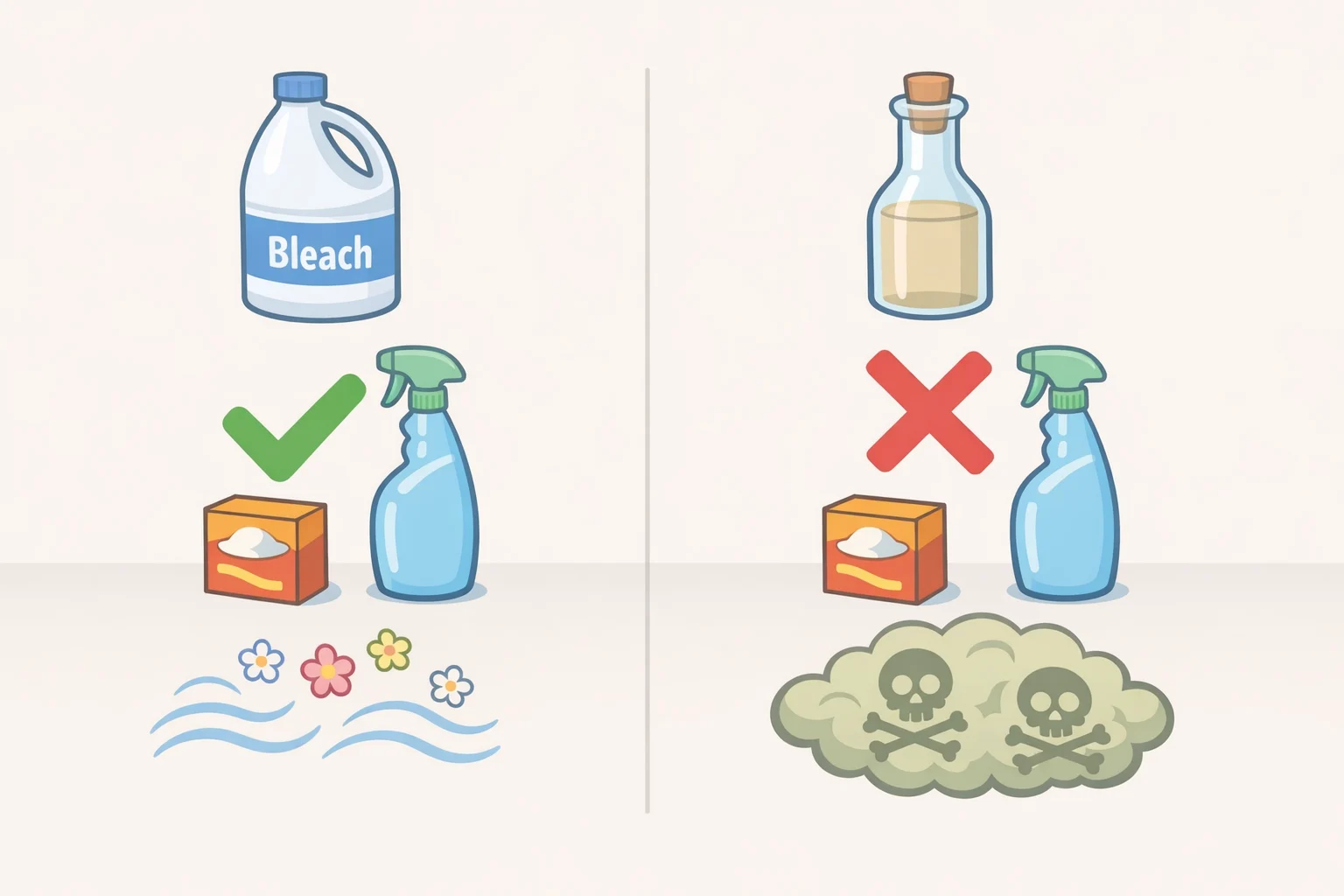
The two main sources here disagree, and it's worth laying out both sides instead of picking one. Eric Schultz at InSinkErator told Consumer Reports that a small amount of bleach belongs in a weekly cleaning routine because it kills odor-causing bacteria (Consumer Reports). The Plumbing Directory takes the opposite position, warning that repeated bleach use damages the rubber seals inside a disposal (The Plumbing Directory).
Neither source settles it, so the safer approach is to treat bleach as conditional rather than routine. Use it only if the disposal's manual specifically permits it, keep the amount small, and never mix it with vinegar or other cleaners. Skip lye and chemical drain cleaners entirely: Consumer Reports notes some contain corrosive materials that can damage disposal components (Consumer Reports).
How often to clean a garbage disposal

For daily use, Consumer Reports recommends a weekly cleaning routine (Consumer Reports). The Plumbing Directory doesn't tie its schedule to how often someone cooks, but makes a related point: once a disposal has had a deep clean, weekly maintenance is what keeps the smell from coming back (The Plumbing Directory).
Lighter use calls for less frequent attention. University of Maine Cooperative Extension suggests sanitizing drains and disposals monthly with a diluted bleach solution, roughly a tablespoon per quart of water (University of Maine Cooperative Extension). N.C. Cooperative Extension frames the baking soda and vinegar treatment instead as a twice-a-year maintenance task (N.C. Cooperative Extension).
These aren't competing numbers so much as different jobs on different clocks. As a practical rule of thumb: weekly for heavy daily cooking or a disposal that already smells off, monthly to twice a year for lighter use, and immediate attention any time odor or visible residue shows up, regardless of what the calendar says.
Good water habits matter more than any schedule. Consumer Reports' testing points to a clear pattern: run cold water before and during grinding, keep it running about 7 seconds after the grinding stops, and give the disposal one more flush once it's switched off, since loose particles settle to the bottom of the trap and need a final rinse to clear (Consumer Reports). The Plumbing Directory adds that most people cut the disposal off too early, and suggests running it an extra 10 to 15 seconds after the food is fully ground (The Plumbing Directory).
What to avoid, and when the smell isn't a cleaning problem
Some things shouldn't go down the disposal no matter how often it gets scrubbed afterward:
- Fats, oils, and grease, which should be cooled and thrown out in a lidded container instead
- Coffee grounds, which tend to settle in the drain trap and can start a slow backup over time
- Fibrous scraps like celery, onion skins, potato peels, broccoli, and lettuce
- Uncooked rice and pasta, since both swell up once they hit water
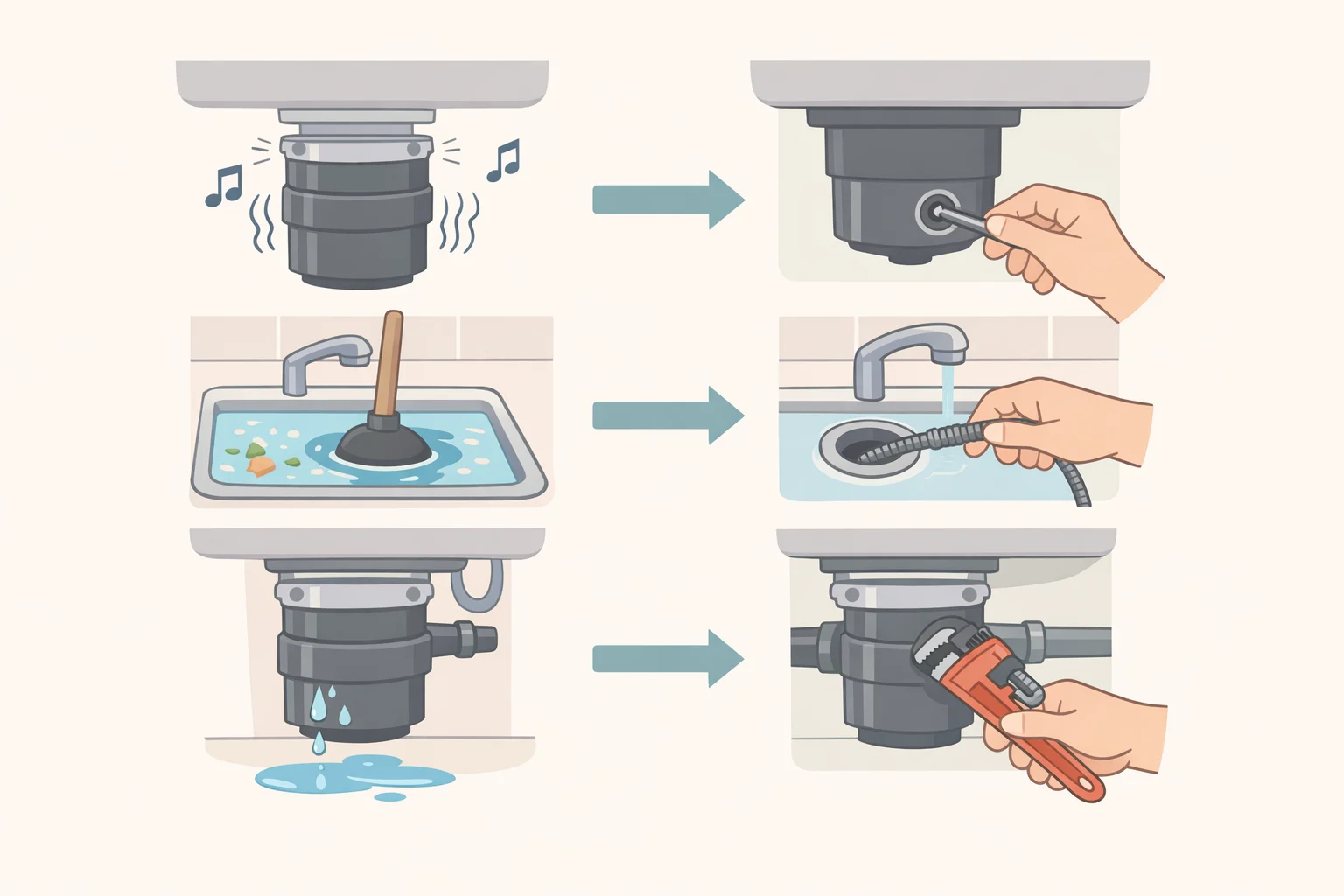
Not every kitchen-sink symptom means the same thing, and it helps to sort them out before reaching for another round of baking soda. A disposal that hums without grinding is a mechanical issue, not an odor problem. A clog shows up as water backing up into the sink rather than draining normally. A smell with no change in drainage usually points to lingering residue rather than a blockage. Actual leaking, water pooling under the sink, is a separate issue again.
If the odor is still there after a thorough splash-guard scrub and a full fizz treatment, the disposal itself may not be the problem. The Plumbing Directory notes the smell may be coming from the drain line past the disposal, somewhere the cleaning routine never reaches (The Plumbing Directory).
One combination is worth checking rather than deodorizing again: a leaking disposal alongside a smell that won't quit. That pairing could point to water damage building up under the sink, according to The Plumbing Directory (The Plumbing Directory). Check for it by looking at the cabinet floor and the pipe connections under the sink for dampness or staining, without taking the unit apart. If there's a leak, or the smell survives everything above, that's a plumber's job, not another round of vinegar.