How to Deep Clean a Rug at Home Without Ruining It
This guide walks through how to deep clean a rug at home without renting bulky equipment or hiring a service. By the end, you'll know whether your rug qualifies for DIY cleaning, how to do it correctly, and how to dry it without creating a mold problem. Drying, not cleaning, is where most home attempts go wrong.
When used correctly, a consumer-grade carpet cleaner can remove deep-down dirt and help most rugs look almost as good as new, per Good Housekeeping. That's worth saying upfront because most people assume a dull, odor-holding rug is either ruined or needs a service call. Usually, neither is true.
This method works on synthetic and blended area rugs with a "W" or "WS" care label that are removable and haven't been exposed to flooding or mold. What it does not cover: wool, silk, jute, sisal, hand-knotted, antique, or heirloom rugs, and any rug with no care label and an unknown fiber composition. Those require material-specific methods or professional handling.
What you'll need: vacuum, carpet cleaning machine, carpet cleaning solution formulated for rugs, clean water.
Before you start: does your rug qualify for DIY wet cleaning?
Video of the Day
Not every rug should be wet-cleaned at home. Knowing that before dragging out the equipment saves the rug and potentially the floor under it.
Check the care label. Look for one of two symbols: "W" means water-based cleaning solutions are safe; "WS" means either water or solvent-based solutions are acceptable. Any other code "S" (solvent only) or "X" (vacuum only) means wet cleaning is off the table, per BISSELL.
No label? Don't guess. If there's no care label and the fiber is unknown, do not wet-clean. Take it to a rug specialist for fiber identification or have it professionally cleaned. A rug that buckles its backing or bleeds its dyes mid-process cannot be un-cleaned.
Stop here if any of these apply:
- The rug has visible mold or a persistent musty odor. If mold is present, the right move is to remove it and fix the moisture source, per the CDC. Porous materials like rugs that have been genuinely mold-contaminated may need to be discarded rather than cleaned, per Harvard Health.
- The rug was exposed to flooding or significant water intrusion. If the affected area exceeds roughly 10 square feet or follows a major flood, professional mold remediation is the appropriate next step, not a cleaning machine, per Harvard Health.
- The rug lives in a kitchen, bathroom, or entryway. Chronic moisture in those spaces makes soft flooring a persistent mold risk. The ALA recommends keeping those areas carpet-free entirely.
If the rug clears all three, proceed.
Video of the Day
How to deep clean a rug at home in five steps
Step 1: Spot-test the cleaning solution before committing
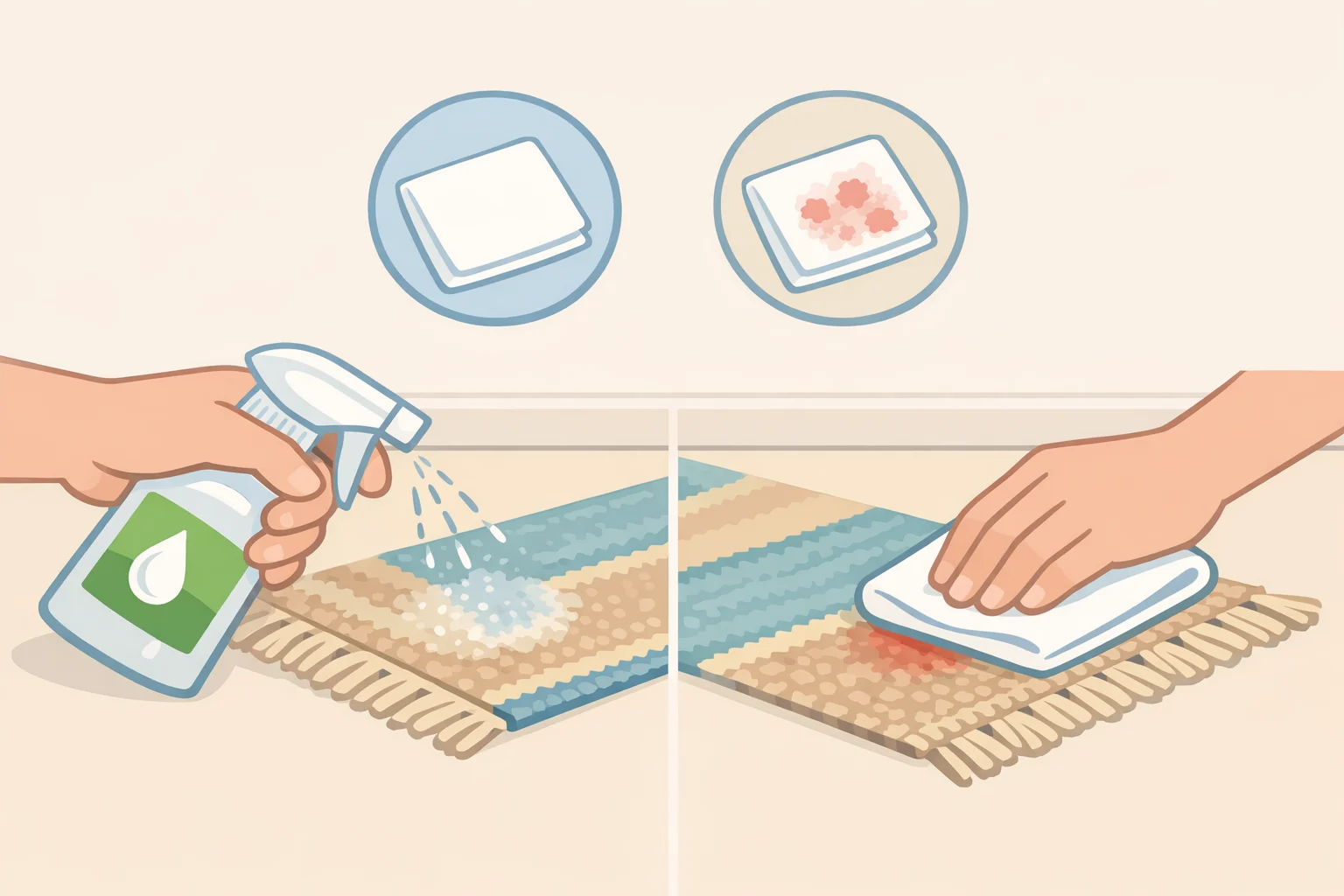
Apply a small amount of carpet cleaning solution to an inconspicuous corner, under a furniture edge or the back of one end. Let it sit for two to three minutes, then blot dry and check for color transfer, discoloration, or fiber distortion. Do this regardless of what the care label says. A label confirms the rug can handle water-based solutions in general, not that every formula is compatible with its specific dyes, per BISSELL.
If the test area looks different from the surrounding rug, stop. Try a milder solution or consult a professional.
Step 2: Vacuum thoroughly, both sides
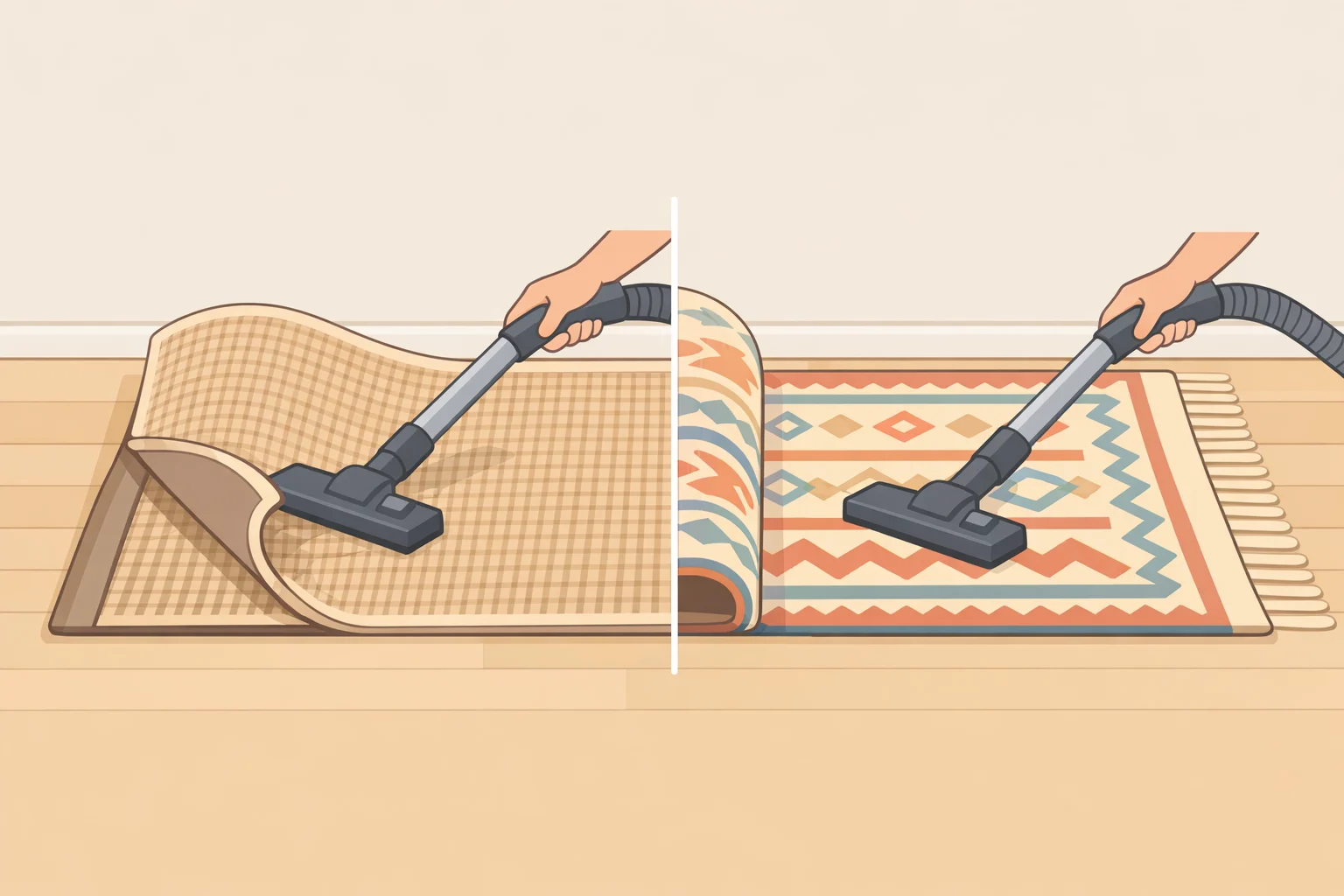
Before any moisture touches the rug, remove as much loose debris as possible by vacuuming the entire surface slowly and thoroughly, per Good Housekeeping. Skipping this turns dry dirt into muddy residue once liquid is introduced.
Flip the rug and vacuum the underside. Debris settles through fibers over time and accumulates in the backing, so both sides matter, per the ALA. Empty the canister or bag outdoors rather than into an indoor bin to avoid recirculating the particulate just removed, per the ALA.
Step 3: Apply cleaning solution in controlled passes
Load the carpet cleaner with solution and clean water per the machine's instructions. Work in sections rather than one continuous sweep, and move the machine slowly. Overlapping passes give the solution time to work on embedded grime. For heavily soiled areas, a perpendicular follow-up pass works the solution into the fibers from a different angle.
Rug fibers tend to be shorter than wall-to-wall carpet, which means they need less formula and suction to get clean, per BISSELL. Apply conservatively and resist the urge to add more solution if the rug looks heavily soiled.
Do not soak the rug or saturate the backing. Excess moisture that penetrates the backing is hard to extract and extends drying time, which creates the conditions for mildew growth. Use the minimum amount needed to produce light foam at the surface.
Step 4: Run a final extraction pass
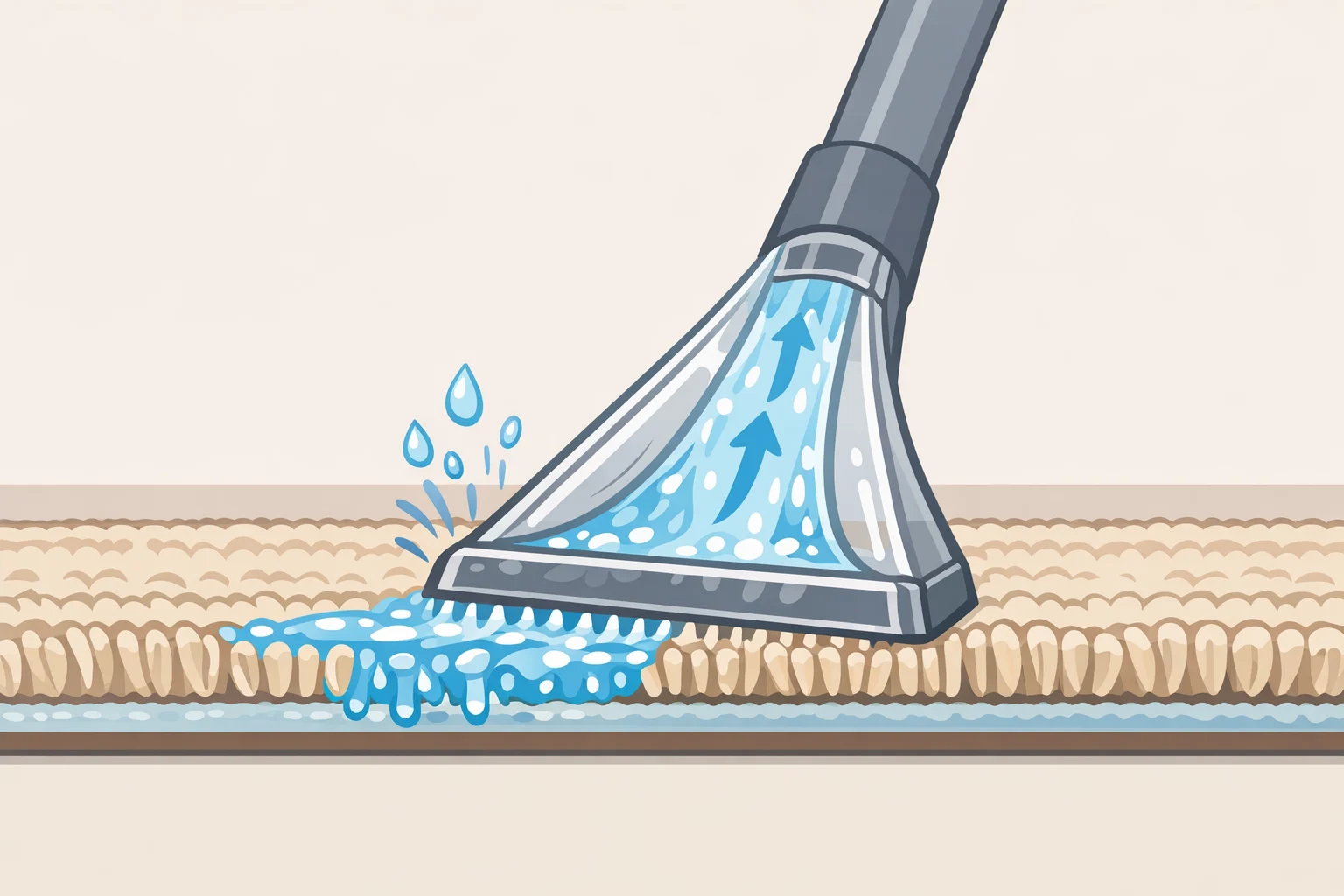
After cleaning, do a slow pass across the entire rug using the machine's suction or extraction mode. Think of it as wringing out a sponge before hanging it to dry. The less water left in the fibers, the faster and safer the drying process, per BISSELL.
Judge by feel: run a clean hand across the surface after each pass. When the fibers feel damp rather than wet and the machine is no longer pulling significant liquid, extraction is sufficient. On a thick rug, this may take two or three passes. Don't treat this step as optional.
Step 5: Dry the rug completely before returning it to use
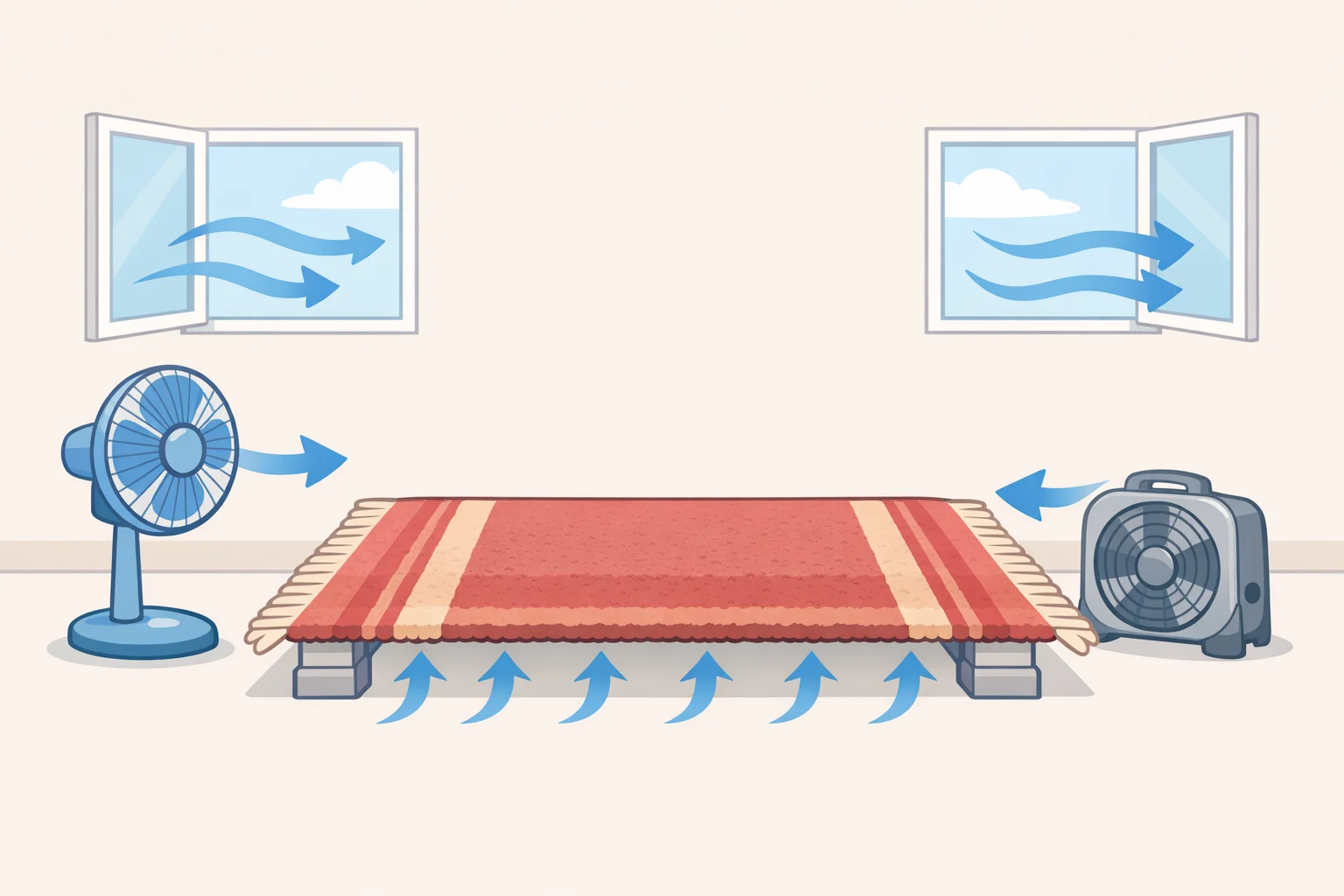
This is where most home deep cleans go wrong. Water damage is the leading cause of mold growth, per Harvard Health. A damp rug left flat in a low-airflow room is an efficient mold incubator.
Don't walk on the rug or move furniture back until it is fully dry, per BISSELL. Speed drying by running fans across the rug surface, opening windows, or running the HVAC system. If possible, elevate one end or dry the rug outdoors in a shaded area so air can circulate underneath as well as over the top, per BISSELL.
Humidity matters. Keeping indoor humidity between 30% and 50% supports faster, safer drying, per Harvard Health. If the home runs above 60%, run a dehumidifier in the room while the rug dries. A cheap hygrometer from a hardware store tells you exactly where you stand.
A rug that feels dry on the surface may still be damp at the backing. Press a palm flat and hold it for a few seconds to check. When in doubt, wait.
Deep cleaning a rug without a machine
This guide focuses on extraction-based cleaning because machines remove moisture more effectively than hand methods. That matters for backing saturation and drying time, both of which affect mold risk.
Hand cleaning, applying solution manually and blotting dry, works for spot treatments or lighter surface refreshes. For a full clean, the problem is control: without a machine to extract moisture, drying depends entirely on airflow and time. On a thick or tightly woven rug, that means extended drying time and a higher chance of trapped moisture in the backing.
If no machine is available and the rug needs more than a spot treatment, professional cleaning is the safer path. The qualification check above applies regardless of method.
After the clean: troubleshooting and maintenance
If the rug smells musty after drying: Don't run it through another cleaning cycle. A musty odor that persists or returns after a full dry suggests moisture may be trapped somewhere, whether in the rug backing, the pad beneath it, or the floor itself. Investigate the source before doing anything else.
If visible mold turns up: The rug may need to go. Porous materials that have been genuinely mold-contaminated often cannot be reliably decontaminated through surface cleaning, per Harvard Health. Prolonged exposure to indoor mold may cause respiratory inflammation, worsening asthma, and other health effects, per Harvard Health. Another cleaning pass is not the answer.
Ongoing maintenance cadence:
Routine vacuuming reduces how much work periodic deep cleaning has to do. Vacuum high-traffic rugs at least weekly; lower-traffic rugs every one to two weeks. Households with pets, children, or allergy sufferers benefit from vacuuming high-traffic rugs two to three times per week, per BISSELL. Treat spills immediately the longer a stain sits, the more deeply it bonds to fibers, per Good Housekeeping.
On wet cleaning frequency, two sources give different guidance. BISSELL recommends cleaning high-traffic rugs monthly with solution, lower-traffic rugs every two to three months, and all rugs at minimum two to three times per year. The ALA recommends annual deep cleaning using dry steam cleaning. The gap makes sense once you consider the source: manufacturer guidance reflects optimal product performance, public-health guidance sets a minimum hygiene floor. Use the ALA cadence as a baseline and adjust upward based on how the rug actually looks and smells.
Rotate the rug 180 degrees every three to six months to distribute wear evenly and prevent permanent traffic patterns from forming, per BISSELL.
Conclusion
If the rug is synthetic or blended, carries a W or WS label, is removable, and can be dried in active airflow, DIY wet cleaning is reasonable. If any of those conditions don't hold, stop before water touches it. That decision matters more than any step in the process itself.
Done consistently, this approach keeps a qualifying rug in good condition without professional intervention. The cleaning is straightforward. The drying is where it counts.
Related guides: Rug care by fiber type (wool, jute, synthetic blends); how to remove specific stains from area rugs; how to select and vet a professional rug cleaning service.