How to Clean a Concrete Driveway Without a Pressure Washer: Match Cleaner to Stain
This guide walks you through cleaning a concrete driveway without a pressure washer. By the end, you'll know which cleaner to use for each stain type, how to apply it manually, and when the stain or surface area makes DIY the wrong call.
The core argument is simple: manual cleaning works when you match chemistry to the specific stain. Water alone won't do it. Bob Vila's hands-on comparative product test found that effective concrete cleaning requires the right product for the right contaminant that finding held across oil stains, algae, mildew, and soot. The other half of this guide matters just as much: some stains, some surfaces, and some driveway sizes are better handled with professional equipment.
Quick-start decision:
- General grime, mold, mildew, algae → oxygen-based cleaner (Step 2A)
- Fresh oil spill (under 24 hours) → liquid degreaser (Step 2B)
- Older, set-in oil stain → poultice or enzyme treatment (Step 2C)
- Rust → acid-based rust remover, not bleach (Step 2D)
- Tire marks, paint, graffiti, large areas, embedded biological growth → skip to "When to stop and call for help"
What you'll need before starting:
- Pump sprayer or spray bottle
- Stiff-bristled scrub brush or push broom
- Garden hose for rinsing
- Rubber gloves and eye protection
- The appropriate cleaner for your stain type (identified below)
Step 1: How to clean a concrete driveway without a pressure washer start by identifying the stain
Video of the Day
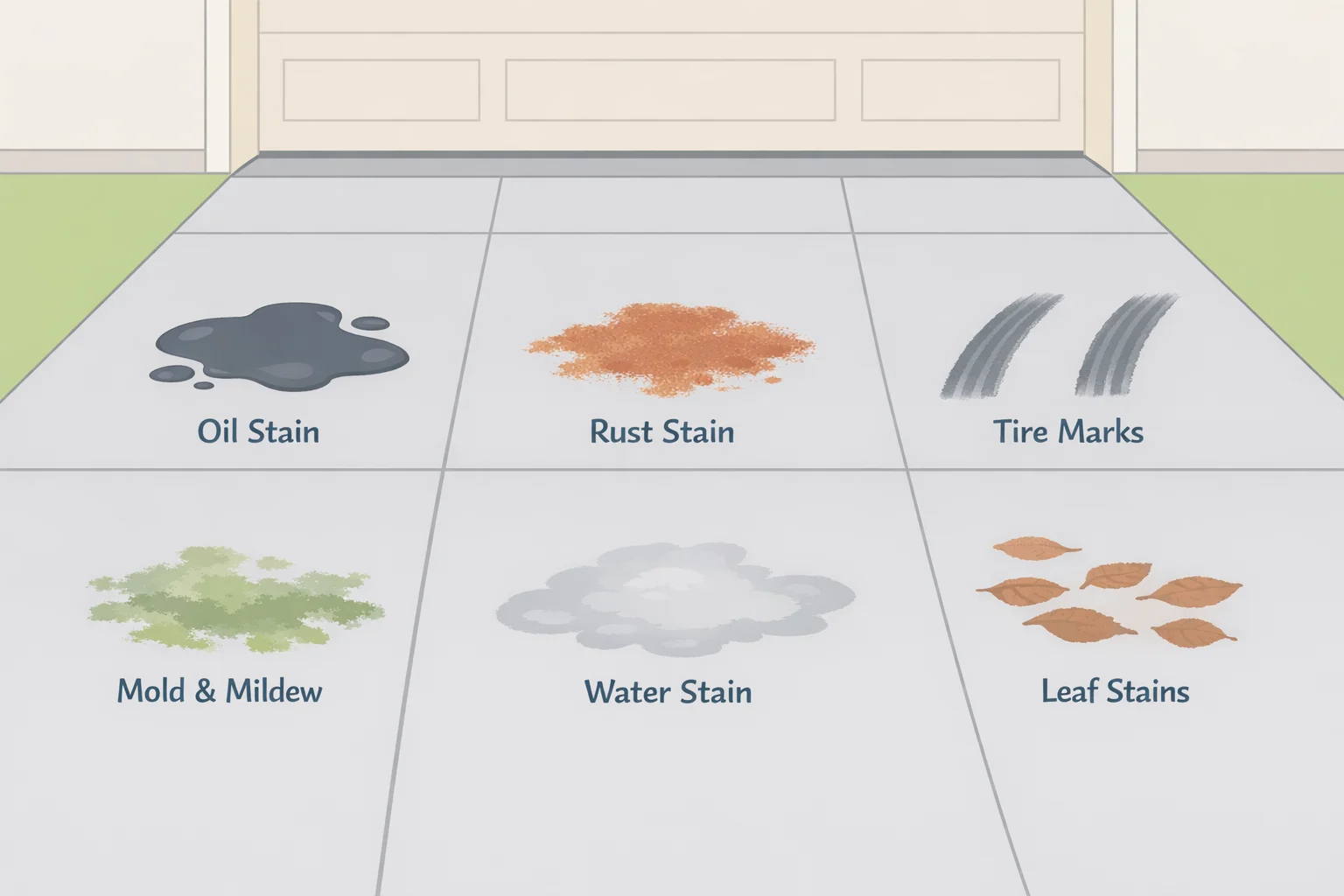
Before buying anything, know what you're treating. Choosing the wrong product doesn't just waste money; it can make the stain permanent. SlabCalc's concrete stain removal guide states directly that wrong products can set stains that would otherwise have been removable.
How to identify common driveway stains:
- General grime, algae, mildew, mold: Dark, greenish-black discoloration, often in shaded areas or after wet weather. Usually responsive to oxygen-based cleaners. Outcome: typically removable in one or two applications.
- Oil or grease: Dark, spread stains with a residual sheen; may feel slick. Age is the key variable. Fresh spills (under 24 hours) are DIY-manageable; older penetrated stains require more involved treatment. SlabCalc notes difficulty gets much harder after the first 24 hours. Outcome: fresh stains usually removable; older stains may need repeat treatments or a poultice.
- Rust: Orange or reddish-brown rings, often from metal furniture legs, fertilizer runoff, or iron-rich irrigation water. Requires a dedicated acid-based rust remover. Outcome: usually removable with the right product; do not attempt with bleach.
- Tire marks: Dark streaks from hot tires depositing carbon and plasticizer residue. Most come off fairly easily; stubborn, aged marks may need professional hot-water equipment. Outcome: often responsive to a degreaser and stiff brush results vary by age and depth; see Step 2E.
A note on efflorescence: That chalky white mineral deposit is not a typical stain. It's salt migrating to the surface through moisture. On concrete less than a year old, it often resolves on its own as the slab dries out, per SlabCalc. If it persists or keeps returning, the underlying cause is a moisture problem poor drainage or a missing vapor barrier not a cleaning problem. Light deposits respond to dry brushing. Recurrent efflorescence belongs in the "call a pro" category.
Test before you commit: On sealed concrete, always test any cleaner on an inconspicuous area and wait 24 hours. Local Concrete Contractor cautions that many cleaners bleach especially can compromise both the sealer and the concrete beneath. Resealing runs $0.75–$2.00 per square foot, or $375–$1,000 for a standard 500-square-foot driveway.
Video of the Day
Step 2: Best concrete cleaner for driveway stains by type
A quick reference before the full methods:
| Stain | Best cleaner | Approximate DIY cost | Typical dwell time |
|---|---|---|---|
| Grime, algae, mildew | Oxygen-based cleaner (e.g., Simple Green Oxy Solve) | $15–$30 | 3–30 minutes |
| Fresh oil (under 24 hrs) | Liquid degreaser (e.g., Oil Eater) | $8–$15/gallon | Immediate–few minutes |
| Older oil stain | Poultice or enzyme cleaner (e.g., ACT) | $10–$20 poultice; ~$20 enzyme | 24–48 hrs (poultice); 3–4 weeks (enzyme) |
| Rust | Acid-based rust remover (Iron OUT, CLR, Whink) | $8–$15 | 10–15 minutes |
| Tire marks | Degreaser | $8–$15/gallon | Few minutes |
Bleach: one consolidated caution before the methods. Bleach is the most common DIY instinct for dark stains and one of the more damaging choices. Household bleach runs 5–8% sodium hypochlorite, which Local Concrete Contractor explains reacts with the calcium compounds in Portland cement, causing discoloration, pitting, and structural weakening with repeated use. On rust stains specifically, bleach oxidizes iron further and can make the stain permanent, per SlabCalc. If you use bleach at all: dilute to 1:10 (bleach to water), limit contact to 10 minutes maximum, and rinse immediately and thoroughly. A single properly diluted application causes minimal harm to mature concrete, but monthly or quarterly use over a year produces cumulative damage visible discoloration and pitting according to Local Concrete Contractor. Oxygen-based cleaners handle organic growth without any of these risks.
Step 2A: General grime, algae, mildew, and organic growth
For algae, mildew, and general grime, oxygen-based cleaners have the strongest support in the sources reviewed here. Bob Vila's comparative test named Simple Green Oxy Solve Total Outdoor Cleaner the top performer it cleaned as well or better than competing products and was the only one tested that carries EPA Safer Choice certification. Though formulated for pressure washer use, it includes spray-bottle instructions, making it fully compatible with manual application.
Powdered oxygen bleach (sodium percarbonate, $15–$30) is a cost-effective alternative. Belovora Exterior Cleaning and SlabCalc both confirm it won't discolor concrete or harm surrounding vegetation key advantages over chlorine bleach.
For light surface dirt only: dish soap in warm water with a push broom works for routine maintenance. Don't expect it to touch actual staining.
Apply: Pre-wet the surface. Spray or pour the cleaner, let it dwell 3–30 minutes depending on buildup severity, scrub with a stiff brush, and rinse completely.
Step 2B: Fresh oil stains (under 24 hours)
Degrease immediately. Bob Vila's testers found Oil Eater Cleaner & Degreaser at a 10:1 dilution removed a fresh oil stain in a single application in spray-on use it matched or exceeded Simple Green's performance. Commercial degreasers run $8–$15 per gallon, per SlabCalc.
Apply: Spray directly onto the stain at recommended dilution, allow a brief dwell, scrub with a stiff brush, rinse. One application is usually sufficient on fresh spills.
Step 2C: Older, set-in oil stains two paths
A spray-on degreaser won't reach oil that has penetrated the concrete pores. The options are a poultice (faster results) or an enzyme cleaner (slower, but thorough).
Poultice method: An absorbent paste diatomaceous earth or cat litter mixed with degreaser draws oil back out of the pores. Crafting With Concrete describes applying it roughly ¼ inch thick over the stain and leaving it for 24–48 hours before scraping and rinsing. Materials cost approximately $10–$20. Best for stubborn or older penetrated stains.
Enzyme method: Bob Vila's testers used ACT Concrete Cleaner and described the results as looking "as good as new." The tradeoff is time: the process takes 3–4 weeks. Enzymes break oil down into carbon dioxide and water rather than flushing it to the surface, so there's no downstream contamination. Apply dry, work into the stain with a brush, wait.
Products like ACT and CAF Eximo Waterless Concrete Cleaner, also tested by Bob Vila, are the closest thing to a true waterless concrete cleaner: dry, microbial or enzyme-based formulas that require no water to activate. They work slowly and work mainly on petroleum stains, but they're a legitimate option for homeowners who want minimal water use and are willing to wait.
If both methods fail: Grinding physically removes the contaminated surface layer. Rental runs $50–$100 per day, generates significant silica dust, and permanently alters the surface profile. That's the threshold for professional help, not a recommended DIY path.
Step 2D: Rust stains
Use a commercial rust remover containing oxalic acid or phosphoric acid (Iron OUT, Whink, CLR). SlabCalc's procedure: apply, let dwell 10–15 minutes without letting the product dry, scrub with a stiff brush, rinse thoroughly. Do not let it dry on the surface. Do not use bleach see the caution above.
Step 2E: Tire marks
Apply a degreaser, let it dwell a few minutes, and scrub with a stiff brush. SlabCalc notes that despite how dramatic tire marks look, they're typically surface-level and come off with relatively little effort. If a stain has aged significantly or doesn't respond after two applications, it may have penetrated deeper and is a candidate for professional hot-water equipment, per Belovora Exterior Cleaning.
How to remove stains from a concrete driveway without power washing: the application process
The technique is consistent across most cleaner types. Variables are dwell time and scrub intensity.
-
Pre-wet the concrete. Dampen the surface with a hose before applying cleaner. This prevents the product from absorbing too fast and helps it spread evenly. Skip this step for dry enzyme products like ACT.
-
Apply the cleaner. Use a pump sprayer for broad areas or a spray bottle for spot treatment. For oil stains, saturate the stain and let it soak briefly before scrubbing, per Bob Vila's tested protocol. For broad organic growth, a garden sprayer covering the full stained area works well. Wet & Forget, a slow-acting option for ongoing moss and algae, dilutes at 1:5 and covers over 2,250 square feet per gallon, per Bob Vila.
-
Scrub. Stiff-bristled push broom for broad surfaces; stiff scrub brush for localized stains. Harder staining and general grime benefit from more mechanical action. For oil stains after soaking, a softer brush is sufficient.
-
Rinse completely. A garden hose is sufficient. The goal is flushing residue off the surface, not just diluting it. For any bleach application, rinsing is critical: contact beyond 15 minutes begins causing visible surface damage, per Local Concrete Contractor.
-
Dry and inspect. Don't assess results on wet concrete stains often look worse until fully dry. If the stain remains, a second application of the same product is the right next step before escalating to a stronger treatment.
Weather note: Apply at least 4–5 hours before expected rain to allow dwell time and rinsing to complete, per Bob Vila's product guidance.
When to stop and call for help
Manual cleaning handles a meaningful range of driveway situations. It doesn't handle all of them and knowing the difference before you start saves time and prevents surface damage from the wrong chemistry.
Belovora Exterior Cleaning identifies the consistent failure cases:
- Deep-set oil and grease that has fully penetrated the concrete over time, where poultice and enzyme have both been attempted without success
- Heavy embedded moss or algae buildup not light surface growth but thick biological material that scrubbing can't dislodge
- Large surface areas scrubbing a 500-square-foot driveway by hand is impractical and produces uneven results
- Aged tire marks that haven't responded to degreaser may require commercial hot-water equipment
- Paint spills and graffiti not a chemistry problem solvable with consumer products
Professional pressure washing runs $200–$400 for a standard driveway, per Local Concrete Contractor. That number looks different beside the cost of repairing surface damage from incorrect chemical treatment: resurfacing after significant pitting or spalling runs $1,000–$2,000, according to the same source. Consumer Reports confirms concrete withstands 1,500–3,000 PSI, with the upper range clearing contamination significantly faster context worth keeping in mind when deciding whether a stubborn stain warrants a call.
Preventing the next cleaning session
The most durable outcome from this whole guide isn't a spotless driveway today; it's reducing how often deep cleaning becomes necessary.
SlabCalc recommends sealing concrete within the first year of installation, then every 2–5 years. A penetrating sealer fills the pores where stains take hold the same pores that make older oil stains so difficult to remove. Speed of response matters more than almost anything else: most stains are removable within the first few hours and get progressively harder after that.
For routine upkeep, Belovora suggests light cleaning with dish soap or an oxygen-based cleaner every 2–3 months during spring and fall, before surface accumulation has a chance to set. That's a much easier job than anything covered in the steps above.
The real use in concrete maintenance isn't scrubbing harder. It's choosing the right cleaner early, acting before stains penetrate, and calling for professional help before the wrong chemistry scars the surface.