How to get blood out of sheets: a step-by-step guide
Blood looks like a disaster on white sheets, but chemically it behaves like any other protein stain. Learning how to get blood out of sheets isn't about finding one miracle product. It's about following the right sequence, and not reaching for hot water or the dryer before the mark is fully gone. This guide walks through a fresh-stain path, a dried-stain path with a single escalation choice, and the point at which repeated treatment starts to risk the fabric more than it helps (Good Housekeeping, 9 days ago).
Fresh stains lift out far more easily than ones that have already dried and set, which is why speed matters more than any specific product. Good Housekeeping's Home Care and Cleaning Lab notes that removing blood is possible either way, though set-in stains sometimes take a few attempts (Good Housekeeping, 9 days ago). Sheets discovered stained hours later aren't ruined. The best way to get blood out of bedding at that point is the same method, just with more patience and possibly a few extra rounds of soaking.
Two rules before you treat anything
Video of the Day

Rinse or soak the stain in cold water the moment you notice it. Hot water can set blood into the fabric, so it's the one thing worth avoiding at first contact, whatever you do afterward (American Cleaning Institute, updated four months ago).
What happens after that first rinse depends on the product you reach for, not a blanket rule. For dried stains specifically, the American Cleaning Institute recommends pretreating or soaking in warm water with a product containing enzymes, then laundering as usual (American Cleaning Institute, updated four months ago). Cold water governs the first contact only. After that, follow the enzyme product's directions and the sheet's care label for wash temperature, rather than treating cold as the rule for every step that follows.
The care label also overrides general advice once bleach enters the picture, especially on colored, printed, or unfamiliar fabric. Test any bleach on a hidden seam first, and if it's safe for the fabric, treat the entire sheet rather than just the stained patch. Spot-bleaching alone can leave an uneven, faded patch behind (American Cleaning Institute, updated five months ago).
Don't dry stained sheets until the mark is completely gone, either. Heat can permanently set the stain into the fibers, turning a two-wash fix into a ruined set of sheets (American Cleaning Institute, updated five months ago).
Video of the Day
What you'll need
Gather the basics before starting: gloves if the blood isn't yours, cold water, bar soap or an enzyme-containing liquid laundry detergent, and a laundry pre-treater or oxygen-based soaking product (Good Housekeeping, 9 days ago; The Dutchman's Laundry, roughly two years ago). Hydrogen peroxide and fabric-safe bleach are worth keeping on hand too, but most stains never need them. Save those for the escalation step further down, if the stain is still visible after an enzyme soak.
Removing a fresh blood stain from sheets
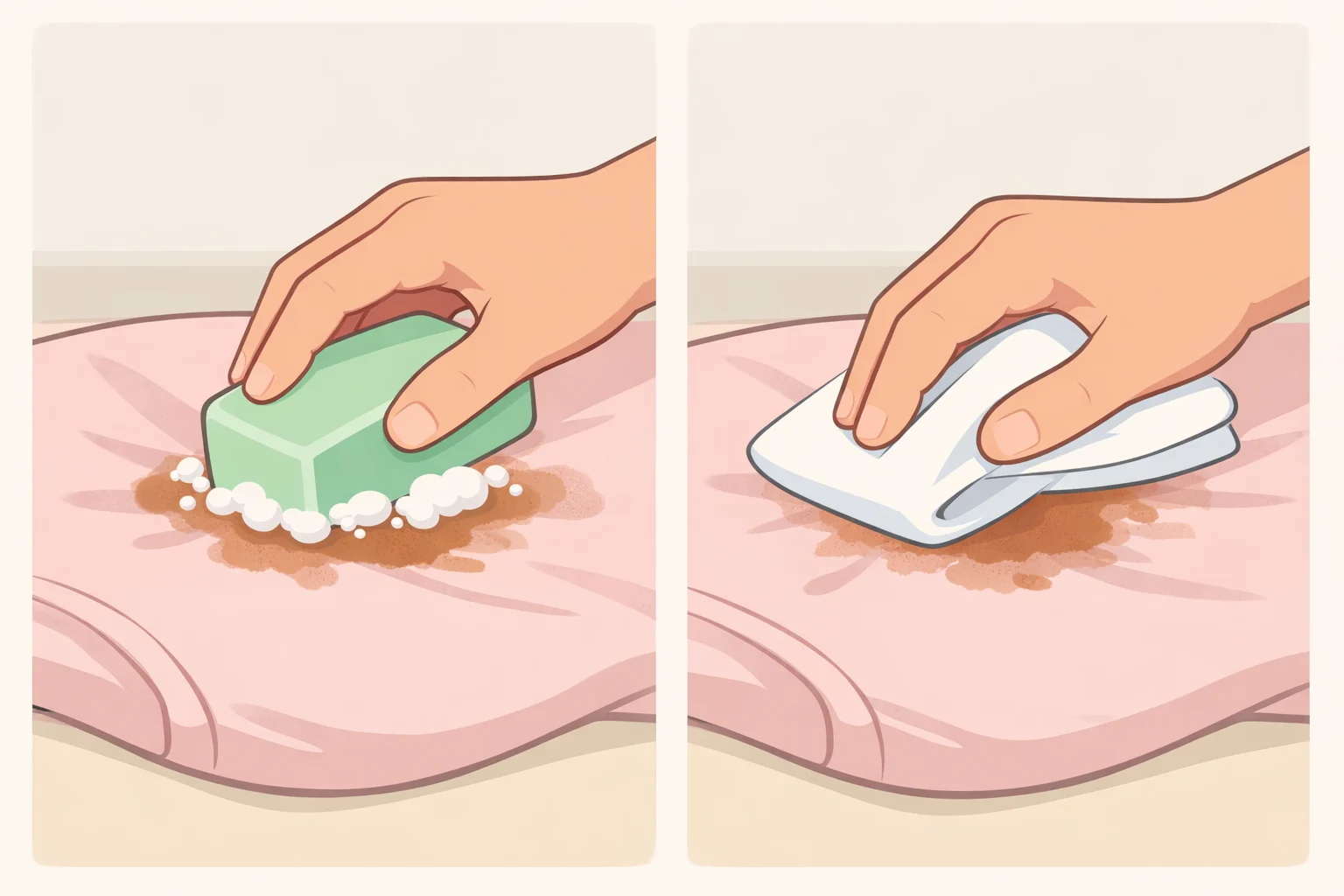
Fresh stains are the easier case, and this sequence works for most colorfast fabrics, sheets included (Good Housekeeping, 9 days ago). A fabric is colorfast if it doesn't bleed dye when treated with water or mild cleaning products; test a hidden seam first if there's any doubt (American Cleaning Institute, updated five months ago).
- Rinse or soak the stain in cold water right away. Do this as soon as you notice it. Sources consistently point to cold water as the first move on a fresh stain (American Cleaning Institute, updated four months ago; Good Housekeeping, 9 days ago). For a fitted sheet, rinse the stain from the back of the fabric rather than the front (The Dutchman's Laundry, roughly two years ago).
- Work in bar soap, a small amount of liquid detergent, or a dab of Dawn dish soap by hand. Dawn's grease-fighting formula can help lift a fresh stain, though set-in blood responds better to an enzyme detergent built for protein stains. Rub whichever you choose directly into the fabric, then rinse and repeat as needed (Good Housekeeping, 9 days ago).
- Blot rather than scrub once the soap is worked in. Sponging the fabric lifts the stain; rubbing spreads it and can damage fibers, which matters more across a full sheet than on a shirt cuff (American Cleaning Institute, updated five months ago).
- Launder per the care label, then inspect before drying. If any trace remains, repeat the soak-and-treat cycle rather than drying the sheets to see if it comes out anyway (American Cleaning Institute, updated four months ago).
How to get dried blood out of sheets
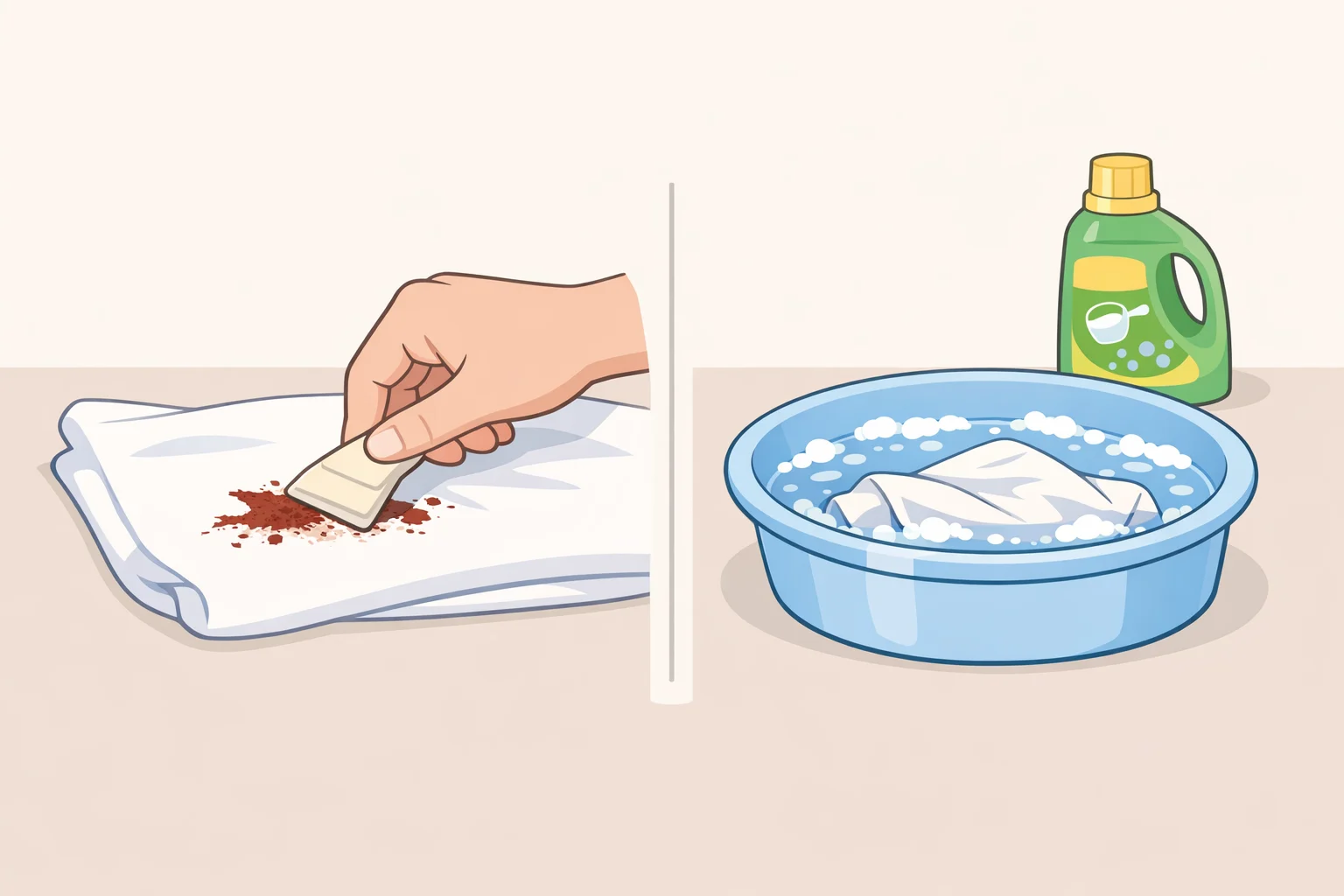
Dried blood takes more work, because the protein has already bonded to the fibers. Treat it as one unbroken sequence with a single escalation decision near the end, not a pile-up of every product at once.
- Scrape off what dried residue you can before adding any water. Wetting the stain first just pushes solid matter deeper into the weave, so start dry.
- Soak in cold water with an enzyme-containing detergent for several hours or overnight. Enzymes are formulated to break down protein, which is why plain detergent alone often falls short on set-in blood (Good Housekeeping, 9 days ago; American Cleaning Institute, updated four months ago). If the stain persists after that first soak, try presoaking longer, or mix a quart of water with a teaspoon of detergent and a tablespoon of ammonia for a stronger soak; keep this ammonia solution on a separate track from any peroxide treatment later on, since the two shouldn't meet (Good Housekeeping, 9 days ago).
- Give the sheet room in the machine. A sheet is a full-size load, not a small garment, and detergent can't work through the fabric evenly if the drum is packed tight (American Cleaning Institute, updated five months ago).
- Launder following the enzyme product's directions and the care label. This is the point where a warmer wash may be appropriate for a dried stain, distinct from the cold-only initial soak; check the label to see which temperature it allows (American Cleaning Institute, updated four months ago).
- If the sheets are colored, printed, delicate, or unfamiliar fabric, stop here. Repeat the soak and wash rather than reaching for peroxide or bleach, and test anything stronger on a hidden seam first if you decide to try it later (American Cleaning Institute, updated five months ago).
If the stain remains on fabric confirmed colorfast and washable, pick one escalation option rather than combining them:
- Spot-test standard 3% hydrogen peroxide on a hidden seam, watch for a color change for about a minute, then apply it briefly (a minute or a few, not an overnight soak) and rinse thoroughly before washing (The Dutchman's Laundry, roughly two years ago).
- Or rewash with a bleach labeled safe for the fabric (American Cleaning Institute, updated four months ago).
- If the sheets can't tolerate chlorine or non-chlorine bleach, use a dedicated stain treater instead, such as Carbona Stain Devils #4 (Good Housekeeping, 9 days ago).
"Pick one" means don't mix chemicals in the same treatment step, not that you're locked into that choice forever. If peroxide doesn't finish the job, rinse it out completely, launder, then try fabric-safe bleach as a separate, later attempt if the care label allows it.
Never combine hydrogen peroxide with chlorine bleach, vinegar, or ammonia-based cleaners in the same step. The Dutchman's Laundry flags this combination as one the CDC specifically warns against, so treat whichever option you pick as a standalone move, rinsed fully before anything else touches the fabric (The Dutchman's Laundry, roughly two years ago).
Expect to rewash and re-inspect before drying rather than assuming one round finishes the job (Good Housekeeping, 9 days ago). If a delicate, valuable, or care-label-restricted set still shows color after repeated soaks and one escalation attempt, it's worth stopping there and having it professionally cleaned rather than layering on stronger chemicals at home. No source sets a hard limit on how many rounds is too many; this is simply a matter of protecting the fabric once the standard steps have genuinely been tried.
If you already used hot water
It happens. The stain goes into a hot wash before anyone notices. The steps above are still worth trying, but full removal may no longer be possible once heat has set the stain (Good Housekeeping, 9 days ago). Start with the cold soak and enzyme detergent anyway. A faint shadow of a stain is sometimes the realistic best outcome, not a sign the technique failed.
What not to rely on
A few pantry fixes get repeated online without holding up well in practice.
- White vinegar. Carolyn Forté, former executive director of the Good Housekeeping Institute Cleaning Lab, says she's never found white vinegar particularly effective on blood stains, and undiluted vinegar can break down fabric fibers over time. If tried anyway, rinse it out completely before machine washing (Good Housekeeping, 9 days ago).
- Salt. It may absorb some fresh blood, but only if applied within seconds, and Forté notes it's unlikely to remove a stain that's already set (Good Housekeeping, 9 days ago).
- Toothpaste. It can treat a blood stain in a pinch, but it isn't recommended for sheets since it can further stain fabric and leave a strange smell behind. Stick with tested methods instead (Good Housekeeping, 9 days ago).
- Baking soda paste. Mix two parts baking soda with one part water, work it into the stain, and let it sit for 30 minutes before laundering. It's not the top recommendation, but it's worth trying if nothing else has worked (Good Housekeeping, 9 days ago).
Period blood
Period blood doesn't need a separate method. It responds to the exact same fresh-or-dried process described above, no special products or timing required (Good Housekeeping, 9 days ago).
The decision tree here is simpler than it looks once broken down: treat fresh stains immediately with cold water and soap, move to an enzyme soak the moment a stain has dried, hold off on the dryer until the mark is gone, and reach for peroxide, fabric-safe bleach, or a stain treater only as a single, last-resort step. Delicate or valuable bedding gets one shot at that escalation before professional cleaning becomes the safer call.