Easy Cowboy Caviar Recipe: A Make-Ahead Texas Caviar Formula
Cowboy caviar earns its keep at potlucks because almost none of the work happens on the day of the party. The dressing can be made up to two days ahead, the assembled salad holds for a full day before serving, and both America's Test Kitchen and Nutrition for ME recommend resting the finished salad for about an hour so the flavors have time to meld (Jessica Gavin; America's Test Kitchen). This easy cowboy caviar recipe walks through a source-based baseline, a framework for swapping ingredients without second-guessing, and a make-ahead timeline built around exactly when to prep each part.
America's Test Kitchen traces the dish, also known as Texas caviar, to Helen Corbitt, then the culinary director at Neiman Marcus in Dallas, who it says served it in the 1940s (America's Test Kitchen). Kathy's Vegan Kitchen tells a slightly different version of the same story, placing Corbitt's debut of the dish, then called pickled black-eyed peas, at a Houston Country Club New Year's Eve dinner in the 1950s (Kathy's Vegan Kitchen). Either account has the dish moving beyond Texas, and America's Test Kitchen notes it's now enjoyed across the country (America's Test Kitchen).
Hands-on prep runs about 15 to 20 minutes across recipe developers, and the published versions share a recognizable core: black-eyed peas, a second bean, corn, tomatoes, peppers, onion, cilantro, and lime (Kathy's Vegan Kitchen; Nutrition for ME; Jessica Gavin). Nutrition for ME's version is itself adapted from The Well Plated Cookbook by Erin Clarke, worth flagging since these are published recipes building on each other rather than three unrelated inventions (Nutrition for ME). Everything past that shared core gets treated as adjustable, which is really the point of the dish.
The easy cowboy caviar recipe formula: what's required, what's flexible
Video of the Day
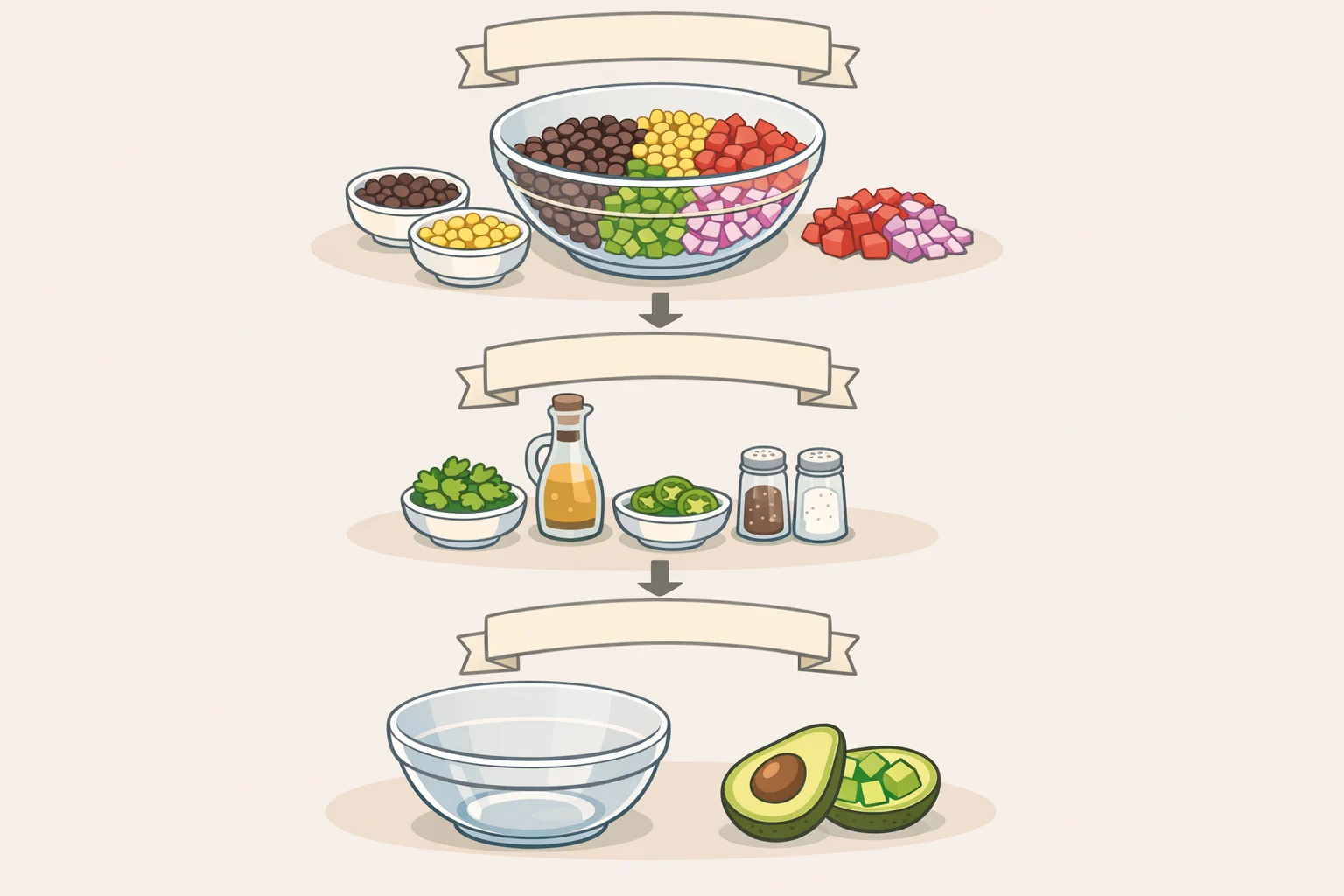
America's Test Kitchen describes a common version of the formula as black-eyed peas, red and green bell pepper, minced jalapeño, and scallions dressed with a tangy vinaigrette, though it notes that every cook has their own version (America's Test Kitchen). Treat that as one solid starting point rather than a fixed rule.
For this adaptable version, treat a few elements as the backbone: black-eyed peas paired with a second bean (black beans appear across the published versions, and Kathy's Vegan Kitchen also lists pinto as a swap), an acid in the form of lime juice or vinegar, and a mix of diced raw vegetables for crunch (Kathy's Vegan Kitchen; Nutrition for ME). That combination reads like a black-eyed pea and bean salsa dressed up as a salad, which is why it works equally well scooped with a chip or forked straight from a bowl.
Past that backbone, flavor builders vary by cook. Cilantro, cumin, garlic, and a sweetener appear in the two cited dressings, and honey and maple syrup both show up as the sweetener of choice, which makes a vegan swap simple (Jessica Gavin). Kathy's Vegan Kitchen recommends adding lime zest alongside the juice for extra freshness; it's a cheap addition worth trying (Kathy's Vegan Kitchen).
Heat is the most personal dial in the whole dish. Jessica Gavin's recipe describes cowboy caviar as mild by default and treats jalapeño along with optional chili powder as adjustments rather than fixed amounts, so cooks can scale the spice for their crowd (Jessica Gavin). Nutrition for ME's version includes cayenne pepper directly in its dressing rather than leaving all heat optional (Nutrition for ME), a reminder that the same base recipe can read mild or spicy depending on how it's dressed.
Avocado is best held back until serving rather than mixed in with everything else. It shows up as an optional addition in Jessica Gavin's recipe, folded in separately from the rest of the mix-ins right before serving (Jessica Gavin).
Once these tiers are familiar, a required backbone, flexible flavor builders, and a serve-last avocado, this stops being a single recipe card and becomes a formula that adjusts to whatever beans, peppers, or heat level happen to be on hand.
Video of the Day
A baseline recipe (about 7 cups, 14 servings)
This baseline follows the quantities Jessica Gavin published, with one substitution noted below; it's a source-based baseline rather than one tested for this article. Before starting, gather a large mixing bowl, a small bowl for the dressing, a whisk, and a cutting board. Canned beans and corn mean no stovetop is needed at all.
Base
- One 15-ounce can black-eyed peas, drained
- One 15-ounce can black beans, drained (pinto beans work as a swap, per Kathy's Vegan Kitchen)
- One 15.25-ounce can corn, drained
- To use fresh ingredients instead: swap in 1½ cups each of freshly cooked black beans, black-eyed peas, and corn (Jessica Gavin)
Vegetables (Jessica Gavin)
- 1 cup diced tomatoes, ¼-inch dice
- 1 cup diced bell pepper, red and green, ¼-inch dice
- ½ cup diced red onion, ¼-inch dice
- 1 tablespoon minced jalapeño
- 2 tablespoons chopped cilantro
Dressing (Jessica Gavin)
- 2 tablespoons lime juice
- 2 tablespoons red wine vinegar
- 2 tablespoons honey or maple syrup
- ⅓ cup olive oil
- ½ teaspoon garlic powder
- ½ teaspoon ground cumin
- ½ teaspoon kosher salt
- ¼ teaspoon black pepper
- ¼ teaspoon chili powder, optional
Optional finish
- 1 medium avocado, diced, added last (Jessica Gavin)
This yields about 7 cups; the source lists 14 servings at ½ cup each (Jessica Gavin).
Step-by-step method
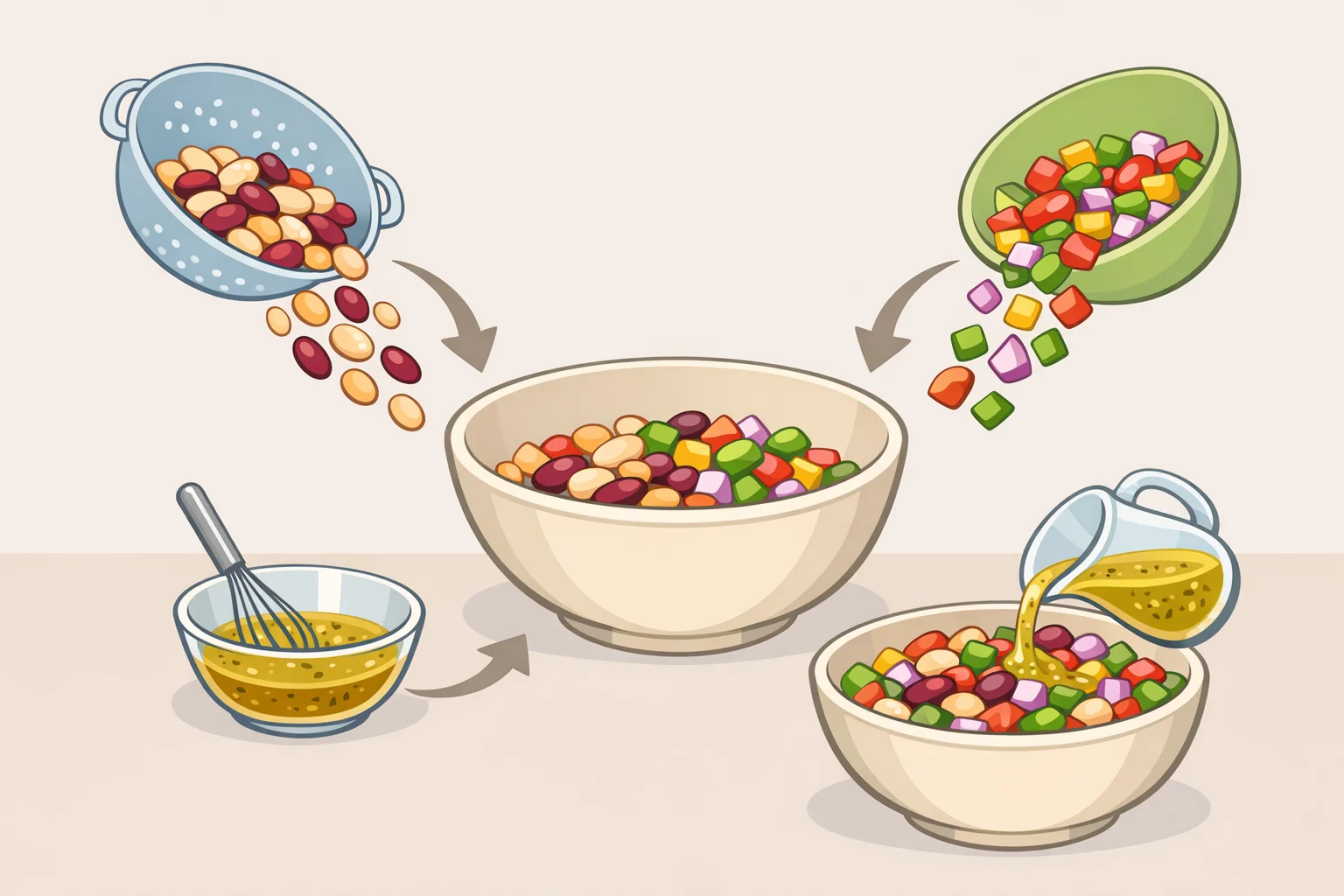
- Drain the canned corn, and rinse and drain the beans. Black-eyed peas, black beans, and corn all work from the can; pinto beans work as a swap for black beans (Jessica Gavin; Kathy's Vegan Kitchen).
- Dice the vegetables. Cut the bell pepper, red onion, jalapeño, and tomatoes into roughly ¼-inch pieces so every bite gets a bit of everything (Jessica Gavin).
- Combine the base. In a large bowl, mix the beans, corn, diced vegetables, and lime juice (Nutrition for ME).
- Whisk the dressing separately. Combine the vinegar, oil, sweetener, cumin, garlic, salt, pepper, and any optional chili powder in a small bowl (Nutrition for ME; Jessica Gavin).
- Pour the dressing over the base and toss, then add the cilantro. Nutrition for ME folds cilantro in at the end alongside the avocado; adding it here instead works fine if the avocado is being held back (Nutrition for ME).
- Refrigerate for about an hour, if possible, so the flavors can meld. America's Test Kitchen recommends this rest, and Nutrition for ME frames the same window as a step to follow "if time allows" rather than a strict minimum (America's Test Kitchen; Nutrition for ME).
- Fold in the avocado right before serving, if using. Jessica Gavin's recipe holds it back until the last moment rather than mixing it in with everything else (Jessica Gavin).
When to make it: a make-ahead timeline
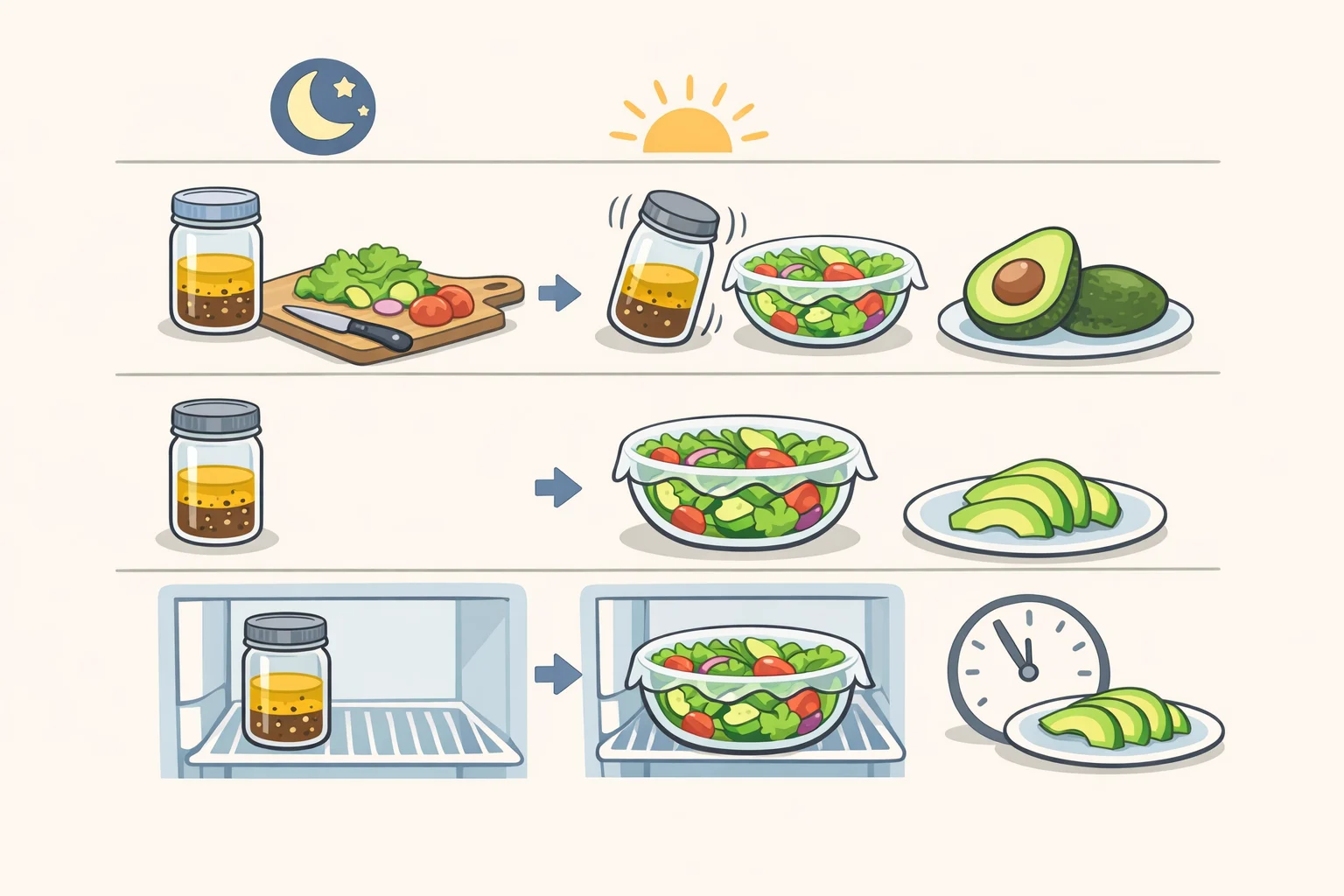
The method above takes about 15 to 20 minutes of hands-on work. What makes cowboy caviar useful for entertaining is how far the dressing, the assembled salad, and the avocado can each be staged ahead of a party.
- Up to 2 days ahead: make the dressing and store it separately from everything else (Jessica Gavin).
- Up to 1 day ahead: assemble the full salad, beans, vegetables, and dressing together, but hold the avocado back (Jessica Gavin).
- About 1 hour before serving, if possible: refrigerate so the flavors meld. America's Test Kitchen recommends roughly an hour, and Nutrition for ME describes the same window as worth doing "if time allows" rather than a strict minimum (America's Test Kitchen; Nutrition for ME). One recipe developer reported that an 8-hour rest made the flavors noticeably more intense; that's a single cook's observation rather than a tested rule, but worth knowing if the schedule allows for it (Kathy's Vegan Kitchen).
- Right before serving: fold in the avocado, if using it (Jessica Gavin).
- After the event: leftovers keep in an airtight container for up to 2 days (Jessica Gavin).
The cited recipes recommend resting the salad before serving, so there is little reason to leave the preparation until the last minute.
Substituting ingredients without breaking the dressing
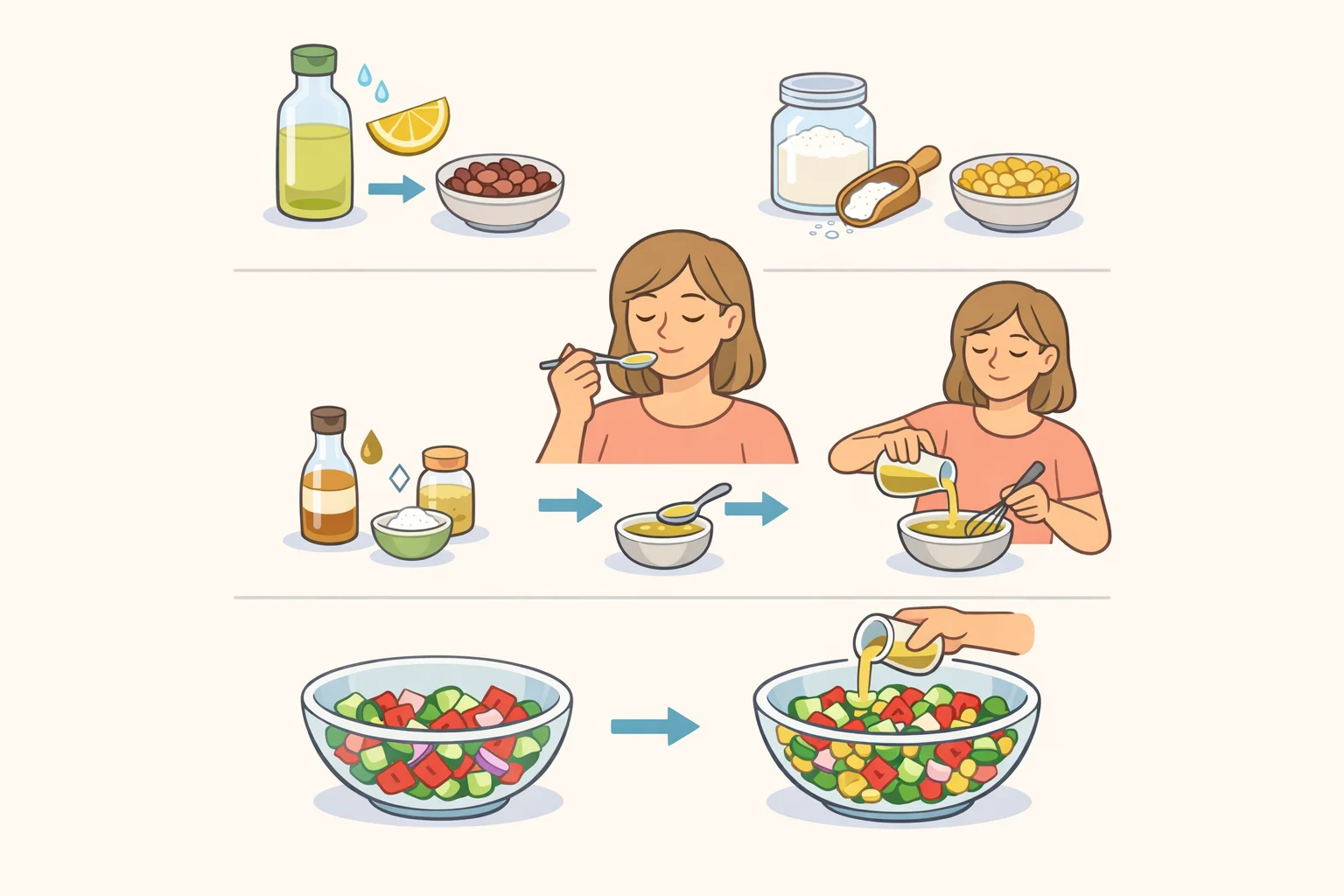
Swapping beans and corn is straightforward as long as the acid-to-oil balance in the dressing stays put. Kathy's Vegan Kitchen swaps pinto beans for black beans directly, and lists fresh corn (about four ears), frozen corn, or canned corn as interchangeable (Kathy's Vegan Kitchen). Jessica Gavin's recipe makes a similar trade in the other direction: replace all three canned staples, black beans, black-eyed peas, and corn, with 1½ cups each of the freshly cooked version (Jessica Gavin).
Because the vegetables and beans soak up most of the dressing's acid, changing their volume without adjusting the vinegar and lime juice can leave the salad tasting flat or too sharp. If a batch runs heavier on beans than the baseline calls for, taste the dressing on its own before pouring it over the base and adjust the vinegar or sweetener to match.
Cherry tomatoes are one ingredient that holds up fine mixed in early rather than saved for the end. Nutrition for ME halves them straight into the base with the rest of the vegetables instead of treating them as a garnish (Nutrition for ME), which is worth copying if tomatoes are going in the mix.
Serving a cowboy caviar dip recipe (and adjusting the batch size)
One of the simplest ways to serve this easy party dip is straight from a bowl with a basket of tortilla chips nearby (Nutrition for ME).
Treated as a cowboy caviar salad, it can be tossed with greens or served straight from the bowl alongside grilled food at a barbecue or picnic (Nutrition for ME; Kathy's Vegan Kitchen). It also works as a topping, spooned over tacos, baked potatoes, or a tofu scramble (Kathy's Vegan Kitchen). The dip and salad versions share the same base; only the vehicle changes, and a chip-friendly batch benefits from keeping the dice a little chunkier so nothing slips through.
Scaling the recipe up or down is easy in principle, since it's diced ingredients tossed together rather than layered or baked, though exact ratios for a doubled or halved batch haven't been tested here. The ½-cup serving size from the baseline recipe is a reasonable unit to plan around in either direction (Jessica Gavin).
For stricter diets, Kathy's Vegan Kitchen offers an oil-free, gluten-free version built on the same bean-and-vegetable core (Kathy's Vegan Kitchen). Calorie counts vary by recipe, from 231 calories per serving in one version to 263 in another, since oil, sweetener, and avocado content all shift the numbers (Nutrition for ME; Jessica Gavin). Treat any specific figure as tied to that particular version rather than to cowboy caviar as a whole.
Building a plan around it
Once the backbone is familiar, the only decision left is scheduling: how many days out to make the dressing, whether to assemble the salad the night before or the morning of, and how long to let it rest before the first chip goes in.
That plan looks the same regardless of the occasion: dressing two days ahead, full salad assembled the day before, avocado folded in at serving time. What changes is the vehicle, chips for a party, greens for a lighter meal, or a spoonful over tacos or a baked potato for a weeknight dinner. Pick the occasion first, then work backward from the serving time to decide when each step happens.