Costco vs Sam's Club membership comparison: fees, returns, and prices
Both Costco and Sam's Club advertise a "100% Satisfaction Guarantee," allow most returns without a time limit, and according to a price survey conducted earlier this year, sell the same 25-pound bag of white rice for exactly the same $0.88 per pound. The loyalists on each side tend to overstate the gap between these two warehouse clubs. But the gap is real, it's specific, and it falls in exactly the places that catch shoppers off guard.
Three shopper types drive most of the meaningful differences in this Costco vs. Sam's Club membership comparison: the budget grocery shopper, the electronics buyer, and the casual or first-time member. This analysis addresses each directly. One honest caveat upfront: food court pricing isn't covered here. Available sourcing on that topic is too inconsistent to anchor editorial claims.
At a glance: how the two clubs compare
Video of the Day

| Costco | Sam's Club | |
|---|---|---|
| Standard membership | $65/year | $50/year |
| Premium membership | $135/year (Executive) | $110/year (Plus) |
| Membership refundable | Yes, anytime | Yes, anytime |
| General merchandise return window | No time limit | No time limit |
| Electronics return window | 90 days | 90 days |
| Cell phone return window | 90 days | 14 days |
| Grocery pricing pattern | Cheaper on eggs | Cheaper on coffee, pantry staples |
| Best for | Electronics buyers | Budget grocery shoppers |
Video of the Day
Membership fees: Sam's Club is cheaper, but the math gets interesting
The base gap is $15 per year. Sam's Club's standard membership runs $50 annually; Costco's Gold Star membership is $65. That looks like a straightforward win for Sam's Club until you account for what each membership includes. Costco's $65 covers two household cards, so a couple sharing the membership pays roughly $32.50 each, per WRAL's February comparison. The research data doesn't detail Sam's Club's household card structure, so a direct per-person comparison isn't cleanly available, but the two-card inclusion at Costco is worth factoring in.
At the premium tier, the spread widens to $25. Sam's Plus costs $110 per year versus Costco Executive at $135, per WRAL. What fills that gap varies by how heavily a member uses each chain's premium perks. Verify current perk details at each chain before upgrading those specifics shift.
The more useful fact for anyone on the fence: both memberships carry essentially zero financial risk to try. Costco's official policy states the fee is refundable in full if a member is dissatisfied for any reason, no deadline attached, per Costco's official return policy. Sam's Club's satisfaction guarantee extends to the membership itself as well. Per StorePolicies, members can cancel and receive a full refund of the current year's fee at any time. One nuance worth noting from that same source: tier-downgrade refunds are limited to once per household per year, meaning outright cancellation is always honored, but cycling between Plus and standard to extract repeated refunds is not.
For the budget grocery shopper, Sam's Club's lower entry price is a genuine advantage. For the first-time warehouse shopper testing the concept, both memberships are equally low-stakes try either one, decide it's not for you, and walk away whole.
Costco vs. Sam's Club return policy: the biggest difference is phones
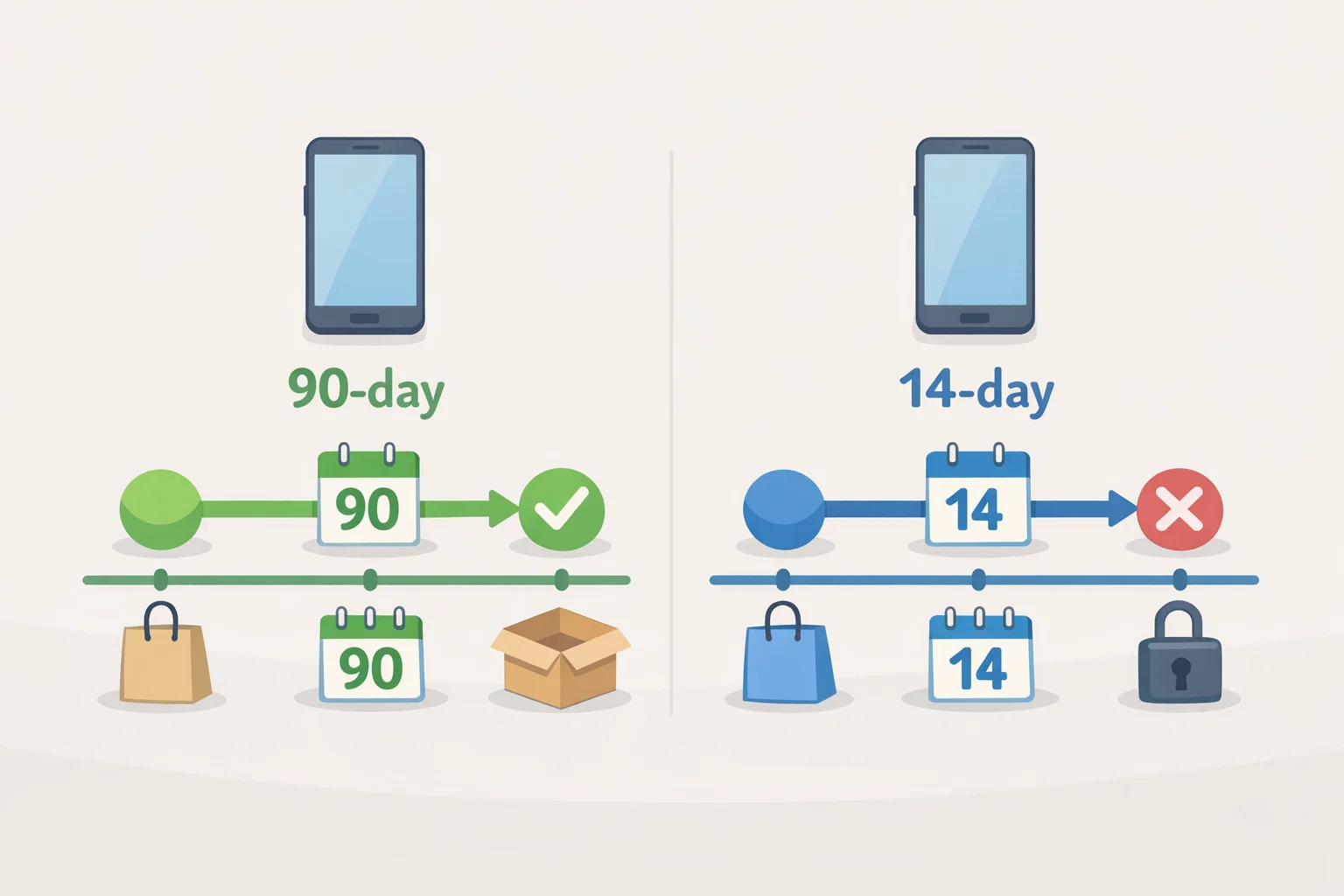
The shared foundation is stronger than most shoppers realize. Both retailers extend a no-time-limit satisfaction guarantee on most merchandise, and receipts aren't strictly required at either chain. At Costco, purchases are tied to membership accounts so staff can pull transaction history at the counter, per Costco's official policy. At Sam's Club, returns without proof of purchase are processed on a best-effort basis using membership information, per StorePolicies. Electronics and major appliances fall under a 90-day return window at both stores. For online purchases, the clock starts on the delivery date at both chains, not when the order was placed so delayed shipping doesn't quietly eat into your window, per ConsumerAffairs and StorePolicies.
Cell phones are where the two policies split sharply. Costco's 90-day window covers cellular phones explicitly, per its official policy. Sam's Club's window is 14 days, applying to prepaid, postpaid, and no-contract phones alike, per StorePolicies. That isn't a minor footnote. Fourteen days to discover a defect, initiate a return, and repurchase is genuinely tight particularly for anyone switching carriers or waiting on a number transfer to complete.
Third-party products add complexity at both stores, though in different ways. Items sold through Sam's Club Marketplace may follow the individual seller's return policy rather than Sam's Club's 100% guarantee, per StorePolicies. At Costco, the parallel carveout applies to special-order kiosk products and custom-installed items, which cannot be returned except for warranty failures, per Costco's official policy. These are distinct situations a marketplace third party versus a custom installation but the practical advice is the same: check the terms before buying through either channel's non-standard offerings.
Each store also carries hard exclusions. Costco's non-returnable list includes airline and event tickets, gift cards, precious metals, and cigarettes or alcohol where prohibited by law; tires and batteries fall under separate warranty programs rather than the standard return policy, per Costco's official policy. Sam's Club's exclusions cover gift cards, prepaid cards, tickets, prescriptions, custom-made items, and collectibles, per StorePolicies. In-store purchases at Sam's Club can only be returned at a physical club location, not by mail.
One unwritten rule at Costco is worth understanding. The chain tracks return frequency per account and can flag or revoke memberships for patterns it considers abusive. ConsumerAffairs reported earlier this year that, according to employee accounts, members who return more than half their purchases may be flagged though no official threshold is published. The "return anything, anytime" reputation holds for reasonable use. It's not a blank check.
For the electronics buyer, Costco's policy is materially stronger, especially on phones. For the casual member who occasionally returns a food item or household good, both policies are functionally equivalent in practice.
Costco vs. Sam's Club prices: what current grocery data shows
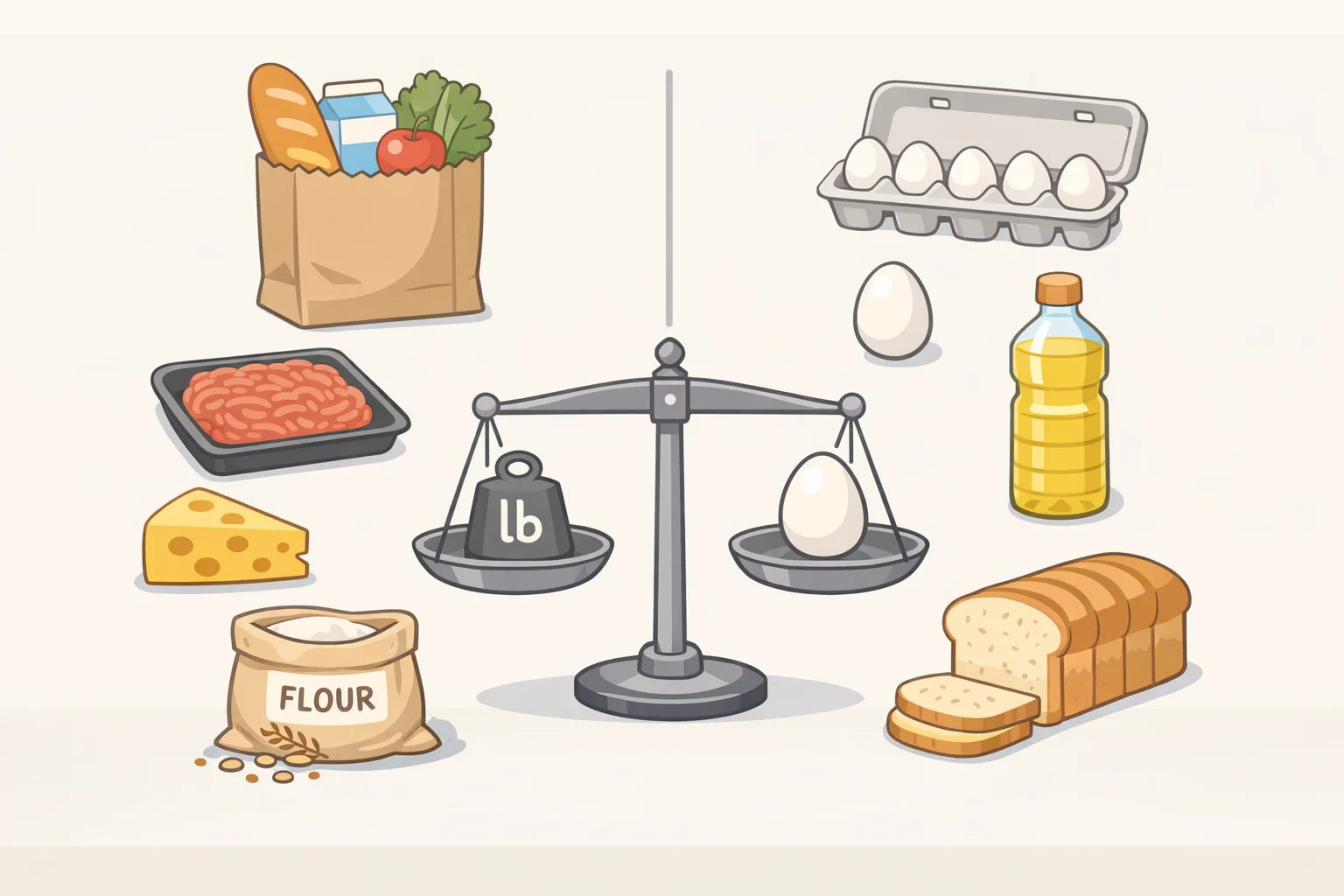
A WRAL price comparison conducted during the week of February 18–24 surveyed private-label store brands Kirkland Signature at Costco, Member's Mark at Sam's Club across grocery staples. The methodology was consistent but the scope was narrow: one week, one region, groceries only. It doesn't reflect national averages, household goods, apparel, or non-food categories.
The pattern that emerged is useful even with those limitations. Costco was cheaper on cage-free eggs, at $0.19 per egg versus $0.24 per egg at Sam's Club. Sam's Club held the advantage on pantry staples: ground coffee ran $6.79 per pound at Sam's Club versus $7.40 per pound at Costco, and standard peanut butter was $0.09 per ounce at Sam's versus $0.19 per ounce at Costco though Costco's version was organic, making that a comparison of different products rather than a clean price gap. Rice and butter were essentially tied: a 25-pound bag of white rice cost $0.88 per pound at both stores, and butter ran $2.11 per pound at Costco versus $2.13 per pound at Sam's Club, per WRAL's data.
WRAL noted explicitly that per-item savings need to be weighed against annual membership cost. A shopper saving $0.05 per egg at Costco on two dozen eggs per week saves roughly $60 per year more than enough to offset the $15 membership gap. But that math only holds if the buying pattern is consistent and those items actually appear in the cart regularly.
No broader basket analysis exists in the available verified sourcing. There's no household goods comparison, no regional variance data, no prepared-food pricing to draw from. The honest summary: Sam's Club wins on coffee and some pantry staples; Costco wins on eggs; most items land too close to call from this data alone.
A note on food court pricing
Searching for a Costco vs. Sam's Club food court comparison is common, and both chains have devoted followings on the topic. This article doesn't cover it. Available sourcing on food court pricing is too fragmented and inconsistent to support reliable editorial claims, and the item mix at each chain changes frequently enough that snapshot data ages quickly. Anyone making a membership decision primarily on food court value should seek out current, firsthand comparisons from their local stores.
How the tradeoffs shake out by shopper type
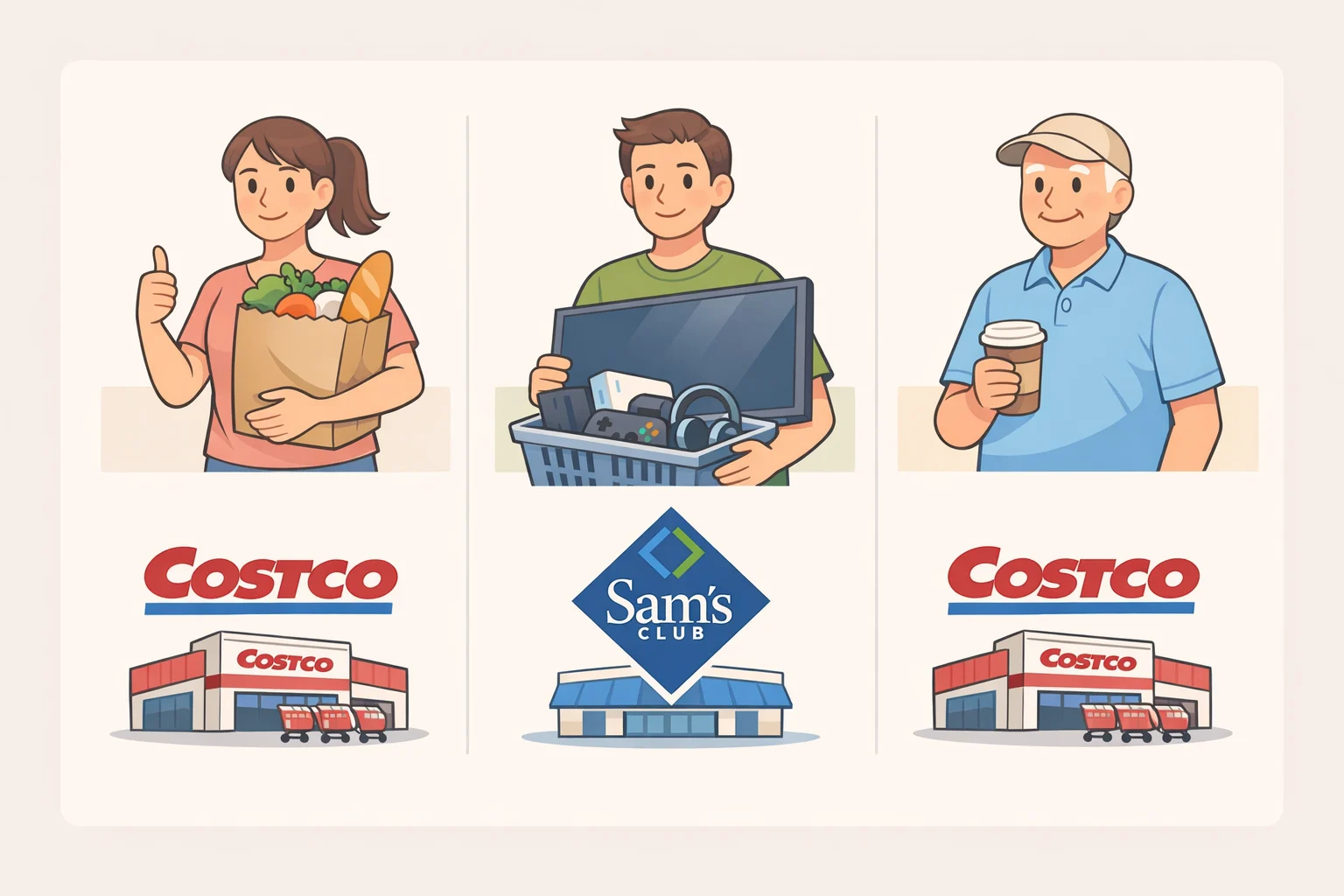
For the budget grocery shopper, Sam's Club has the stronger case. The lower membership cost $15 per year less at standard, $25 less at premium is a real advantage when grocery shopping is the primary use case. The price data available suggests modest but genuine savings on pantry staples over Costco, and the return policy for food and general merchandise is equivalent in practice.
For the electronics buyer, Costco's policy is materially better, particularly on phones. The 90-day cell phone return window versus Sam's Club's 14-day window is the single largest practical difference in this entire comparison, per Costco's official policy and StorePolicies. Whether that window matters depends entirely on whether the reader buys phones at a warehouse club. If so, the $15 annual membership premium is trivially justified by a single return situation that falls inside Costco's window but outside Sam's Club's.
For the casual or first-time member, the choice is genuinely a toss-up on financial risk. Both memberships are fully refundable, per Costco's official policy and StorePolicies for Sam's Club. The lower entry price at Sam's Club ($50 versus $65) makes it a marginally smaller initial commitment, but a Costco trial carries the same exit option. The practical tiebreaker here is proximity: which store is closer, and which carries products you already buy.
A simple check for the undecided: if you buy a phone or tablet from a warehouse club every two to three years, Costco's 90-day return window represents far more potential value than the $15 annual fee difference. If you never buy electronics from a warehouse club, that calculation flips Sam's Club's lower fee wins the membership cost comparison outright.
The verdict
Sam's Club is the better-value membership for shoppers whose warehouse spending skews toward food and household staples. The $50 entry price is lower, the return policy on general merchandise is equivalent to Costco's, and the available price data suggests it holds its own or edges ahead on pantry items, per WRAL.
Costco is the stronger choice for electronics buyers, especially anyone buying a phone from a warehouse club. A 90-day return window versus 14 days is a concrete consumer protection advantage the $15 annual membership premium doesn't come close to covering the exposure if that window ever matters, per Costco's official policy.
What both clubs share and what gets underappreciated in most of these comparisons is that the membership fee itself is fully recoverable if you change your mind. Joining either club to test it is a low-stakes experiment. The structural gaps worth watching for changes that would shift this analysis: the membership tier pricing spread, and that cell phone return window.