Mower Deck Height for Mulching Leaves: Use Max Every Time
Raise the mower deck to its highest position. That's the complete answer to the mower deck height for mulching leaves, and CSU Extension states it without qualification: highest setting, bagger removed, at least two passes. The deck height question is settled before you start the engine.
The harder part is reading the conditions around it. Leaf depth, moisture, and what the lawn looks like after mowing determine whether this process benefits the turf or quietly sets it up for winter damage. Get those conditions right and mulching leaves is less work than bagging with measurably better results. Get them wrong and you've traded one problem for another.
This guide walks through the readiness check, the correct mower setup, the two-pass method, and what to do when the result isn't right or the leaf load is too heavy to mulch in place.
What you need before starting: deck at maximum height, bagging attachment removed or mulching plug installed, dry leaves, and a leaf layer thin enough to see grass through. All four matter. The sections below cover each one and explain the adjustments when conditions aren't ideal.
Step 1: Check whether your lawn is ready to mulch
Video of the Day
Do this before touching the mower. It takes thirty seconds and determines whether you proceed, reduce the leaf load first, or redirect the excess entirely.
The check is visual: if grass blades are visible through the leaf cover, the layer is light enough to mulch in place. If the turf is completely hidden, the leaves will compress against it rather than nourish it. CSU Extension's GardenNotes puts the threshold plainly: visible turf means the layer is manageable.
University of Wisconsin research puts weight behind that rule. Lawn plots left with roughly 5 centimeters of leaf cover, with some grass still showing, fared better over winter than both bare lawns and heavily covered ones, according to GROW magazine. Those plots showed the least smothering and snow mold damage and the strongest turf quality and color going into spring. Most homeowners won't measure 5 centimeters, but the principle translates: the goal is moderate cover with visible grass, not burial.
Moisture matters as much as depth. CSU Extension notes that this process works significantly better with dry leaves. Wet leaves resist chopping and mat down on the turf after the mower passes, which recreates the same smothering problem you're trying to prevent.
Timing matters here too. Don't wait until the full season's drop has accumulated before making a first pass. A lighter load mulched every week or two is far easier on the mower and produces cleaner results than one heavy end-of-season session where everything is wet, dense, and overdue.
Before mowing, address conditions that aren't right:
- Damp leaves: wait one to two dry days before mowing
- Leaves matted flat from rain: break them up with a rake before the first pass
- Layer thick enough to hide the turf completely: rake the excess off and redirect it to garden beds or a compost pile, then proceed with what remains
Video of the Day
What height should a mower deck be for mulching leaves?
Maximum. Not one notch down, not "pretty high." On most walk-behind mowers, the height lever moves to its uppermost position; on riding mowers, the dial or selector goes all the way to the top stop. CSU Extension repeats this instruction across multiple publications without variation.
The reason it works: a high deck gives the mower more clearance to pull leaf material in without bogging down, while the blade still generates enough turbulence to break fragments apart. A lower setting pinches the blade too close to the turf and tends to produce clumps rather than the confetti-sized pieces that can actually filter between grass blades.
Once the deck is set, remove the bagging attachment entirely. Mulching works by keeping leaf fragments circulating under the deck for repeated contact with the blade. A bag stops that recirculation immediately. If the mower has a dedicated mulching plug or rear-discharge block-off plate, install it before the first pass.
If the mower has a mulching mode, use it. Ohioline notes that mowers with a dedicated mulching function chop material into finer, faster-decomposing pieces than standard cutting modes. A standard mower without one can still do the job, but it may need additional passes to reach the same result.
One thing the deck height setting cannot compensate for is a leaf load that's simply too heavy for the equipment. If the mower labors visibly mid-pass, the layer is more than it can process cleanly at that depth. Stop, rake the area shallower, and restart. Pushing through a heavy load produces worse results and strains the motor.
How to mulch leaves with a lawn mower: the two-pass method
First pass
Mow in straight, slightly overlapping rows the same way you'd cut for a normal turf pass. After this pass, leaves will be partially reduced but still recognizable as fragments, maybe half-leaves or quarters. That's expected. One pass is not enough to finish the job.
Second pass
Cross perpendicular to the first, 90 degrees off your original lines. CSU Extension recommends at least two passes as the baseline, with this crossing pattern sending fragments back under the blade for further reduction. Heavier loads may need a third pass to get there.
What success looks like
After the final pass, leaf material should be broken into small, irregular pieces sitting at or below the top of the turf canopy, not lying visibly on top of the grass blades. Run a hand across the surface: if your fingers reach the soil level without catching on leaf clumps, the material has settled into the canopy and will begin breaking down over the coming weeks. That's the outcome to aim for.
Troubleshooting when the result isn't right
Clumping after mowing: Leaves were likely damp, or the load was heavier than two passes could handle. Add another pass first. If clumps persist, redistribute them with a light rake. Don't leave leaf mats sitting on the turf heading into cooler weather. The Wisconsin research identified compressed leaf layers as the specific condition tied to smothering and snow mold damage over winter.
Mower stalling or laboring mid-pass: The leaf layer is too deep for the equipment at this setting. Stop, rake the area shallower, and restart. There's no benefit to forcing it through.
Fragments still sitting above the canopy after multiple passes: The leaf load was likely too heavy for the mower to process thoroughly. Rake some material off the area, then make another full pass at maximum deck height. The GardenNotes guidance points to small pieces that filter into the turf as the goal; if you're not getting there with the current load, reduce the load rather than lower the deck.
Thick or waxy leaves: Dense leaf drops from oaks take more passes than thin maple or birch leaves. The same process applies, but budget an extra pass and wait for a run of dry days before starting if possible.
When the leaf load is too heavy to mulch in place
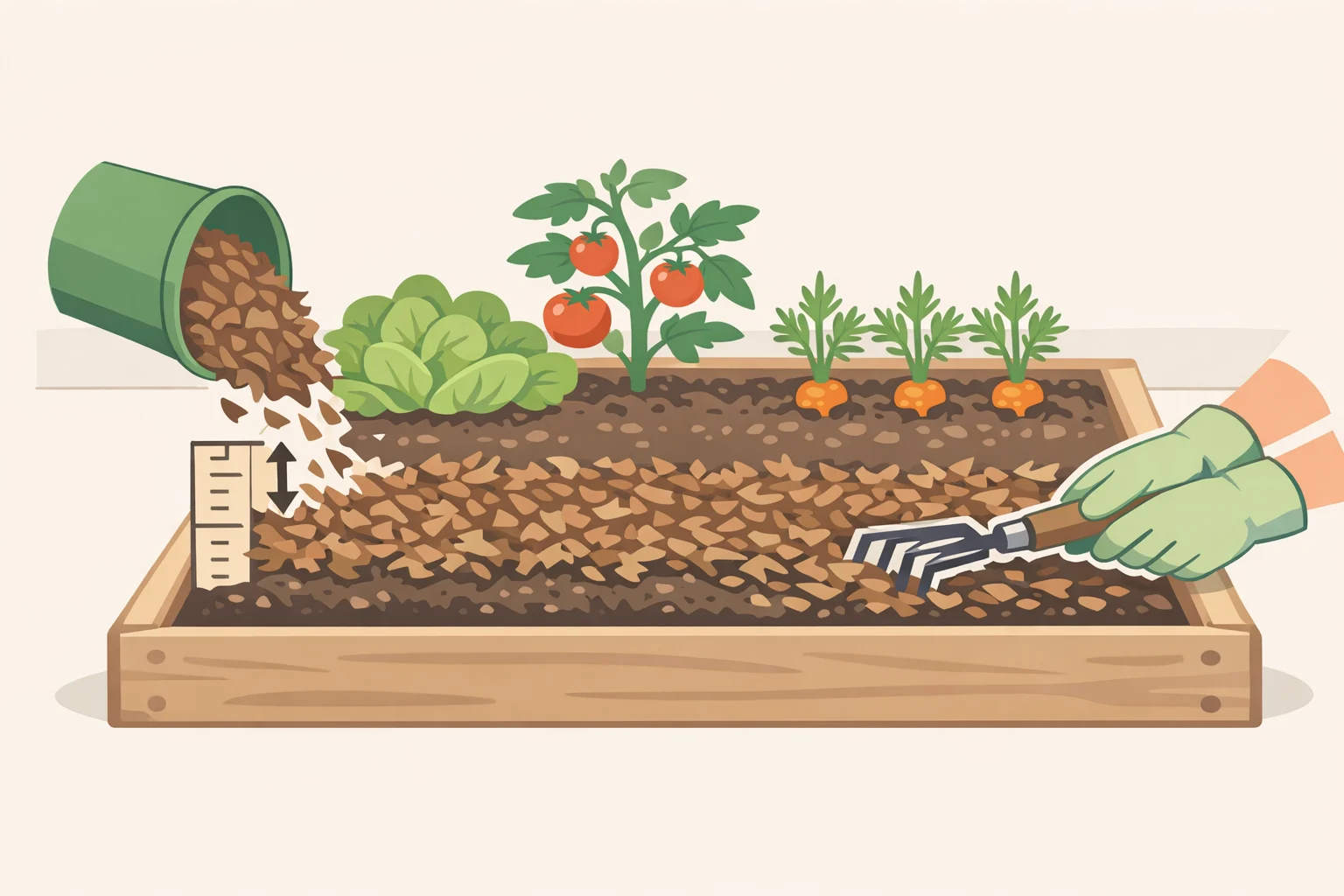
If the turf is completely buried before you start, mulching in place is the wrong call. Proceeding anyway risks leaving a compressed mat of leaf material on the lawn surface, which is exactly the scenario GROW magazine identified as damaging to winter turf health.
Excess leaves aren't waste. CSU Extension recommends running them through the mower first, then spreading a 6 to 8 inch layer directly into vegetable garden beds, where they break down over winter and improve soil structure going into the next growing season. For perennial plants and shrubs, 3 to 6 inches applied around the base works as insulating mulch that also adds organic matter by spring. CSU Extension's GardenNotes describes placing shredded leaves inside a wire cage around individual plants at the same 3 to 6 inch depth for cold protection.
Running excess leaves through the mower before redirecting them is worth the step. Chopped material is easier to spread, compacts less under winter precipitation, and integrates into bed soil more readily than whole leaves piled raw.
For leaves that can't be used on the property at all, composting is the next option, though that's a separate process.
Deck height is fixed. Read what's in front of the mower.
Set the deck to maximum. That part doesn't change, and CSU Extension and its GardenNotes publications repeat it consistently. The setup is simple.
What the setting can't do is make up for the wrong conditions. Wet leaves, a buried lawn, or a mower pushed through a load it can't process produce outcomes that range from useless to damaging. None of those failures are hard to avoid once you know what to look for.
The Wisconsin findings are the useful benchmark: moderate leaf cover with visible turf, managed correctly, produces lawns that come out of winter with stronger color, less disease damage, and better overall turf quality than both bare lawns and overloaded ones. That result is available on any lawn where the conditions are managed before and after each pass. Done right, mulching leaves takes less time than bagging and leaves the lawn in better shape for spring.
For excess leaves redirected off the lawn, see related guides on fall garden bed preparation and backyard composting.