Household Cleaners You Should Never Mix: Bleach Risks Explained
The rule is short. Never mix bleach with ammonia or any other cleaner. That is the CDC's position, stated without qualification. What follows is the explanation that makes the rule stick, because the accidents that send people to poison control centers rarely involve someone deliberately combining chemicals. They involve someone cleaning a bathroom in two steps.
Household cleaners you should never mix with bleach include toilet bowl cleaners and other acid-based products, plus ammonia-based sprays common items under most sinks. In 2016, the American Association of Poison Control Centers tracked more than 6,300 chlorine exposures in a single year, making chlorine the most commonly reported inhaled irritant in the United States, according to StatPearls/NCBI. About 35% of those cases came from one specific act: mixing a household acid-based cleaner with bleach. Not in a factory. In a bathroom.
The two combinations that cause the most harm
Video of the Day
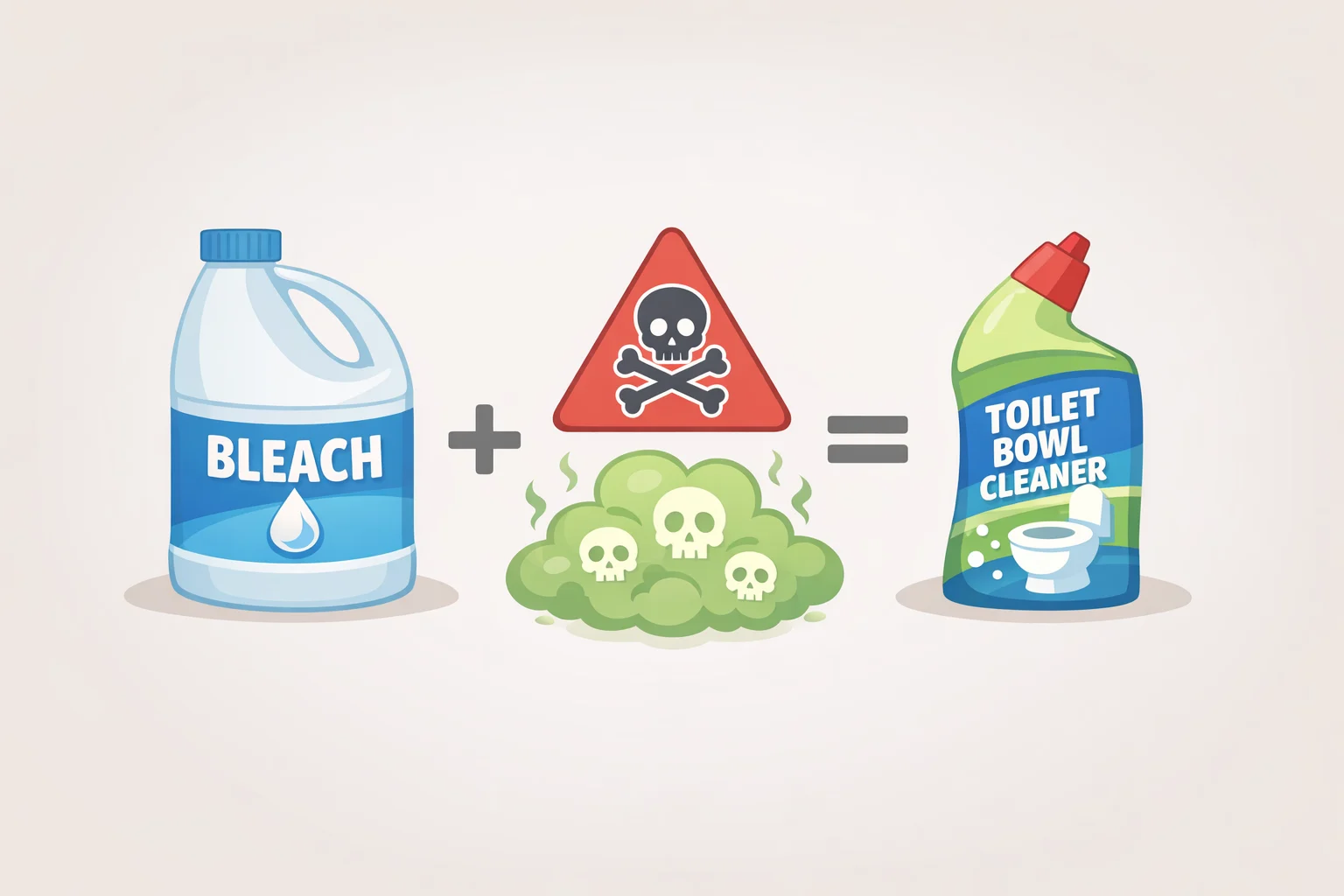
Most household bleach contains sodium hypochlorite as its active compound. That is the term safety and medical literature uses consistently, and it is what reacts with certain other cleaners to produce toxic byproducts. Two product categories account for the documented risk.
Acid-based cleaners, especially toilet bowl cleaners. Medical literature names toilet bowl cleaners as one of the most dangerous products to combine with bleach the acid reacts with hypochlorite and releases chlorine gas, per StatPearls/NCBI. Rust removers and descaling products carry the same risk because they share the same chemical profile: a strongly acidic formulation. If a product is marketed for cutting through mineral deposits, rust, or lime scale, treat it as incompatible with bleach.
Ammonia-based cleaners. Many glass cleaners and multi-surface sprays contain ammonia. The CDC warns that household ammonia can release toxic gas when mixed with other cleaning products. Check the ingredient list for "ammonia" or "ammonium hydroxide" before using any spray in a space where bleach has already been applied or is about to be.
The impulse to combine products is not careless. Medical researchers note that people mix chemicals in pursuit of a reasonable goal: stronger disinfection, faster fumigation, more thorough cleaning, as StatPearls/NCBI documents. The assumption is that two cleaners together do more than either does alone. The chemistry does not cooperate. Instead of a cleaner surface, the combination produces a toxic reaction that neither product label describes or prepares you for.
Understanding what bleach actually is helps here. It is reactive by design that reactivity is what makes it effective as a disinfectant. But the same chemical properties that let it break down pathogens make it unstable when it encounters certain compounds. It is not a neutral carrier that amplifies whatever it is mixed with. It is a reactive agent that changes chemically when combined with an acid or an ammonia-based compound, and what it changes into is not a stronger cleaner.
Video of the Day
What the reaction produces and what it does to your lungs
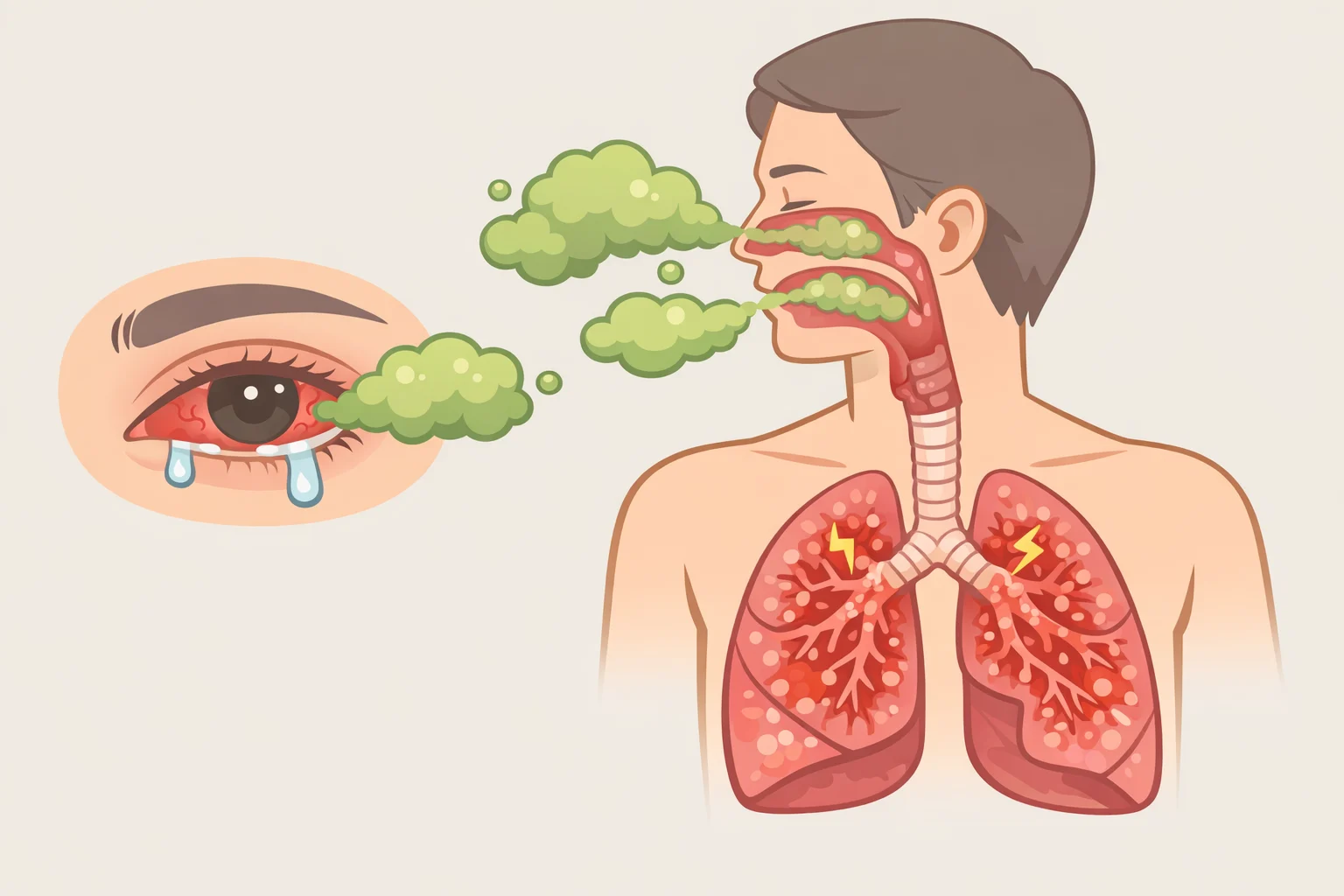
When hypochlorite contacts an acidic cleaner, the reaction releases chlorine gas. Medically, chlorine gas is classified as an asphyxiant: it interferes with the body's ability to take in oxygen, per StatPearls/NCBI. Mixing bleach with products that contain acid or ammonia is the most common at-home source of chlorine gas exposure, according to StatPearls/NCBI, and roughly 35% of all recorded cases are attributed to exactly that combination.
The mechanism of harm is specific and worth understanding. When chlorine gas contacts moist tissue in the eyes or lungs, it forms hydrochloric acid directly on that surface, as StatPearls/NCBI explains. That acid damages tissue, causes airway injury, and can lead to asphyxiation and death. The smell is alarming, but it is not the hazard the gas itself is the corrosive agent. Think of it as acid forming on the lining of your lungs rather than on a countertop. The damage is not a side effect of irritation; it is the chemical reaction itself.
A small, poorly ventilated bathroom concentrates that effect quickly. There is no safe threshold of exposure to manage by cracking a window after the fact.
For bleach-ammonia combinations, the CDC confirms that mixing the two can release toxic gas and states plainly that no known cure exists for ammonia exposure treatment is supportive, not corrective. A hospital can manage symptoms; the exposure itself cannot be undone. That distinction matters for how seriously you take prevention versus response.
Even without mixing, bleach used in an enclosed space requires adequate ventilation, according to StatPearls/NCBI. Open a window and run an exhaust fan as a baseline whenever bleach is used indoors. That is the floor for safe use, not an extra precaution reserved for worst-case scenarios.
Why these accidents happen during ordinary cleaning routines
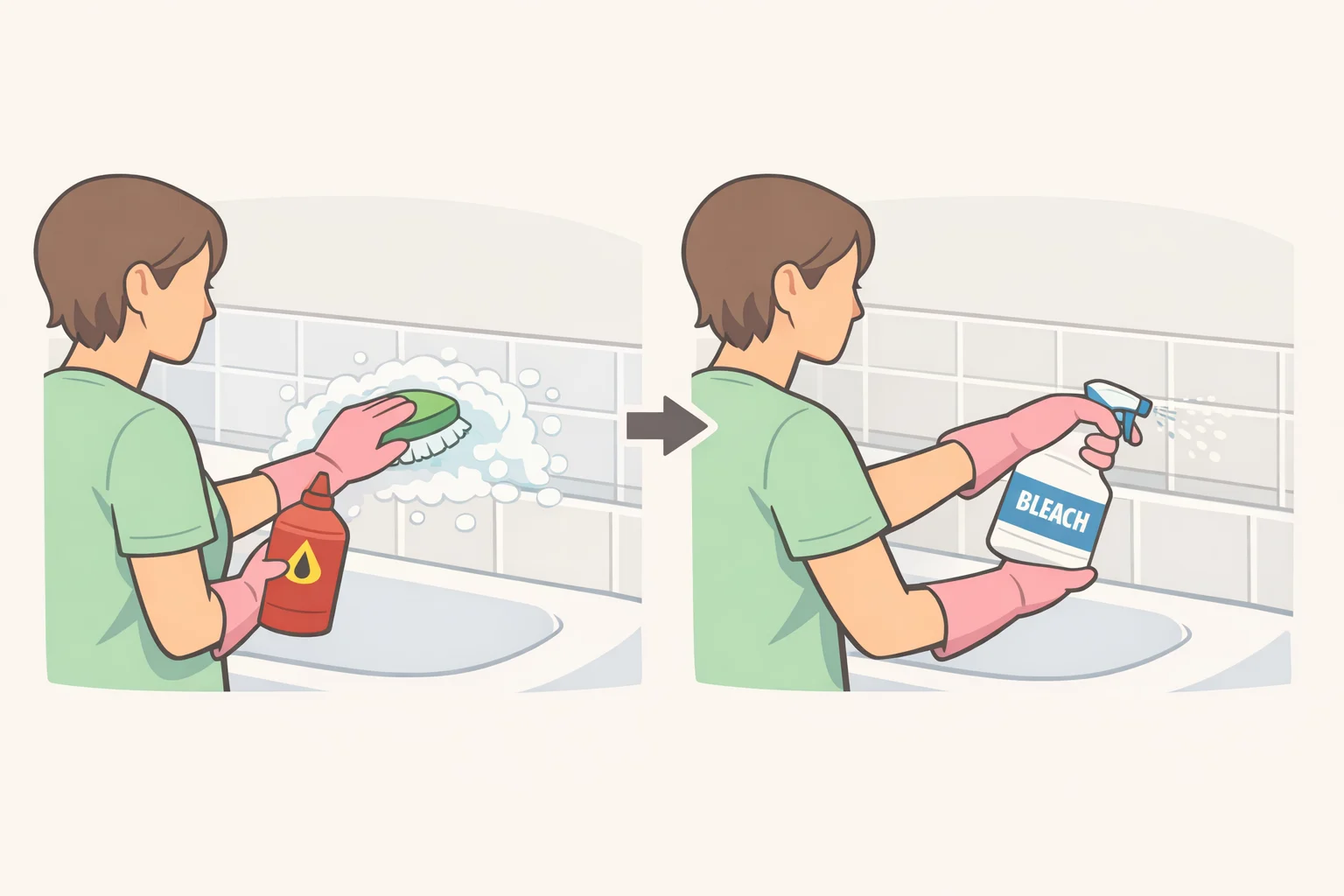
The exposure scenarios most likely to cause harm are sequential, not intentional. Someone scrubs a toilet with a bowl cleaner, then sprays bleach on the surrounding tile without rinsing first. The acidic residue from the bowl cleaner and the bleach never need to be deliberately combined wet surfaces in proximity are enough to trigger a reaction. The person cleaning the bathroom never mixed anything. They just moved from one product to the next.
In a mold remediation scenario, the sequence runs differently but the result is the same. Bleach is frequently reached for during mold cleanup. If a multi-surface spray containing ammonia has already been applied to the same wall or surface, the person adding bleach has no obvious signal that a second reactive compound is already present. There is no visible indication of the earlier product, no smell that distinguishes it from normal cleaning odors until the reaction is already underway.
These are not edge cases. They are the documented pattern, and they share a structural feature: the person cleaning has already moved past the moment of risk before they recognize it as one. That is why the sequence of products matters as much as the products themselves.
Medical researchers point to a follow-on problem that compounds the original accident. People who do not understand why an accidental exposure occurred are likely to repeat the same conditions, per StatPearls/NCBI. The accident gets repeated because it was never recognized as one it was just a cleaning day that ended with a headache and watering eyes. If the connection between the products and the symptoms is not made, nothing about the next cleaning session changes.
Consumer education about the risks of mixing cleaning chemicals is listed in medical literature as one of three primary national strategies for reducing chlorine gas exposures, alongside industrial safety protocols and rail transportation safety, per StatPearls/NCBI. Placing household knowledge alongside industrial and infrastructure concerns is a deliberate framing it reflects how significant the gap is considered in public health terms. The research also notes that health professionals play a specific role in educating patients after accidental home exposures, precisely because that conversation is where the pattern can be broken.
How to use bleach safely, and what to do if something goes wrong
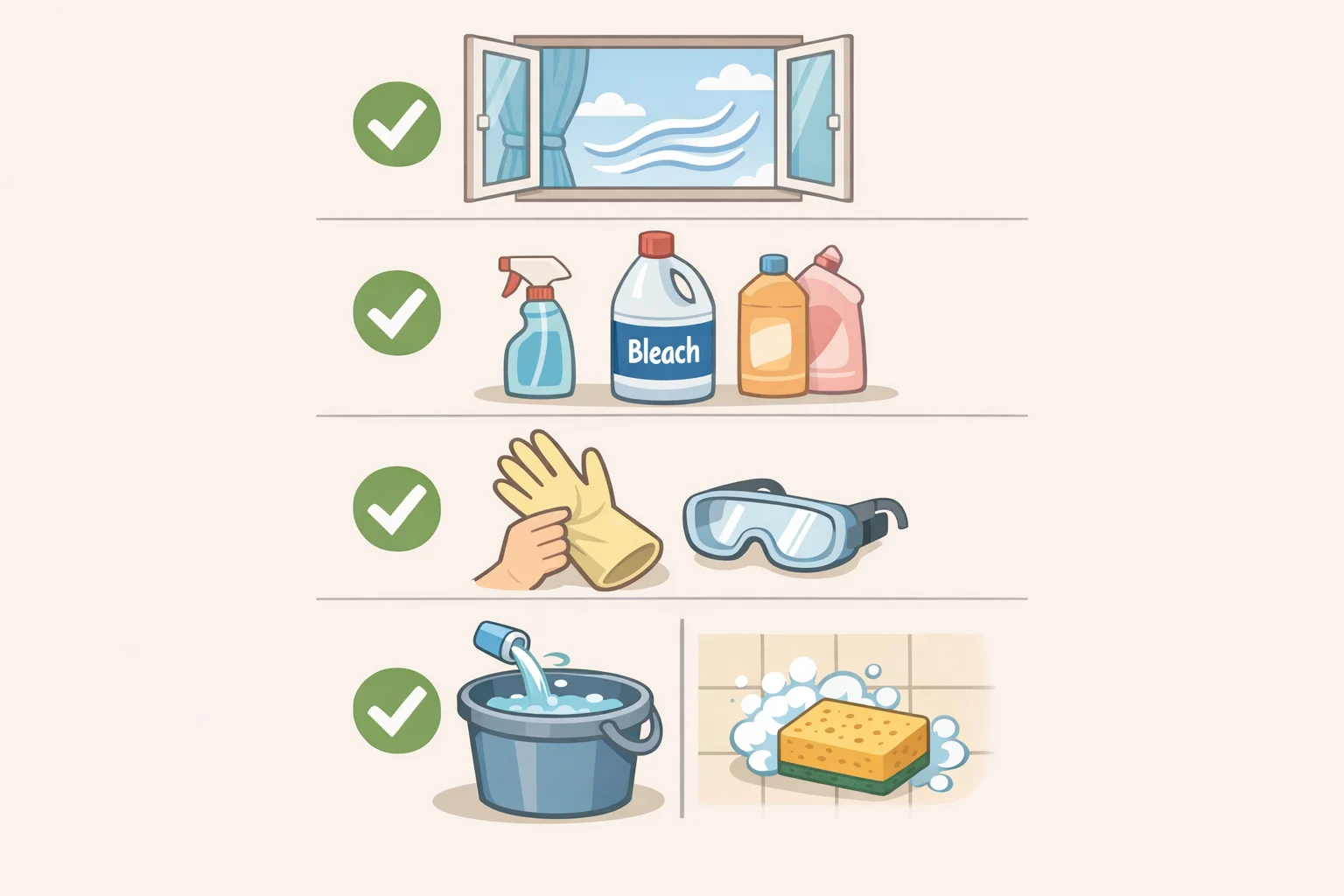
The protective rules the research supports are short. None of them require new equipment or different products.
Use one product at a time. Both the CDC and bleach toxicity literature state the rule plainly: do not mix household cleaners, per StatPearls/NCBI. Choose one product for a surface. Do not layer a second on top, even after the first appears dry. "Appears dry" is not the same as "fully rinsed and gone" residue remains.
Ventilate every time bleach is used indoors. Adequate ventilation is required whenever bleach is used in an enclosed space, per StatPearls/NCBI. Open windows and run the exhaust fan before starting, not after you notice irritation. The goal is air movement throughout, not airing out afterward.
Check labels before switching products. If an earlier product in your cleaning sequence was acid-based (toilet bowl cleaner, rust remover, descaling product) or contained ammonia or ammonium hydroxide, it should not come into contact with bleach. Rinse the surface thoroughly and allow time for ventilation before introducing bleach. Reading the label once, before the first use, is simpler than tracking what has already been applied to a surface.
Tell everyone in the household. Educating people after an accidental exposure is essential because uninformed repeat exposure is a documented outcome, per StatPearls/NCBI. That logic applies before any exposure happens. If multiple people reach into the same cleaning cabinet, all of them need to know which combinations to avoid. One informed person in a household does not fully solve the problem.
If exposure happens, the following reflects standard safety guidance and goes beyond the specific research cited in this article:
- Leave the area immediately and move to fresh air.
- Call U.S. Poison Control at 1-800-222-1222 for guidance on whether emergency care is needed.
- Difficulty breathing, eye pain, or chest tightness is a 911 situation, not a wait-and-see one.
- Do not re-enter the space until it has been thoroughly ventilated and cleared.
The fix is simpler than the hazard suggests
No new products are needed, and the rule does not require memorizing chemistry. Acid-based cleaners and ammonia-based cleaners should not contact bleach on the same surface, in the same room without rinsing, or in the same container. One product at a time. Check labels before switching. Open a window whenever bleach is in use.
Medical researchers identify consumer education as the primary lever for reducing household chlorine gas exposures, per StatPearls/NCBI. Knowing what not to mix, and passing that knowledge to anyone else who shares the cleaning cabinet, is the intervention. The CDC's full bleach guidance and its ammonia fact sheet are the authoritative references for anyone who wants the complete official picture on either topic.