Prosciutto Melon Skewers: Prep Ahead Without Soggy Results
Prosciutto melon skewers take about 15 minutes and five ingredients to assemble, no cooking required (Fresh Apron, 2025). The flavor logic behind them is centuries old: prosciutto e melone, the two-ingredient Italian pairing rooted in Emilia-Romagna and Tuscany, works because the salt of the meat and the sweetness of the melon sharpen each other (Chef Denise, 2026). The skewer format converts that classic combination into a bite-sized appetizer.
The problem most people run into has nothing to do with the recipe itself. Melon releases moisture as it sits, drained mozzarella still carries liquid, and balsamic glaze runs the moment it meets a wet surface. Sources consistently recommend drying the melon and mozzarella thoroughly before assembly and waiting until serving to add any glaze, because the skewers get wetter as they sit (Fresh Apron, 2025; Wholesome Yum, 2026). Skip those steps and the prosciutto goes limp, the platter looks tired, and a straightforward appetizer turns into a salvage operation. Manage them and the skewers hold cleanly, either assembled day-of or, with careful prep, up to 24 hours in advance.
This guide covers a reliable base build, a make-ahead workflow with honest timing guidance, and a short set of variations for once the fundamentals are solid.
Prerequisites: You'll need 3-4 inch bamboo cocktail picks (toothpicks work but make for awkward handling at a party), paper towels, and a serving platter large enough to hold the skewers in a single layer (Fresh Apron, 2025).
Ingredients: what to buy and how much
Video of the Day
The default modern build uses five ingredients: cantaloupe, prosciutto, fresh mozzarella (ciliegine size), basil, and balsamic glaze. The traditional Italian version stops at two, melon and prosciutto only, and produces a cleaner result with fewer moisture complications (Chef Denise, 2026). Which version you choose should be a deliberate call. See the decision framework at the end of this section.
Base ingredients for approximately 20 skewers:
- 1/2 medium cantaloupe, peeled, seeded, cut into 1-inch cubes
- 4-8 oz thinly sliced prosciutto (see note below)
- 8 oz fresh mozzarella, ciliegine size, drained omit for the traditional build
- 20 fresh basil leaves omit for the traditional build
- Balsamic glaze, for drizzling at service only omit for the traditional build
On prosciutto quantity: The spread across sources is wide and matters for shopping. Fresh Apron (2025) uses 4 oz for 20 skewers with torn, loosely folded pieces. Wholesome Yum (2026) uses 12 slices for 24 skewers with accordion-folded half-slices. Chef Denise (2026) notes that wrapping cubes or cutting slices in half for a full 24-piece batch pushes the requirement closer to a pound. The practical rule: a folded ribbon onto a pick uses far less than a fully wrapped cube. Decide your style before you shop.
On melon variety: Use ripe but firm cantaloupe as the default. It holds its shape on a pick and its sweetness balances the prosciutto's salt directly (Fresh Apron, 2025). Honeydew is a solid second choice with a milder flavor and useful visual contrast. Watermelon works in terms of flavor but is softer and wetter, which complicates threading and adds to the moisture problem. Bon Appétit (2022) makes the case that the broader principle, sweet melon against salty cured meat, holds across cantaloupe, honeydew, and watermelon. The flavor logic is flexible; the texture requirements for skewers are not.
Traditional vs. modern a quick decision framework:
- Choose the 2-ingredient build (melon + prosciutto only) when you want the simplest prep, the most portable result, and the longest safe holding window. Fewer wet ingredients means fewer moisture problems.
- Choose the 5-ingredient build (add mozzarella, basil, balsamic glaze) when you want a fuller appetizer bite and have time to execute the drying steps carefully. The additional flavors and textures are worth it; so is the higher margin for error.
Video of the Day
How to make prosciutto melon skewers that stay firm
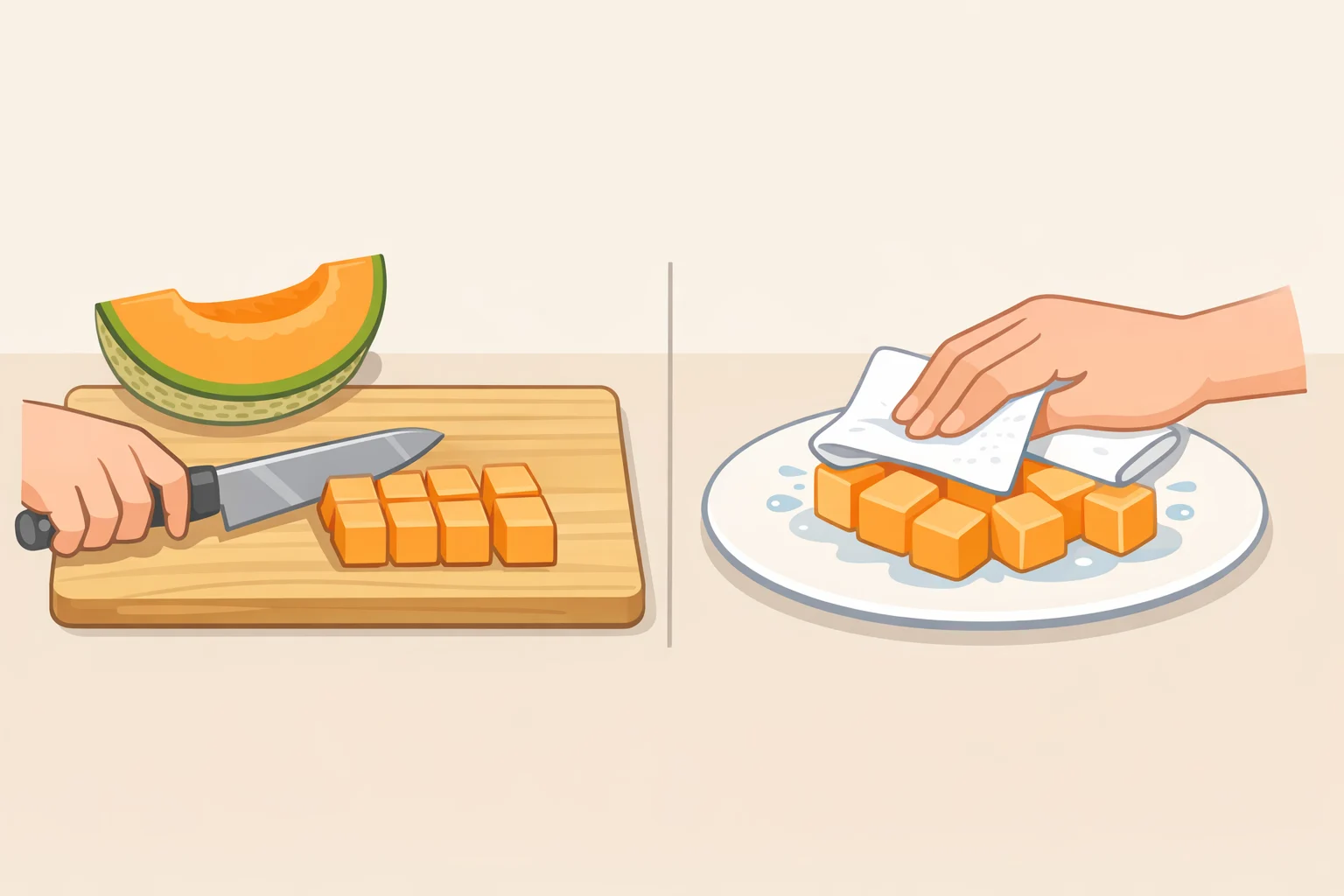
Assembly runs about 15 minutes (Wholesome Yum, 2026; Fresh Apron, 2025). Most of that time is cutting and drying. The drying is where people skip ahead and regret it.
Step 1: Cut the melon into uniform 1-inch cubes. Skip the melon baller. Cubes save time and are easier to cut to a consistent size, which matters for how the skewer sits on the platter (Fresh Apron, 2025). After cutting, spread the cubes on a paper towel and press another on top. Pat firmly. Set them aside to continue drying while you prep the other components.
Step 2: Drain and dry the mozzarella. Pour off the brine, spread the ciliegine on a paper towel, and press lightly. Sources consistently flag wet mozzarella as a contributor to soggy skewers (Fresh Apron, 2025). A few minutes of draining makes a visible difference.
Step 3: Prep the prosciutto. Tear or cut each slice into pieces sized to fold once onto the skewer without bunching. Thin-sliced prosciutto folds easily; if yours is thicker, work with half-slices. The goal is a single folded ribbon that looks intentional, not a wadded clump.
Step 4: Thread each skewer in this order. Cantaloupe cube, folded prosciutto, basil leaf (fold large leaves in half), mozzarella ball. Press each component snug against the last. The assembled skewer should feel compact, with no sliding. Arrange in a single layer on the serving platter as you go. Do not stack.
Note: This order follows Fresh Apron (2025). Wholesome Yum (2026) uses a two-melon version with a different sequence; if you're building the cantaloupe-only skewer, the Fresh Apron order works cleanly.
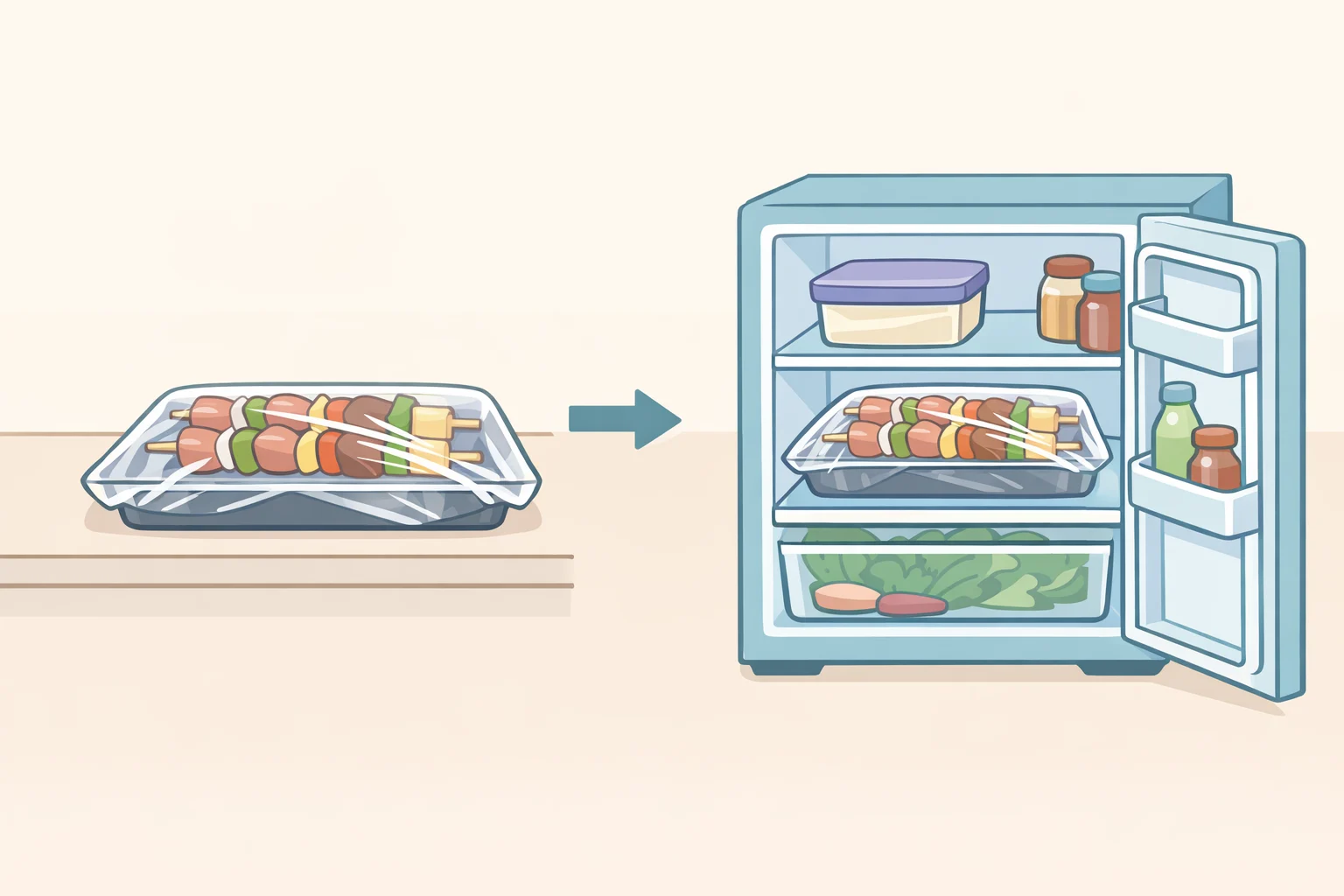
Step 5: Cover and refrigerate. Do not add glaze yet. Both balsamic glaze and honey run as the skewers sit, pulling moisture into the prosciutto (Wholesome Yum, 2026). Cover the platter tightly with plastic wrap and refrigerate until service. Drizzle right before you carry it out.
Make-ahead timing: what the sources say and what to actually do
Sources disagree here, and it's worth being direct about it. Chef Denise (2026) recommends assembling just before serving to keep the prosciutto from going soggy. Fresh Apron (2025) puts the practical window at a few hours ahead. Wholesome Yum (2026) says fully assembled skewers can hold up to 24 hours but also notes these are best assembled day-of, since the fruit releases moisture as it sits.
Those positions aren't contradictory. The difference likely reflects recipe style and how much moisture is removed before assembly. The 24-hour figure is the outer limit under good conditions, not the default.
The safest default: assemble same-day, a few hours ahead. If that's not practical:
- Up to 2-3 days before: Cube or ball the melon and store in an airtight container lined with paper towels in the refrigerator. Change the towels if they become saturated (Wholesome Yum, 2026).
- Up to 24 hours before: Complete the drying steps thoroughly, assemble the skewers, cover tightly, and refrigerate. This holds when the melon and mozzarella are genuinely dry before threading.
- Right before serving: Drizzle glaze or honey. No exceptions.
Common failure points:
- Skipping or rushing the pat-dry step on melon and mozzarella
- Adding glaze during assembly instead of at service
- Using overripe melon that's already soft before it hits the skewer. Ripe but firm is the specification (Fresh Apron, 2025)
- Stacking skewers in storage, which traps moisture and crushes the prosciutto
On outdoor summer serving: Prosciutto and fresh mozzarella are both perishable. Don't set out the full batch at once in warm weather. Stage from a refrigerated backup in smaller rounds so the platter stays cold and fresh throughout service.
Variations: once the base version is working
Get the base recipe right first. The variations below are worthwhile, but each introduces its own texture or flavor wrinkle, and those are easier to evaluate once you know what a well-made skewer should taste and feel like.
Honeydew alongside cantaloupe: Using both melons adds visual contrast and two slightly different flavor profiles. Cantaloupe is more aromatic; honeydew is milder and cooler. Alternate them for color effect, one on each end of the skewer (Wholesome Yum, 2026). Straightforward upgrade, no added complexity.
Hot honey instead of balsamic glaze: The sweet-heat combination with prosciutto works well. Use it as a replacement for balsamic, not an addition (Fresh Apron, 2025). The same last-minute drizzle rule applies.
Mint instead of basil: Lighter and more refreshing. A useful swap when serving these alongside rich food. Mint is more fragile than basil, so thread it just before serving if you're assembling ahead.
Feta or goat cheese instead of mozzarella: Both work, but both are considerably saltier than mozzarella, and prosciutto already brings plenty of salt. Use a smaller piece than you'd use of mozzarella and taste as you go (Fresh Apron, 2025).
Salami instead of prosciutto: Bon Appétit (2022) makes the case that bolder cured meats pair well with melon. The flavor is more assertive and suits people who find prosciutto too subtle. Account for salami's firmer texture when folding it onto the pick.
Watermelon: The flavor pairing is good; the logistics are harder. Watermelon is softer, wetter, and more prone to splitting on the pick. Cut pieces slightly larger than you think you need, thread them last, and handle minimally. Budget extra drying time (Fresh Apron, 2025).
Which version to make
The choice comes down to two variables: how much time you have for prep, and how far in advance you're assembling.
The traditional 2-ingredient build, melon and prosciutto only, is the more forgiving option. Fewer wet components means fewer things that can go wrong, and it holds better over time. If you're assembling anywhere close to the 24-hour limit, this is the smarter call.
The 5-ingredient version, with mozzarella, basil, and balsamic, delivers a fuller bite and makes a stronger visual impression on a platter. It rewards same-day assembly and careful drying. For a first attempt, start here: cantaloupe, prosciutto, mozzarella, basil, glaze at the last moment. Get the texture right, then decide whether the added prep is worth it for your situation.