Can You Mix Laundry Detergents? What's Safe and What's Not
Most people who mix laundry products aren't running chemistry experiments. They're improvising: the bottle is running low, the stain looks stubborn, or they half-remember reading that vinegar does something useful. The instinct to combine is understandable. The chemistry, unfortunately, rarely cooperates.
Can you mix laundry detergents? The short answer depends on what you're combining:
- Can you mix different laundry detergents? Usually yes, but it rarely helps and can backfire.
- Should you mix laundry detergents? For most loads, no. One product at the right dose is enough.
- Is it safe to mix laundry detergents with bleach or vinegar? Depends on the type. Some combinations reduce performance; others release toxic gas.
- What happens if you mix laundry detergent brands? Usually redundant chemistry and wasted product. Sometimes the ingredients actively interfere with each other.
- Best default: one detergent at label dose, with additional products used in sequence rather than all at once.
Before getting into the combinations, one number grounds the whole discussion. According to peer-reviewed research on compound protease detergents, enzyme-based formulations account for roughly 80% of detergents sold in Europe and the United States, with Japan running nearly 100% enzyme products (Applied Sciences, late 2021). That bottle on the shelf is already a precisely engineered system. It isn't a neutral liquid waiting to be improved by whatever gets poured on top.
The practical stakes run from dingy shirts and wasted money at the minor end to chemical exposure at the serious end. The chemistry isn't complicated once the categories are in place.
Can you mix different laundry detergents? Usually pointless, sometimes counterproductive
Video of the Day
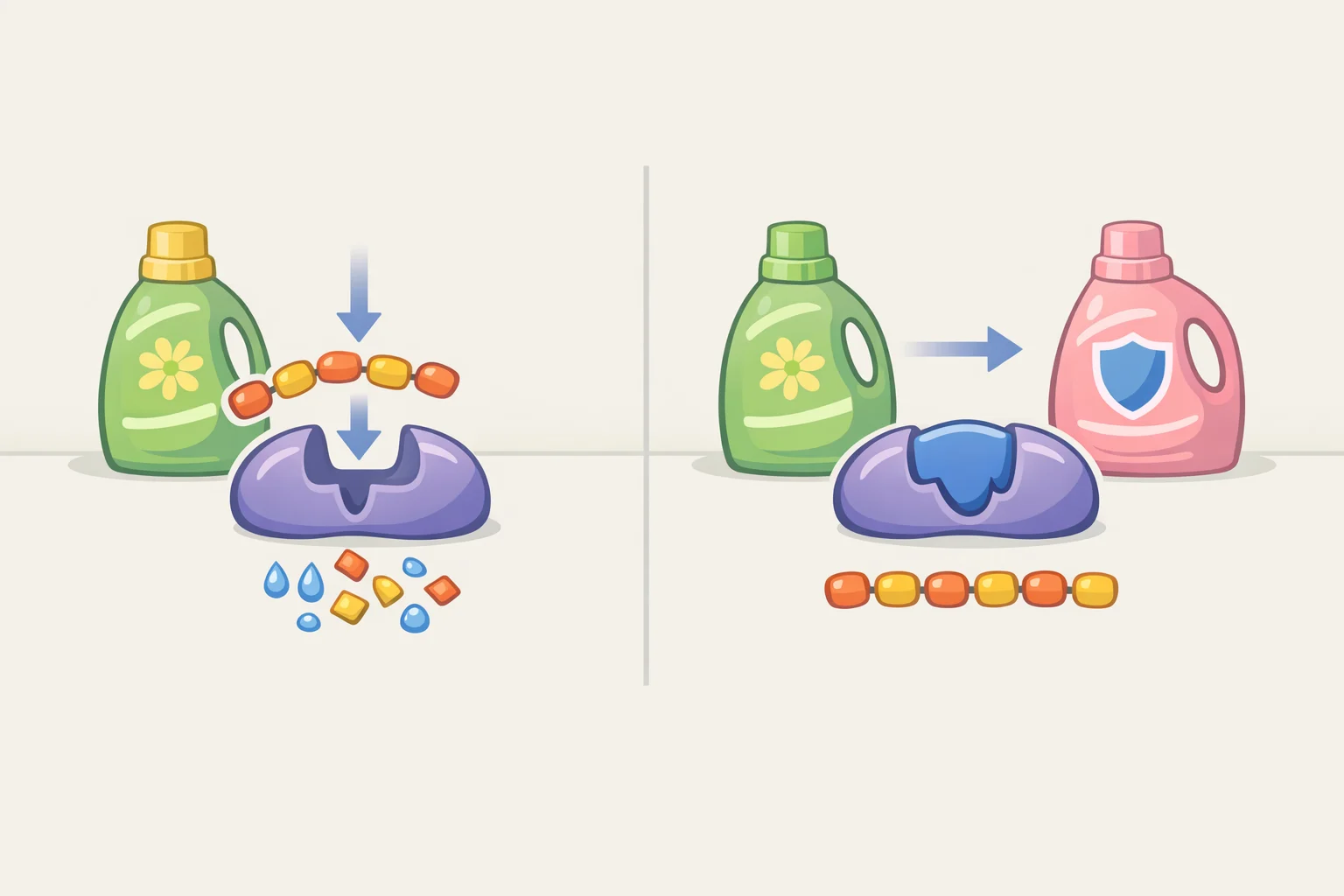
Two mainstream liquid or powder detergents poured into the same wash almost always attack the same problem with the same toolset. Many mainstream detergents rely on similar enzyme systems, proteases in particular, targeted at protein and organic stains. Adding more doesn't add more mechanisms. It adds more dose past the point where more dose helps, and any excess surfactant has to work its way out of your fabrics over subsequent cycles.
The bigger issue is that two products don't simply add together; they interact. Research on compound protease detergents found that some common laundry additives improved enzyme performance, while others, including EDTA and CMC, inhibited enzyme activity entirely (Applied Sciences, late 2021). Two products that individually perform well can produce a mixture that performs worse, because one ingredient from the first product blocks the active enzyme in the second. Manufacturers test their own formulations for exactly this kind of interference. Consumer mixing bypasses all of that work.
There's a more acute version of this problem when two products carry opposite surfactant types. Anionic and cationic surfactants bind together and form an insoluble solid that neither cleans fabric nor rinses clean (cleange.com, earlier this year). Standard detergents use anionic surfactants, so this incompatibility is most relevant when a detergent is combined with certain fabric softeners or conditioning treatments built on cationic chemistry. Between two regular detergents it's less likely to apply, but it's worth knowing why "more product" isn't a safe assumption.
A common version of the same mistake: doubling up on detergent and a separate enzyme booster because a stain looks serious. Both products likely carry overlapping enzyme chemistry. The stain doesn't receive more enzymatic action; it receives similar action at a higher dose, with more residue to manage afterward.
The practical rule is simple. One detergent, at the label dose. The University of Maryland Extension states it plainly: always read the label, follow the instructions, and use the recommended amount. Over-dosing is a particularly common source of residue buildup in high-efficiency machines, which use lower water volumes and have less capacity to flush out excess surfactant.
Video of the Day
Is it safe to mix laundry detergents with bleach or vinegar?
When the question shifts from mixing two detergents to combining detergent with bleach, an oxygen booster, or vinegar, the stakes change. Some combinations are merely ineffective. One category is genuinely dangerous.
The combinations with no upside
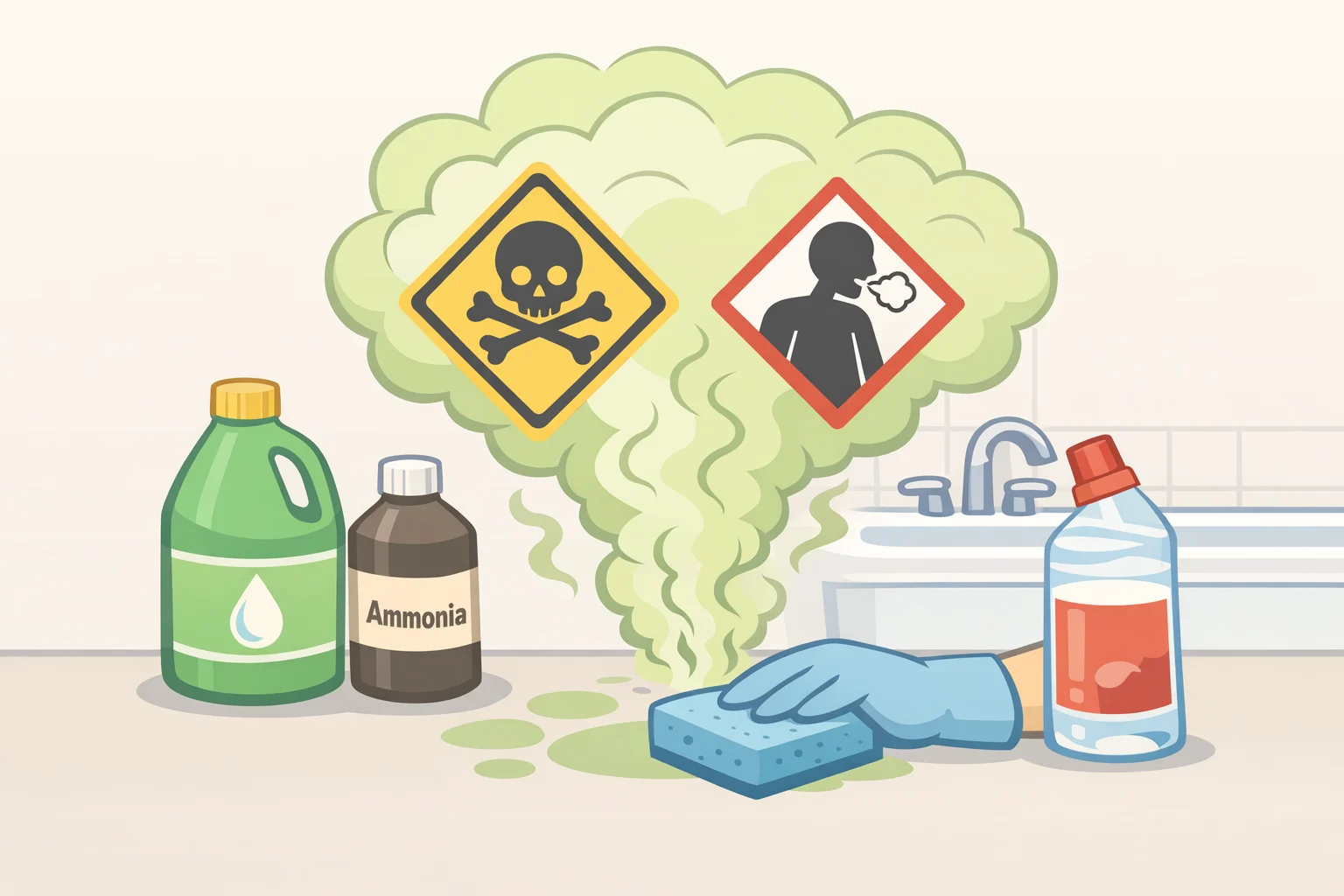
Chlorine bleach combined with ammonia-containing products releases chloramine gas. Combined with acid-based cleaners, it releases chlorine gas (cleange.com, earlier this year). These are not remote edge cases; they are predictable chemical reactions with predictable consequences.
Two independent sources make this point without qualification. The University of Maryland Extension warns that mixing bleach with any other household cleaner or disinfectant can generate toxic gas. HealthyChildren.org is direct: never mix cleaning products; certain combinations release irritating or dangerous fumes; detergent should never be combined with ammonia or other household cleaners.
The safety rule is unambiguous: do not combine chlorine bleach with ammonia, acids, or other household cleaners. That's the hard line.
Chemistry that cancels itself
Even setting aside the gas concern, adding chlorine bleach to an enzyme-based detergent in the same step destroys the enzyme before it reaches the fabric. Chlorine denatures enzymes on contact (cleange.com, earlier this year). The consumer ends up with the bleach chemistry and none of the enzyme chemistry, meaning protein stains like blood and grass get no enzymatic lift at all. Two mechanisms go in; effectively one comes out, and it isn't the one suited to the stain.
Oxygen bleach (percarbonate) is less aggressive but still problematic when added simultaneously with an enzyme detergent. Unlike chlorine, percarbonate doesn't destroy enzymes instantly; it degrades them gradually over the wash cycle (cleange.com, earlier this year). Some commercial formulations include stabilizers that allow brief coexistence of the two, but that compatibility is engineered in by the manufacturer. Adding a separate oxygen booster to a detergent at home doesn't carry that engineering. A sensible workaround is sequential: let the enzyme do its work first, then introduce the oxygen bleach in the main wash.
Vinegar is the third case. It's mildly acidic, and added to a wash containing percarbonate, it can partially neutralize the bleaching reaction and may reduce whitening power (cleange.com, earlier this year). Enzymes also denature in strongly acidic conditions, at pH below 4 (cleange.com, earlier this year). Ordinary wash vinegar may not reliably reach that threshold, but adding it in the same step as enzyme detergent or oxygen bleach risks undermining both. A common mistake: pouring in vinegar for odor control or softening when an oxygen bleach is already in the drum.
Across all three scenarios, the pattern is the same. Incompatible chemistry doesn't partially work. One mechanism may disable the other, or both are weakened. Adding more product doesn't fix it. Changing the order does.
What actually works: sequence and stain matching
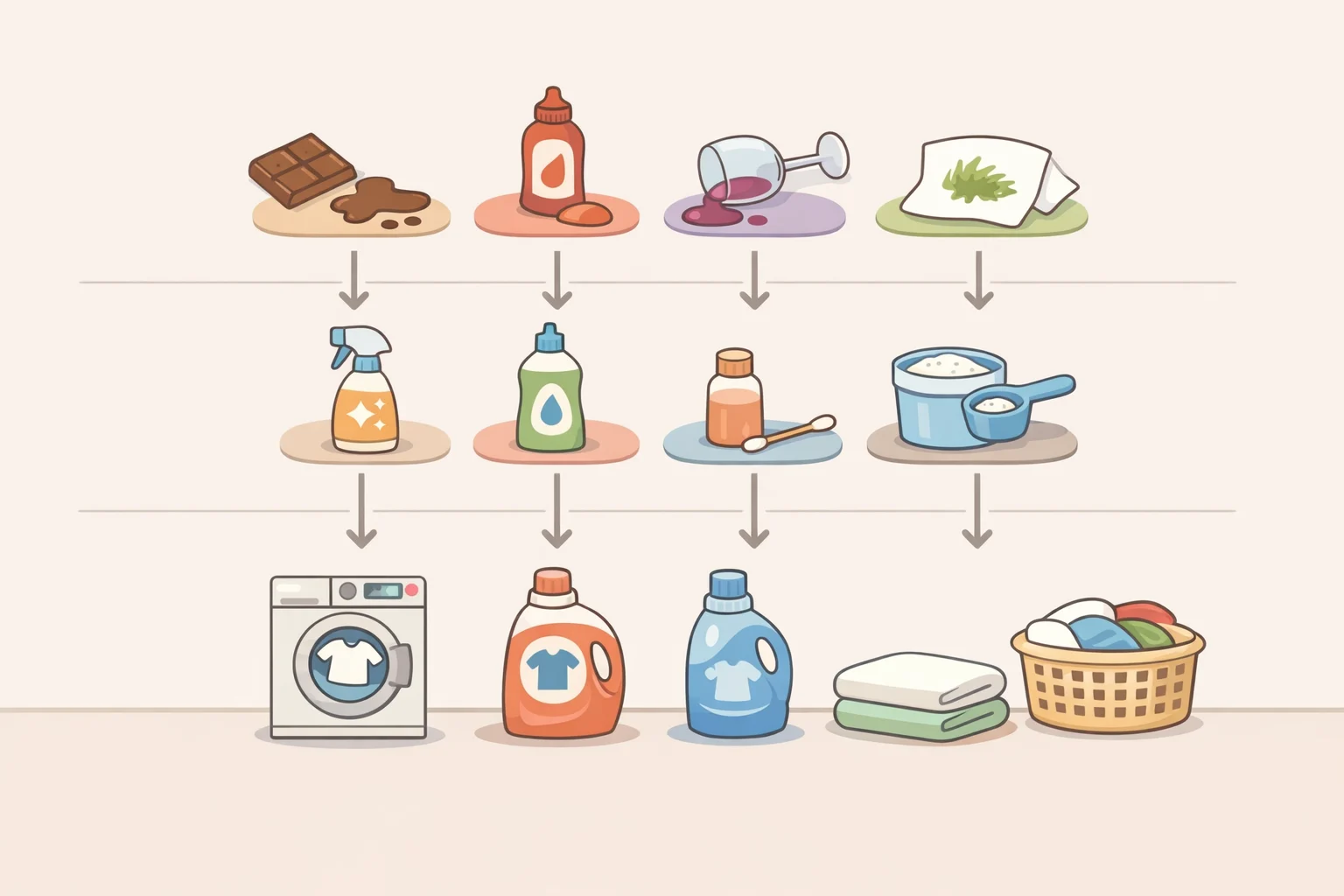
Using products in separate steps is not the same thing as mixing them together. When products are isolated in time, the incompatibilities above largely disappear. Each mechanism completes its job before the next one enters the drum. Sequential use is what makes multiple laundry products viable; simultaneous dosing is what creates the problems described above.
A sensible sequence, based on product compatibility, looks like this: enzyme-safe pre-soak in warm water at moderate pH first; surfactant main wash second; oxygen bleach either added to the main wash or as a follow-up step; chlorine bleach, if used at all, on whites as a separate step with no other products present (cleange.com, earlier this year). Temperature matters here too. Proteases reach peak activity between 50 and 60°C and denature above that threshold (Applied Sciences, late 2021). Starting with very hot water eliminates the enzyme before the wash begins.
The other key principle is matching the product to the stain type, not scaling the amount of product to the severity. Protein-based stains, blood, grass, egg, sweat, need enzyme action. Discoloration and dingy whites need oxidative bleaching. Oil and grease need surfactant lift. Applying the wrong mechanism doesn't produce partial cleaning; according to stain removal chemistry, using an incompatible mechanism can set a stain rather than lift it (cleange.com, earlier this year). The enzyme type also matters more than the volume of product used. Laboratory testing found that trypsin outperformed alkaline protease by 1.3 times on protein stains and 1.6 times on bloodstains; keratinase also outperformed alkaline protease on both stain types; alkaline protease alone showed limited performance in isolation (Applied Sciences, late 2021).
Here's how that plays out on a real stain. For blood or grass on cotton: pre-soak in cool to warm water with a standard enzyme detergent. The protease breaks protein chains into smaller fragments that can then be lifted from the fabric during agitation. Transfer to a normal wash at 40-50°C with a fresh dose of detergent. If whitening is needed, add an oxygen bleach product to the main wash, not the soak. Skip the vinegar. The chemistry stays functional because each mechanism operates in its own window, not in competition with the others. The decision path is stain type, then product class, then timing, not stain severity, then more product.
A framework for the machine
Before adding a second product to any wash, run it through a quick three-bucket test:
- Pointless: two products targeting the same stain mechanism with overlapping chemistry. Redundant dose, no added benefit.
- Counterproductive: one product disables or degrades the active ingredient in the other. Enzyme detergent plus chlorine bleach in the same step. Enzyme detergent plus strong acid at pH below 4. Percarbonate plus vinegar in the same pour.
- Dangerous: chlorine bleach combined with ammonia-based or acid-based products simultaneously. HealthyChildren.org and the University of Maryland Extension state this without qualification. Treat it as a hard constraint, not a guideline.
One detergent at label dose handles the majority of laundry. For stubborn stains, sequencing beats doubling up: enzyme pre-soak first, then the main wash, then a bleaching step if needed.
Detergent formulations continue to improve precisely because compatibility is difficult to engineer. Researchers building a superior compound protease formula had to test every additive individually to determine which ones helped enzyme activity and which ones blocked it (Applied Sciences, late 2021). That testing is already embedded in a well-formulated single detergent. When uncertain, let the label do the chemistry.