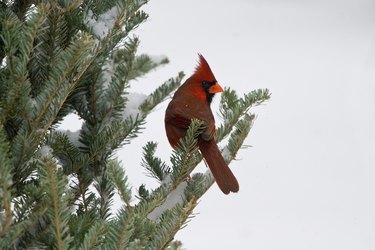
Think of the classic Christmas tree and you'll get a clear vision of the Fraser fir (Abies fraseri): flattened, shiny, dark green needles spiraling up to a pyramidal shape. Fraser fir is used as a holiday tree, but it is also an attractive evergreen for large backyards away from city pollution.
Appalachian Natives
Video of the Day
Native to a small area in the Appalachian Mountains, Fraser fir grows in the wild at an elevation of 4,500 to 6,900 feet above sea level. A mature Fraser fir can rise to 50 feet with a spread no more than 30 feet. The needles are dark green but silver-banded beneath, and the purple seed cones stand erect on the branches. The tree is an American native, but it is named for Scottish botanist John Fraser, who introduced the first specimens to the U.K.
Video of the Day
Cool-Climate Fir
The Fraser fir is rare in the wild in modern times, but its mountain beginnings continue to influence where it's grown. Its native range is a cold, foggy, moist area that can be termed a cool-temperate rainforest, with some 75 to 100 annual inches of precipitation spread throughout the year, where summer temperatures stay below 60 degrees Fahrenheit. The Fraser is not a fir for warm climates, even with extra care, and only grows well in U.S. Department of Agriculture plant hardiness zones 4 through 7.
Growing Conditions
You should plant Fraser fir in moist, well-draining, slightly acidic soil, spacing multiple trees at least 30 feet apart. Although this fir tolerates some standing water, it will not grow well in heavy clay soils. The area should provide at least partial sun, and the tree will grow fastest with full sun. You don't need to prune or fertilize Fraser fir. The tree has shallow roots and needs protection in windy areas. Do not plant the tree in an urban area because it does not tolerate pollution.
Balsam Woolly Adelgid
Despite its narrow growing range, the Fraser fir does not suffer from serious insect or disease problems as long as it is planted appropriately. Its primary enemy is the balsam woolly adelgid, a flightless insect invader that has killed several million trees. Unfortunately, it is difficult to control this insect even in ornamental specimens. If you notice cottony masses of gray eggs on twigs of a young fir, scrape them off with a metal brush and hose down the tree. If your fir tree is infested, you can call in a professional to spray the entire tree with imidacloprid with a high-pressure sprayer. Alternatively, the Oregon Department of Forestry recommends replacing the tree.
- Missouri Botanical Garden: Abies Fraseri
- National Forest Service: Abies Fraseri
- Plants for a Future: Abies Fraseri
- Bachman's Landscaping: Fraser Fir
- Oregon Department of Forestry: Balsam Woolly Adelgid
- Forest Service: Balsam Woolly Adelgid
- Pacific Northwest Insect Management Handbook: Fir (Abies)-Balsam Woolly Adelgid
- Center for Plant Conservation: Abies Fraseri
- Michigan Department of Natural Resources: Balsam Woolly Adelgid