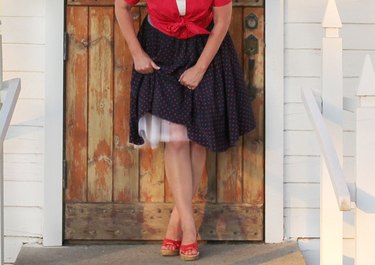
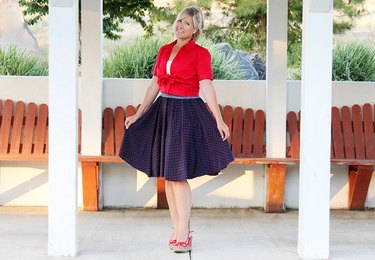
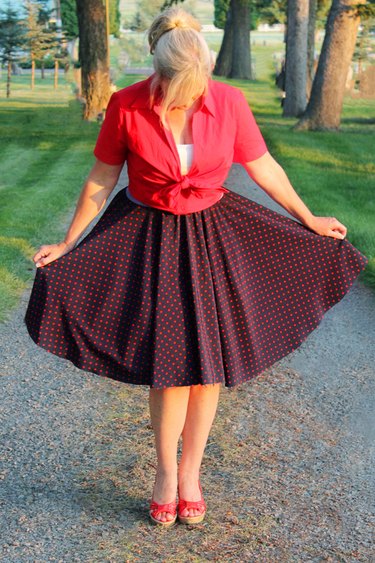
As more people become interested in vintage clothing, especially the rockabilly style, crinolines are once again emerging as a must-have item in women's wardrobes. No longer just popular for weddings and special occasion dresses, crinolines can now be worn under everyday skirts and dresses or even worn as the skirt itself. Make your own -- in any color imaginable -- by using an old slip and a few yards of netting.
Video of the Day
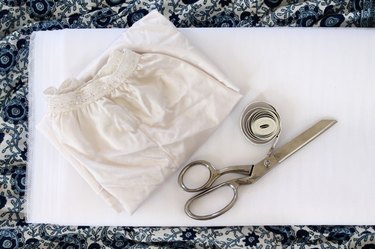
Things You'll Need
A well-fitting slip
3 yards of stiff netting, 54 inches wide (per layer of the crinoline)
Measuring tape
Sharp scissors or a rotary cutter and mat
Sewing machine with 90/14 needle and thread
Pins
Tip
When choosing the fabric to use for your crinoline, be sure to choose a netting and not a soft tulle. Netting is stiffer than tulle and will provide more structure for your skirt or dress.
Step 1
Determine the length of your crinoline and divide this number by three. The slip waistband layer will be one-third of the length measurement and the netting layer will be two-thirds of the length measurement. For example, if you'd like the length of your crinoline skirt to be 21 inches long, the slip waistband layer will be 7 inches long and the netting layer will be 14 inches long.
Video of the Day
Step 2
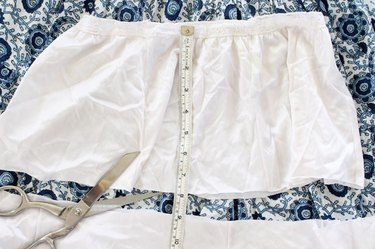
After you've determined your measurements, cut the slip to one-third of the length of your desired crinoline.
Step 3
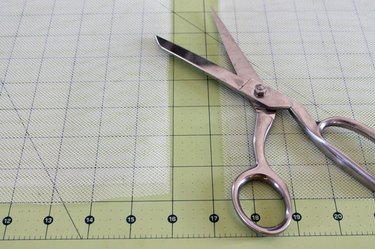
Cut five strips of netting to be two-thirds of the length of your desired crinoline. You can use scissors, but a rotary cutter and mat is an efficient method if you have one. When you're finished cutting, you should have five strips that measure 54 inches wide by two-thirds the length of your crinoline.
Step 4
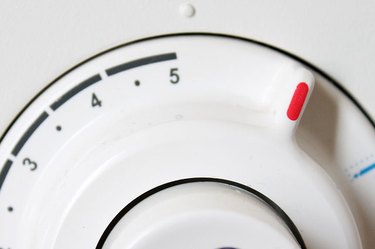
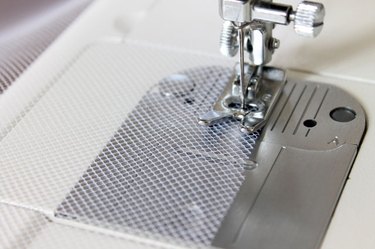
Change your sewing machine to the longest stitch.
Step 5
Using the longest stitch on your sewing machine and a 90/14 needle, sew 1/2 inch in across one of the long edges on one of the netting strips.
Step 6
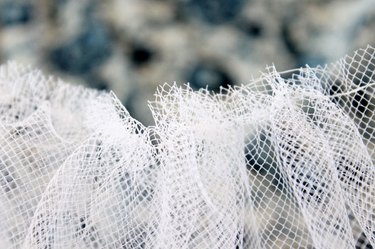
Pull on the bobbin thread of the basting stitch to gather the top edge of the netting strip.
Step 7
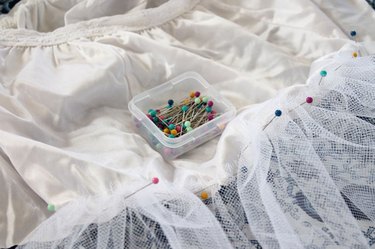
Pin the gathered edge of the netting strip to the bottom edge of the slip.
Step 8
Change the machine back to a medium stitch and sew the gathered edge of the netting to the bottom edge of the slip. Continue to gather, pin and sew the remaining strips of netting to the bottom of the slip until you have gone around the entire bottom edge of the slip.
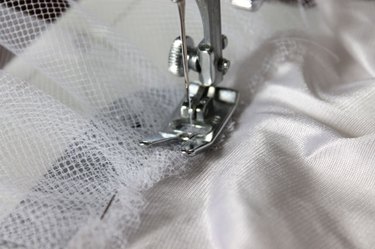
You can use one layer of netting strips for a medium fullness, or keep adding layers to increase the fullness of your crinoline.
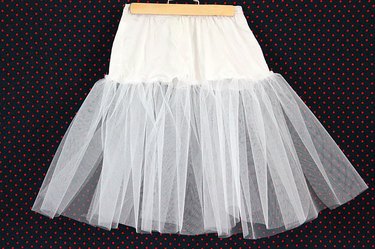
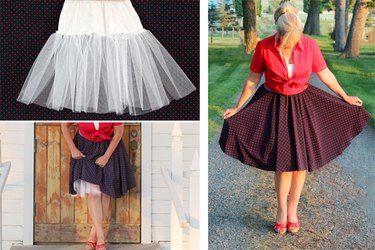
Customize your crinoline to match the color of your skirt if you don't want it to show, or make different color crinolines that peek out playfully from under your skirts.