Things You'll Need
Corn husks
Pork lard or vegetable shortening
Masa harina, coarse tamale grind
Broth
Plastic wrap
Tortilla press
Banana leaves
Steamer
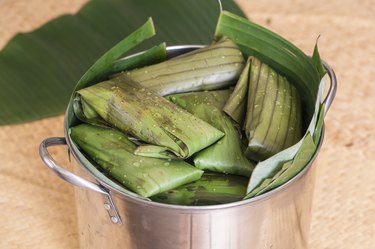
Mexican food is all about family. Authentic tamales, for example, entail many steps. They're not laborious, but a couple of extra hands helps -- and that's where you can put your partner or the kids to work. You need authentic ingredients for authentic tamales, so use pork lard in the tamal dough. And reserve the water from the meat you simmered for the filling. There are numerous tamale recipes, but pork in red chile is traditional. If you have an aversion to pork, you can substitute vegetable shortening for pork lard and try a filling of chicken in green chile or beef in adobo sauce.
Batter
Step 1
Set the husks in a pan and pour boiling water over them until they're submerged; set a plate on the husks. Soak the husks until they're pliable, about 2 hours. Choose the most pliable husks that measure at least 6 inches wide and 6 inches long and dry them with a towel.
Video of the Day
Step 2
Mix 1 cup of pork lard for every 25 tamales you want to make in a stand mixer with a couple pinches of salt until fluffy, 1 to 2 minutes. Use the paddle attachment and medium speed.
Step 3
Add the masa harina to the lard incrementally, letting the previous addition coalesce before adding the next. Lower the speed to medium low. You need 4 cups of masa harina for 25 tamales.
Step 4
Add an equal amount of pork or beef broth as lard to the masa harina slowly; if you used 1 cup of lard, add 1 cup of broth. If you simmered meat for the tamales, use the reserved cooking liquid.
Step 5
Mix the masa or dough for a couple minutes and test it. Drop 1/2 teaspoon in a glass of water; light and fluffy tamal batter floats. Mix the masa for another minute or two if it doesn't.
Step 6
Adjust the consistency with a little broth if needed; tamal dough has the consistency of loose cake batter. Adjust the seasoning as needed with salt.
Assembly and Steaming
Step 1
Spread the tamal batter on half of a folded sheet of plastic wrap and cover it with the other half of plastic wrap. Press the wrapped dough in a tamale press until the batter is about 1/4 inch thick.
Step 2
Place 3 tablespoons of your filling on the tamale and spread it evenly to within 1 inch of the edge. Fold the tamale almost in half -- about two-thirds of the way up. Fold the edges of the tamale in on all sides to make a rectangular packet. Remove the plastic wrap. Place a plantain leaf ripped into a rectangular shape on top of the folded packet to cover its seams.
Step 3
Separate the husks and lay them on the work surface with the narrow ends facing you. Place each packet, dough side down, on a corn husk. Wrap the husk around the packet the long way. Fold the open ends under the tamales and set them seam-side down on the work surface. Fill a pot with water and place a steamer insert in it. Bring the water to a boil.
Step 4
Lay the tamales in the steamer insert seam-side down. You can stack the tamales if needed, but don't overcrowd the steamer. Cover the tamales with a layer of husks.
Step 5
Cover the steamer insert with the lid. Steam the tamales for 1 1/2 hours and check for doneness; when ready, the husk unfolds away from the tamale cleanly and without sticking.
Step 6
Transfer the tamales to a plate and let them rest for 5 to 10 minutes before serving.
Video of the Day