Things You'll Need
Fur fabric, short length
Fur fabric, long length
Black felt
Floral wire
Tin snips
Elastic
Hook and loop tape
Spats pattern
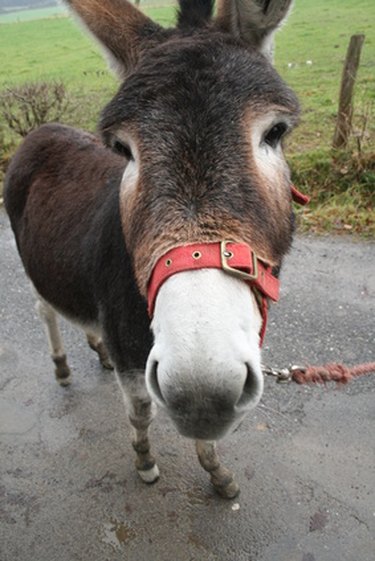
Donkeys have very specific features, from their big pointy ears to their oblong hooves to their long, thin tails. When creating a donkey costume, you must pay attention to these details in order to make clear what the costume is supposed to be. Fortunately, a few key pieces of material and a little imagination will go a long way in bringing your donkey costume to hee-hawing life.
Ears
Step 1
Cut out four ear shapes, using the short fabric, to make the fronts and backs of two ears. Donkey ears look like horse ears except longer. Think of them also as looking like rabbit ears but a little shorter.
Video of the Day
Step 2
Sew a pair of ear shapes together, with the furry sides of the pieces on the inside. Sew a seam around the ear, leaving the bottom end open. Clip around the edge, careful to cut only fabric and not the seam. Turn the ear inside out, so that the fur is outside and the seam and raw edges are inside. Sew the second ear.
Step 3
Cut two pieces of floral wire. Bend them both into triangular shapes that match the shape and size of the ears. These will make the ears stiffer and able to stand up. Insert the triangular wire into each of the ears so that their shapes align.
Step 4
Cut out a headband. Make it about 2 inches wide and long enough to stretch around your head from ear to ear. For comfort, taper the ends of the headband to points. Cut two of these shapes to make top and bottom sides.
Step 5
Sew the headband together as you did the ears, sewing all the way around but leaving open an edge. Turn the headband inside out, tuck the raw edges of the opening inside and sew the opening shut.
Step 6
Turn the raw edges of the ears inside, and then sew the ears onto the headband by hand using a running stitch.
Step 7
Sew elastic to the end points of the headband, which should fit snugly on your head. Cut the elastic so it'll have to stretch a little when the headband is being worn.
Tail
Step 1
Cut a rectangular length of the short fur fabric. Cut it the length you would like the tail to be. About 12 inches long by 2 inches wide should suffice.
Step 2
Fold the rectangle in half lengthwise, with the fur on the inside. Sew up one side, and sew one end shut. Then turn the tail inside out through the open end.
Step 3
Cut a tuft from the longer fur fabric to make the end of the tail. Cut this piece about 2 inches by 2 inches.
Step 4
Comb the longer fur to lie in one direction and then fold in half, so the fur moves in the direction of the seam. Sew up one side only, and then turn the tuft inside out. Because the fur is long, you'll leave the end open, so the fur can hang.
Step 5
Tuck in the raw edge of the longer tail piece. Insert an end of the furry tuft piece, and sew these pieces together. This completes the tail. Simply pin it on your trousers with a safety pin to wear.
Hooves
Step 1
Use a spats pattern to make your hooves. If you don't have one, you can improvise with a circle. Using paper, cut out a circle big enough to easily cover the top of your foot. Cut another circle out of the middle for your ankle, making your pattern now a ring. Then cut out a pie-shaped wedge from the outer edge of the circle. Place the pattern over your foot, and make sure the sides come down far enough but do not drag the floor, and that the back can overlap at the heel. Adjust the pattern until it fits.
Step 2
Cut out a pair of spats from the black felt using your pattern. Because felt doesn't ravel, you won't have to finish any edges.
Step 3
Add hook and loop tape to the back of the hoof spats, so they can close around the feet.
Step 4
Sew elastic to the sides of the spats, to be passed under your shoes. The elastic will add stability and hold the sides of the spats in place. Now your hooves are complete.
Tip
As an alternative to floral wire, use buckram or stiff interfacing.
Add a pair of fake buck teeth for a more cartoonish look.
Turn your donkey into a sports mascot by wearing a baseball or basketball uniform.
Place hook and loop tape on your backside and the top of the tail. Play a hide-and-seek game where your children try to "pin the tail on the donkey."
Video of the Day