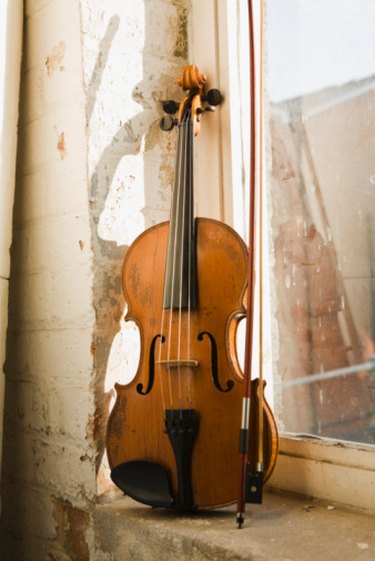
DIY Violin

DIY Violin thumbnail
Building your own violin can be done with a violin kit.

Building your own violin may not qualify you as a luthier, but you can build a violin using a kit. Violin kits include basic parts, systematic instructions and some tools you need. Using a violin kit, a DIY violin using pre-cut and pre-sanded parts will eliminate the need for little more than hand tools to construct your violin. Templates are also available; however, you will need to purchase additional parts and supplies to complete more than just the body of the violin. The kits and templates are available online and at various stores where you purchase musical instruments and supplies.

Things You'll Need

  • Violin kit
  • Spring clamps
  • High carbon steel knives
  • Bevel or long-handled gouge
  • Measurement ruler
  • Wood glue (such as Titebond Glue)
  • Paintbrush
  • Violin stain and varnish
Show More

Instructions

    • 1

      Check your kit to ensure you have everything you will need. Clear a workspace in a well-ventilated room, on a clean, solid work surface where you will be able to leave the violin for ample time to dry.

    • 2

      Clear any burrs in the pre-cut routes for the purfling on the top of the violin. Connect the ends of the routing -- or you may create a small design on the back of the violin. Insert the purfling strip, bending carefully; use a bending iron if needed. Glue the purfling into place, and once dry you can trim the excess and scrape it so it is flush.

    • 3

      Measure, align and glue the bass bar under the top of the violin. If needed, plane or scrape the bar to shape its bottom. Fit the bar by test fitting the bar with the thickest end toward the bottom of the violin.

    • 4

      Measure and sand all the edges of the violin. Attach the top of the violin to the sides and back checking to ensure the underside fits well and create rounded edges by sanding as needed.

    • 5

      Practice clamping the violin parts. When you are comfortable with this process, spread Titebond Glue (recommended) on the rims and clamp the violin to rest on your work area.

    • 6

      Temporarily glue the fingerboard and nut to the body, shape and smooth the neck to a smooth rounded finish. Align the neck and fingerboard with the centerline of the body ensuring the neck matches up without any gaps.

    • 7

      Measure and cut a small notch at the bottom of the topside of the violin where you will insert the tailgut saddle once the finish of the violin is complete.

    • 8

      Attach the fingerboard to the neck of the violin. Measure, align and apply glue to the bottom of the fingerboard. Clamp the fingerboard and wrap the entire neck with a rubber band. Allow to dry overnight.

    • 9

      Insert the violin peg reamer, twisting one time, checking the fit and repeat a second time if needed. All four pegs should extend equally. Add the remaining hardware: tail gut, fine tuners, bridge and the nut.

    • 10

      Sand, varnish, and stain the violin as desired. String the violin, tweak any minor adjustments and give the violin a test play.

Tips & Warnings

  • Allow plenty of time for drying when you scrape, varnish and stain the violin. As you craft your violin, be sure you make small adjustments and measure frequently.

  • Be sure your workspace is clean, dry and dust free.

  • Wear eye protection and gloves when needed.

  • The tools are sharp, so be cautious when working with them.

Related Searches:

References

Resources

  • The Art of Violin Making By Chris Johnson and Roy Courtnal
  • Useful Measurements for Violin Makers: A Reference for Shop Use; By Henry A. Strobel
  • Photo Credit Hemera Technologies/AbleStock.com/Getty Images

Comments

Related Ads

Featured