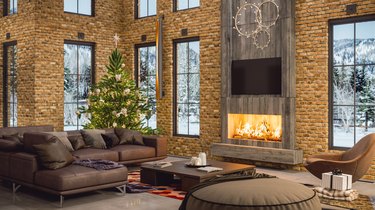
How do you want your Christmas window lights to look this year? Do you want them to look like they were hung haphazardly or like they were arranged with finesse and care? Anyone can throw some rope lights in a window, but not planning it and not taking enough time makes it appear sloppy. Hanging Christmas lights should be a more thoughtful process, and the time you invest will definitely make a difference.
Christmas Lights for Inside Windows
Video of the Day
If you do not have rope lights, measure your windows first to see what length of light strand you need to buy. When possible, choose rope lights with wires that match the color of your window frame. If the wire is dark green and the frame is white, the wire will draw more attention than you might prefer. You want the window to look nice but not overdone, so choose mini lights that will not overwhelm it. Always test your lights before hanging them because once they are up, you don't want to take them down unnecessarily.
Video of the Day
The easiest method for hanging lights is to buy plastic clips that attach to the inside of a window frame. These clips have adhesive strips and are sticky on both sides. You can start by attaching one of the strips to the top of the window frame and place more around the rest of it.
These clips need at least half an hour to dry before you can move on to the next step. Remove the covering to expose the other sticky side, attach the clips and wait another 30 minutes. To hang the lights, work your way around the frame, sliding the light wire into the clips.
Outside Window Christmas Lights
You can use gutter hooks for hanging Christmas lights in outside windows. Because the hooks are generally already there, they will leave no marks or damage. If you do not have gutters, use cup hooks. These can be screwed into the wall and are great for fairy lighting on the top or bottom of a window. The other option is wire suckers, which can be hung inside or outside, and they also do not leave marks.
LED lights have a bluish tint and last longer than regular lights, and incandescent lights have a softer glow and are easier on the eyes but are not as durable. You can find battery-operated lights too, and these are perfect for windows that are not near power sources.
When using any kind of clips, hooks or wire suckers, space each one approximately 12 to 18 inches apart, ensuring that there is one in each corner. Once they are up, start your first light strand at one of the bottom corners and extend upward along the side. Keep it tight; otherwise, it will start to sag.
More Light-Hanging Tips
It's good to explore more helpful tips for hanging Christmas lights before you get started. The best-looking homes have a balance of lights from top to bottom and horizontally. A busy-looking first story looks incompatible with an empty second floor.
It is very important to measure and buy enough accessories to hang everything. Note where your extension cords and power sources are located and plan accordingly. If your side yard or backyard is visible to passersby, it is nice to decorate them as well to complete the look. Remember to turn the lights off if you plan to go out of town.