Things You'll Need
Calculator
Knitting needles
Yarn
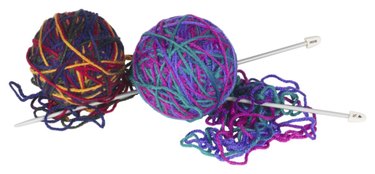
Changing the size of the needles used in a knitting pattern will change the fit, size and way the knitted piece drapes, but it is another way to personalize your work. Using larger needles and thicker yarn without adjusting the pattern will yield a finished product that is too big. Conversely using smaller needles and thinner yarn will produce a smaller finished product. With a little bit of math, you'll be able to convert any knitting pattern to use the size needles that you would like.
Step 1
Knit a gauge swatch the same size that the pattern calls for with the needles that you would like to use.
Video of the Day
Step 2
Count how many stitches and rows there are in your gauge swatch.
Step 3
Divide the stitch count from your gauge swatch by the stitch count listed in the pattern and round to two decimal places to find your stitch converter.
Step 4
Multiply the stitch count listed in the pattern by the stitch converter. This will be the number of stitches you will cast on.
Step 5
Count the number of rows in your gauge swatch.
Step 6
Divide the number of rows in your gauge swatch by the number of rows listed for the pattern to find your row converter.
Step 7
Multiply the number of rows from the pattern by your row converter.
Tip
Depending on the number of stitches the pattern lists to cast on, round your converted stitches up or down accordingly to cast on an appropriate number of stitches. The number of stitches per inch multiplied by the size equals the number of stitches needed. The number of stitches divided by the number of stitches per inches yields the size of the finished product.
Video of the Day