Things You'll Need
White school glue
Two-part resin epoxy
Latex gloves
Tooth picks
Sponge brush
Paper plate
Mini clamps
Heavy wood board
Glass sheet
Newspaper
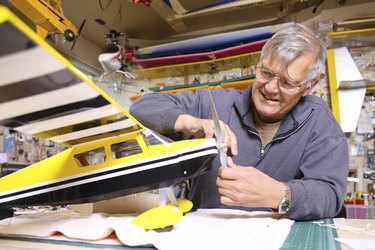
The right glue ensures that your models and craft projects look crisp and don't fall apart. Whether you want to glue paper to plastic sheets or plastic foam, there are options for a secure result. Consider simple white PVA school glue for gluing paper to plastic foam. Or turn to a quick-drying two-part resin epoxy for holding thicker paper and plastic sheets together.
Using White School Glue
Step 1
Spread newspaper over the table surface to protect against drips. Sponge brush a thin layer of white glue across the back of the paper. It is better to err on the side of not enough glue than to end up with so much that it soaks the paper.
Video of the Day
Step 2
Position the paper, glue-side down over the plastic foam. Make sure that the paper edges are even before pressing it onto the foam. Gently, smooth down the edges with your hands to secure the paper to the foam surface.
Step 3
Lay a heavy wood board or glass sheet over the foam. This presses down on the paper to keep it smooth while it dries. Allow the glue to dry for a full 24 hours before displaying.
Using Two-Part Epoxy
Step 1
Spread newspaper over the work area. Put on latex gloves to protect your hands. Open the resin epoxy according to the package instructions. Some resins are available with two parts in one-squeeze bottle. Both parts are squeezed out at the same time and mixed together.
Step 2
Squeeze out a small amount of the two-part epoxy onto the paper plate. The amount depends on the size of your project. Consider starting with less, so you don't have any waste.
Step 3
Mix the two-part epoxy with the end of the toothpick for about one minute. You want to mix both parts together very well.
Step 4
Pick up a small amount of the epoxy resin with the end of the toothpick. Spread it along the edge or the backside of the piece of paper.
Step 5
Press the paper into place against the plastic sheet. Hold for about one minute. This should give the epoxy enough time to set so that you don't have to keep holding the paper against the plastic. If the paper will not stay in place, clamp it down. Most epoxies dry within five to 20 minutes. Leave the epoxy to cure overnight before continuing with your project.
Tip
The 3M brand offers spray-on adhesives that glue paper to plastic and dry within six minutes. Hold the can 6 to 8 inches from the paper surface and apply a light coat of the adhesive.
Warning
Resin epoxy dries quickly and it is difficult to remove. Do not get epoxy on your skin or in your eyes. Work in a well-ventilated area.
Video of the Day