Things You'll Need
Knitting needles
Bowl of warm water
Paper towels
Yarn swift (optional)
Large bowl
8 cups hot water
1/2 cup table salt
1 cup white vinegar
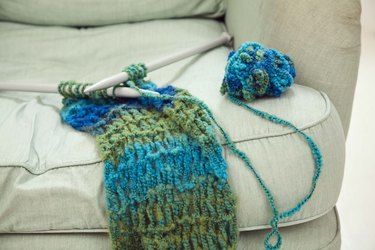
The time to find out whether your yarn is colorfast is before you actually knit with it, not after. Yarn that is not colorfast can ruin your entire project, or even a whole load of laundry. If you test your cotton yarn and determine that it bleeds color when wet, you have a few alternatives to set the dye. The technique you choose depends on the type of item you are making and how badly the yarn bleeds. The worst colors for bleeding are red, black and navy blue, but all dark or strong colors have the potential to bleed.
Step 1
Knit a 4-inch-by-4-inch square from your cotton yarn, and bind off. If the yarn color has bled onto your hands or needles, proceed immediately to Step 3. Otherwise, immerse the swatch in a bowl of warm water for 20 minutes.
Video of the Day
Step 2
Check to see if any dye is present in the water--it may tint to pink, blue or purple, depending on the color of the base yarn. If the water remains clear, remove your swatch, and blot it with paper towels. Examine the paper towel for dye spots. If you find them, you will need to set the dye.
Step 3
Skein the yarn. This dye-setting technique will not work if the yarn is in a tightly wound ball. Use a yarn swift to skein the yarn if needed.
Step 4
Combine 8 cups hot water and 1/2 cup salt in a large bowl, and stir to dissolve the salt. Add 1 cup vinegar, and mix well.
Step 5
Completely immerse the skeined yarn in the bowl, but do not agitate it to avoid tangling. Let sit for 20 minutes, and rinse with hot water until the water runs clear.
Step 6
Allow the yarn to air dry before using.
Tip
If your yarn is in a ball and you don't have a swift, you can wrap it around the legs of a chair to make a skein.
If you are skeining the yarn yourself, tie it in several places to keep it from tangling. Pre-skeined yarn is already tied.
Decide what you are going to make with the yarn. If you are making a solid color object, you can set the color after you are finished knitting. If you are making something using multiple colors, you will have set the color before you start knitting.
Warning
This technique will not work on wool yarn, because the hot water will felt the wool.
Video of the Day