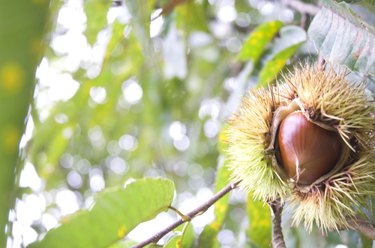
How to Identify Chestnut Lumber
Prices for chestnut lumber skyrocketed after a devastating blight infected virtually all of the American chestnut population, forcing suppliers to import European chestnut lumber. American chestnut has become known as the "Cadillac" of antique woods, and, except for chestnut veneers, is now so rare it is generally available only in fine woodworking supply houses, salvage yards or through online specialty wood suppliers and sold as an exotic wood. One of the most common mistakes in identifying chestnut lumber is confusing it with oak.
Chestnut has become treasured for its rich, unique antique glaze-colored appearance with flaws and is used for high-end custom woodworking projects that require an aged, artistic quality. Oak is often used for building furniture with a natural, rustic looking appearance.
Does this Spark an idea?
Instructions
-
-
1
Put the chestnut and oak boards side by side in good natural daylight and compare their colors. Note how the colors of the chestnut board range in tone from a soft, light brown coffee color to some sections turning to a chocolate or mahogany colored red. Note how the oak board contains warmer, white-yellow and ochre shades, graduating to lighter shades with blushes of a pinkish red.
-
2
Compare the grain patterns. Once again, the boards have similar grain patterns, but the chestnut grain is a little rougher, and blemished, whereas the oak has a wavy pattern of finer grain.
-
-
3
Look for a thin sap line in the chestnut board. This is often a surefire way to tell the difference between chestnut and oak, although it's not always found in every chestnut board because boards are cut from different parts of the log. Look for a thin band of wood that is light in color and close to one side of the board; sapwood is the wood closest to the bark. This particular sapwood line is not found in oak boards.
-
4
Look for worm marks in the boards. In chestnut lumber, these are lines caused by worms in trees infected by the blight. The worms are long gone, but wormy chestnut lumber is highly priced because of the lace-like squiggled line pattern created by pin worms boring through the wood. These miniature channels in the wood can be felt on contact. In some cases, the worm marks look like miniature bullet holes in a spray pattern covering a larger area. The oak board will not have worm marks.
-
5
Touch the surface of each piece of lumber and press a fingernail into the wood. On the chestnut, the fiber should give relatively easily, which means it can be easily dented. Oak will not give as readily, and therefore is better suited for use in hardwood furniture.
-
6
Use the tape measure to measure the distances between knots in the two boards. Chestnut, characteristically, will feature small, oval shaped knots about 1 to 4 inches apart. Measure the distances between the oak knots. Oak lumber has fewer knots, but larger knot patterns about 3 to 8 inches apart.
-
7
Study the ring patterns in the two boards. Ring patterns are revealed when logs are cut at the mill. Look carefully at how the oak rings create a wider pattern similar to the designs created when oil floats on water, and in particular how the oak rings flow more gracefully around knots, making the knots almost look like eyes in the wood. Chestnut ring patterns are straighter, smaller and less distinctive in design.
-
1
Tips & Warnings
As with anything in nature, there can be extreme variations from the norm. Oak boards can range from a light white tone with delicate details to almost black. Chestnut boards can be lighter colored than usual, depending upon which part of the log they are cut from.
Antique chestnut boards can be found at salvage yards where antique flooring has been reclaimed from the demolition of old houses.
The blight that infected the American Chestnut tree forests was introduced to the United States sometime between 1900 and 1908. In just 40 years it killed over four billion American Chestnut trees.
References
Resources
Comments
-
betterbody
Feb 25, 2011
Good info. I did not know how valuable chestnut is until I thought about replacing some.