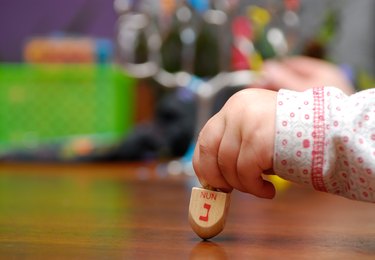
How to Learn About Judaism- for Kids
Whether you're planning a casual chat with a Jewish child or have been asked to help one learn about the faith, start by matching the child's age with his or her ability to master esoteric concepts---then go slowly. It's hard to cover a 5,000- year-old religion in a single session, even when you're working with adults, so you may want to schedule a couple of tutorials. That stated, take the following facts down to your child's level---throw in a couple of macaroons---and make your stories so compelling, he or she begs to learn more.
Things You'll Need
- Copies of Jewish sacred texts
- Photos of Jewish rituals and celebrations
- Books about holidays and rituals
- Puppet of an old man with a beard
Instructions
-
-
1
Explain to the child that, according to the Jewish religion, a single, unique Creator/Master of the universe created the world. Tell him or her that the Creator has many names, one so sacred, it can't be completely spelled out, so it's usually penned: G-d. Add this information:There's a concept known as Yichud. This means that there are no other Creators--- just G-d--- and His "Oneness" is unique and undisputed, as explained in Deuteronomy 6:4 of the Old Testament (known as the Tanach).
-
2
Describe G-d to the child as being a powerful force with no body or physical presence, according to the Jewish perspective. The Tanach often speaks of G-d stretching out his hand, but tell the youngster that this is just a figure of speech since G-d has no body so He can't do such things. Add the fact that Jews believe that G-d is eternal so He isn't constrained by the passage of time or the generations of people who come and go.
-
-
3
Tell the boy or girl you're chatting with that Jews do not believe in "idolatry," which is why there are no statues on display in Jewish temples and synagogues. Jewish people only pray to G-d, never to intermediaries or substitutes like angels, stars, planets or people.
-
4
Find simple ways to convey the principle of "Nevu'a" or prophecy to the child, since this is a very important concept. Jews believe that some people walking the earth are of such high moral character and do such a great job of following G-d's Commandments, they are granted the gift of insight.
-
5
Use a puppet to explain why Moses is considered the greatest prophet of all as a result of G-d declaring him a wise teacher when He gave him the Torah on Mt. Sinai. In return, Moses communicated directly with G-d in a strong and loving way. Other prophets had to prepare and wait for G-d's summons.
-
6
Locate copies of Jewish Holy Books, written for the juvenile market, including the Talmud and the Torah (also known as the Five Books of Moses) at book stores, libraries and synagogues. Explain that the latter was given by G-d to Moses to guide the Jewish people, so at least one copy is kept in every Jewish house of worship. Importantly, tell the child that Jewish people observe 613 commandments rather than just 10 and that not one word or letter in the Torah can be changed, added or deleted.
-
7
Remind the child that some day--- maybe even today---a Messiah (anointed one) will come to save the world. He will be a descendant of King David's, wiser than King Solomon and equal to Moses' ability to make prophecies. As a result of this long-awaited arrival, the dead will be revived, but to stay in G-d's graces and be among the resurrected, all Jews must behave kindly and ethically.
-
8
Read aloud translations of some of the hundreds of prayers and rituals Jews must follow to walk in G-d's path. If you speak Hebrew, show the child how a prayer sounds in the language of Israel. Choose from a daily prayer, mezuzah blessing, Shehechiyanu blessing, traveler's prayer, bedtime Shema Yisrael prayer, Sabbath blessing, Havdalah blessing, Rosh Hashanah blessing or a Chanukah blessing.
-
9
Inform the child that there are many kinds of Jews practicing the faith around the globe, and each has his own rules and rituals. The most well known are Reform, Humanistic, Reconstructionist, Conservative, Orthodox and Ultra-Orthodox. Additionally, every Jew on the planet has roots in Ashkenazi (Europe), Sephardic (Spain) or Ethiopian cultures. This evolution came about due to the diffusion of the original 12 tribes of Israel.
-
10
Use pictures to teach children about the Jewish calendar and important holidays like Yom Kippur, Rosh Hashanah, Tu'bish'vat, Purim, Passover, Chanukah and other celebrations and holy days that take place on specific dates coinciding with the lunar calendar. Point out that each has its own food, prayer, time, custom and ceremonial protocols. Don't forget to add that weddings, funerals, bar and bat mitzvahs (coming-of-age ceremonies), baby namings and other events are also subject to unique customs and rules.
-
1
Tips & Warnings
If the child is old enough to understand the complexities of history, you might wish to delve into the differences between the Jewish religion and the Jewish homeland by giving him or her the history behind the declaration of the Jewish State in 1949.
References
- Photo Credit © Jewish Journal