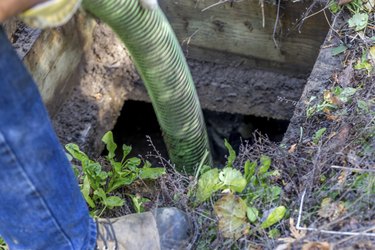
Shade trees are an energy-saving investment that reduce your cooling bills in summer. Yet, if you have a septic system, planting a shade tree may be problematic. The tree can interfere with the proper functioning of your drain field by shading the field and by the roots infiltrating, clogging and damaging the pipes. To prevent damage to your septic system, carefully consider the tree's species, its water needs and the distance from the drain field.
Drain Field Basics
Video of the Day
The septic system consists of a tank where solid wastes settle and a drain field. The drain field is a series of perforated pipes, usually laid parallel to each other 8 to 10 feet apart. Each pipe is buried in a bed of gravel and covered with soil. The pipes are at least 6 inches under the surface of the soil. The waste water flows from the tank to the pipes, soaking into the soil. The combined effects of beneficial bacteria, shallow-rooted vegetation, such as grasses, and evaporation filter and cleanse the waste water, making it safe by the time it reaches the ground water.
Video of the Day
Trees and Their Roots
Trees have wide, shallow root systems that spread in a network underground, reaching a distance of two to four times the diameter of the canopy, or equal to the height of the mature tree. Most tree roots grow in the top 24 inches of soil, although in soft or sandy soils the roots may grow 3 to 7 feet deep, depending on the species. The larger roots fan out from the base of the tree and the small feeder roots grow out and up from those large roots. Water-loving trees, such as willows (Salix spp.) have extensive root systems, much larger than other shade trees.
Keep the Roots Out
To prevent the shade tree's roots from invading the nutrient rich drain field, consider the mature size of the tree. A tree that grows 40 feet tall may have roots that extend 40 or more feet from the tree's trunk and should be planted at least 40 feet from the drain field. However, this isn't always possible. To help block the tree's roots, install a 5 foot tall geotextile barrier containing trifluralin in the soil between the drain field and tree, extending the length of the drain field. The trifluralin prevents the roots from growing into and past the barrier. Generally, root barriers are installed at least 5 feet from the drain field and 5 feet from the tree.
Tree Planting Basics
After selecting a site for the tree, dig a hole at least three times the width of the root ball, and the same depth. Make the hole an oblong shape, four or five times longer and wider at the side away from the drain field. This is to help encourage the roots to grow away from the septic system. Do not add fertilizer or amendments to the soil. Remove the tree from the grower's pot or packaging and place the root ball at the upper side of the oval, at an equal distance to three sides. Back fill with the excavated soil until it is at the same level that it was in the grower's pot. Water thoroughly and add more soil if necessary to finish filling the planting hole.
Less Invasive Trees
Because of their smaller root systems, some trees are generally less of a danger to the drain field than large shade trees. The minimum planting distance is 10 feet from the drain field, preferably at the farthest end from from the house and septic tank, where the soil is drier. Among the better choices for landscapes near septic systems are the Japanese maple (Acer palmatum) and "Amanogawa" Japanese flowering cherry (Prunus serrulata "Amanogawa"), both hardy in U.S. Department of Agriculture plant hardiness zones 5 through 8, golden rain tree (Koelreuteria paniculata), hardy in USDA zones 6 through 9, and sourwood (Oxydendrum arboreum) trees, hardy in USDA zones 5 through 9. These small decorative trees grow between 20 and 30 feet tall, depending on the species.
Trees to Avoid
Several tree species are not recommended for planting near drain fields. Water-loving trees such as the weeping willow (Salix babylonica), hardy in USDA zones 5 through 10, silver maple (Acer saccharinum), hardy in USDA zones 3 through 9, and white poplar (Populus alba), hardy in USDA zones 3 through 8, are among the shade trees with large and invasive root systems. Willows are especially notorious for root systems that reach 100 feet or more from the tree's trunk.
- Clemson Cooperative Extension: Landscaping Over Septic Drain Fields
- Colorado State University Extension: Healthy Roots and Healthy Trees
- Virginia Cooperative Extension: Planting on Your Septic Drain Field
- Monrovia: Japanese Maple
- Monrovia: "Amanogawa" Japanese Flowering Cherry
- Monrovia: Golden Rain Tree
- Missouri Botanical Garden: Oxydendrum Arboreum
- Monrovia: Weeping Willow
- Missouri Botanical Garden: Acer Saccharinum
- Missouri Botanical Garden: Populus Alba
- Colorado State University Extension: The Ten Commandments of Tree Planting