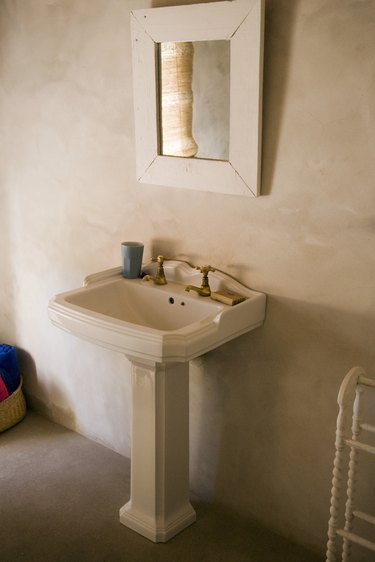
Things You'll Need:
- channel lock pliers, mini tubing cutter, tubing cutter for 1 1/2" tubing razor knife, 24"level drill, 3/16"dia. drill bit
- 3/8" drive ratchet and sockets, tape measure, Teflon tape, 8" adjustable wrench, black sharpie, small edges (cedar wood shakes) 3/8"x 3" anchor bolts, pedestal sink, faucet with pop up drain, P-Trap,
- sponge, rags,
- lavatory supplies
-
Step 1
The location for the pedestal sink will need to be prepared for installation. Wood backing has to be installed behind the drywall to give the pedestal sink something solid to attach to. Don't skimp on this wood you want enough wood so the sink doesn't move the wood by someone leaning on the sink. Use the dimensions from the installation instructions or set the basin on top of the pedestal and measure for the location of the wood to be installed.
-
Step 2
The drain for the sink needs to be set just right so that the finish work will go together easier. When setting the drain make the threads for the trap adapter stick out just past the finished wall. If the threads stick out to far then the escutcheon will not fit up tight to the wall. So check the depth of the trap adapter threads before putting the sink in place.
-
Step 3
Press the small foam pads adhesive side down on top of the pedestal. With the faucet and pop-up drain mounted on the basin place the basin on top of the pedestal. Move both pieces together up against the wall with the drain centered with the sink. Check the pedestal for level. If it is not level use the cedar wood shakes as wedges to make the pedestal level. Don't cut the cedar shakes yet this will be done later. Now adjust the basin to make it level as well. With the sink centered and level mark the points where the anchor bolts will go through the china into the wall. Many pedestal sinks come with a wall mounting bracket if yours does then slide the bracket up under the sink and make it tight up against the wall and the china. Be careful not to move the basin, if you have someone to help you have them hold the sink in position while you're doing this. Now mark the holes in the bracket where the anchor bolts will hold the bracket to the wall.
-
Step 4
Move the pedestal sink out of the way. Use the drill with the 3/16"dia. drill bit to drill pilot holes on the marks that you made. Next screw in the anchor bolts into the pilot holes. Make the wall mounting bracket tight to the wall. The anchor bolts that go through the china need to be removed.
-
Step 5
Take the lavatory supplies and wrap the tops of them with Teflon tape. This will create a gasket like seal. Attach the supplies to the bottom of he faucet. Make sure to get a good tight connection you don't want these to be leaking later on. Next take the J-bend portion of the P-trap and slip it on the tailpiece of the pop-up drain. Measure the height of the center of the drain where it sticks out of the wall. With the basin sitting on top of the pedestal put the p-trap together and make the trap arm the same height as the drain pipe. Mark the top of the J-bend on the tailpiece so you have a reference mark. Next take the basin off of the pedestal and tighten the slip nut on the J-bend. Make this connection secure it will be very difficult to get to this connection later on.
-
Step 6
Move the pedestal into position and set the basin on top of the pedestal. Check the small adhesive pads if they have fallen off stick them back in place. Line up the holes in the china with the holes in the wall and screw in the anchor bolts. Don't tighten these yet you still have to adjust the basin and level the pedestal. Put the cedar wedges back in place to level the pedestal and adjust the basin. Now that everything is level tighten the anchor bolts. Be careful not to over tighten the bolts they could crack the sink.
-
Step 7
Use the tape measure and measure from the center of the J-bend opening to the trap adapter. Add about 1 1/4" to this measurement so some of the trap arm will be inside the adapter. Cut the trap arm to length with the tubing cutter. Next slip on the slip nuts and washers and don't forget the escutcheon. Install the trap arm. Catch the slip nuts with your fingers and tighten as much as possible by hand. Tighten the rest of the way with the channel lock pliers. You'll notice the first nut on the J-bend is almost impossible to get to that is why you must tighten it before you set the sink.
-
Step 8
Take the lavatory supplies and gently bend them to line up with the supply valve connections. Now mark the supplies where they will fit into the compression joint on the valves. Use the mini tubing cutter and cut on your marks. Slip the compression nuts and ferrules onto the supplies and put the supplies into the valves. Catch the nuts with your fingers and tighten by hand. Now finish tightening with the adjustable wrench.
-
Step 9
Remove the aerator from the spout of the faucet. Turn on the hot and cold supply valves and run the water in the sink to flush out the lines. When the water runs clear put the aerator back into the spout. Close the pop-up drain and fill the basin with water. While it is filling check underneath the sink for any leaks and repair them if necessary. When the basin is full open the pop-up drain and let the water out. Check under the sink once more for any leaks and repair them.
-
Step 10
Use the razor knife to cut off the excess cedar wood that sticks out past the china on the pedestal. Next caulk around the base of the pedestal where it meets the floor. Also caulk along the top edge of the basin where the basin meets the wall. Dampen the sponge and wipe off the excess caulk to make a smooth caulked joint. Clean up and admire your handy work.


Comments
deepthinkin said
on 2/23/2009 I wish we had had your instructions when we installed our sink. These are finely detailed and easy to follow! Thanks.