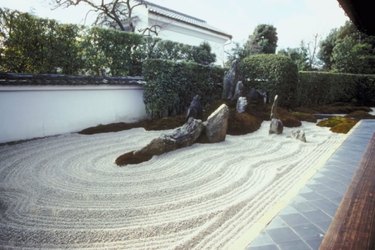
Zen gardens, also known as rock gardens, are simple in construction. Only a few elements are used in a Zen garden, but it is the way they are used that gives the garden meaning. Each placement of an object symbolizes something else, such as water, mountains or islands. Rocks, sand and moss are used as reduced scale representations of large natural areas. Zen gardens can be any size, from a 12-inch square to an acre. Since Zen gardens require few items, and they are simple items, the cost is relatively low. The size of the garden does affect the cost.
Rocks
Video of the Day
Large rocks placed at specific places and angles are one of the most prominent parts of a Zen garden. Cost and placement of these rocks can range from free to hundreds of dollars. Small Zen gardens will use smaller rocks that can be found at gardening stores for a few dollars, or dug up from the yard. Large rocks can also be dug up from fields. Local farmers may have large rocks they dug up from the fields, and will let you have them for free or cheaply. The costly way to get rocks is through a landscaper. Landscapers will charge to haul the rocks to the garden and place them in the correct spot. Landscapers make, on average, according to the Bureau of Labor Statistics, $10 to $15 an hour. Well-established companies may charge more, and the price does not include cost of designs. Another option is to rent machinery to move the rocks yourself.
Video of the Day
Sand
The entire floor of the Zen garden will be covered in sand, usually white sand. Smaller Zen gardens will not need much sand, and will save a lot of money. Larger Zen gardens, which will need tons of sand, will cost upwards of $200 or more. Play sand, meant for sandboxes, can be purchased at local garden centers and home improvement stores. As of 2011, a 50-lb. bag costs between $4 and $8. White sand is more costly. For a small Zen garden, purchase white sand at pet stores, the kind used for saltwater aquariums. Larger amounts of white sand may be available at garden centers, home improvement stores and through landscaping companies. White sand can cost up to $1 a pound. If living in northern climates, talk to the local Department of Transportation about the availability of bulk sand in the area.
Moss
The main plant used in Zen gardens is moss. Moss is usually used to represent islands. Small Zen gardens can use terrarium moss. It is available at local department stores, home improvement stores and garden centers. They cost no more than a few dollars. Moss can be dug up from forested areas and transplanted to the garden. The costly way to get moss is through a seller that provides moss by the square foot. Moss that grows well in sandy soil, such as hair cap moss and cushion moss, costs about $15 to $20 per square foot, as of 2011.
Paths
Many, but not all, Zen gardens have small paths. The cost of the paths depends on what is used to make them. Flat stones can be purchased at local home improvement stores, and each stone costs between $2 and $5 as of 2011. These stores will often deliver the stones for a price. Landscapers will also provide stones for paths, deliver them and place them for higher fees. Wood paths installed around the garden are another option. As of 2011, long boards, up to 8 feet, cost between $2 and $20 depending on the type of wood. The boards can be laid next to each other and end to end, without the need for nails.
Considerations
There is no right or wrong way to make a Zen garden. A few other items used in Zen gardens include trimmed trees, loose stones and fountains. Always do research to find the best price for all items. Save money by doing as much of the work as possible yourself. Keep in mind the cost of upkeep once the Zen garden is complete. Moss will need to be misted regularly, and any trees watered. A strong storm may destroy parts of an outdoor garden, which will need to be replaced.