The fake mustache has long been a staple of comic chicanery, whether it's worn for a Halloween party, a theatrical performance or an amusing gag. Party stores and novelty shops often carry fake mustaches, although it's a lot more fun to spend time making them at home with your friends or children. However you do it, you'll need to attach them to your face. Fortunately, there's not just one right way.
Spirit Gum
Video of the Day
The classic way to attach a fake mustache with reliable staying power is by using spirit gum, a glue-like adhesive meant for application to the face. Spirit gum, however, can be messy to work with and painful to remove. Apply the spirit gum directly to your face, tap it to activate it and then press your mustache into place. Use remover designed especially for spirit gum for the easiest mustache removal.
Video of the Day
Self-Adhesive Mustache
Many inexpensive mustaches are available with self-adhesive backs. Though these products may not hold up to the rigors of being worn during a stage performance under hot lights, they might be the perfect choice for surprising your friends or attending a costume party. Self-adhesive mustaches come packaged with a protective strip of paper that must be peeled off to access the sticky backing. Make sure to wait until the moment you are ready to attach your mustache before peeling off the protective backing.
Attach with an Elastic Band
If you'd like to make a homemade construction paper mustache, attach it to your head by adding a band of thin elastic. Create your mustache and then hold it up to your face to measure the necessary length of elastic. Cut the elastic to length and attach it to the mustache with staples or hot glue. The elastic band will let you avoid adhering a mustache directly to your face.
Wear "Groucho" Glasses
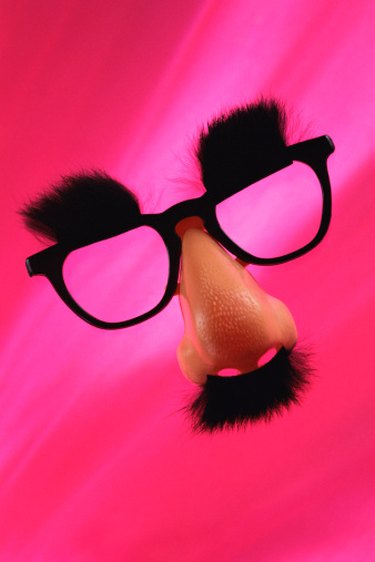
Groucho Marx, the famous comedian of film and TV, spawned a whole category of costume disguise. A large pair of eyeglasses with a large fake nose and brush-shaped fake mustache can be purchased as an all-in-one costume piece often referred to as "Groucho" glasses. Some models also include bushy fake eyebrows. This mustache application only requires putting the glasses on as you would any pair of glasses.
Put Your Mustache on a Stick
If you have an outlandishly large homemade mustache, or you simply don't want the mustache attached to your face, attach it instead to a small piece of dowel pole or wooden stick. This hand-held mustache can be "attached" to your face at will simply by holding it up against your face with the mustache in place just above your upper lip.
- LifeTips: Costume Tips: Q: How do I put on a fake mustache?
- Grains of earth: I Ways to Wear a Fake Mustache
- Cosplay.com: Fake moustache and beard
- Halloween Costumes.net: Spirit Gum Adhesive and Remover
- dealextreme: Stylish Costume Fake Mustache
- Party With This.com: Groucho Glasses with Nose & Mustache
- URDB World Records: Most Fake Mustaches Applied To Face In One Minute In A Prius
- Fake Moustache: Moustached Guide to Everything