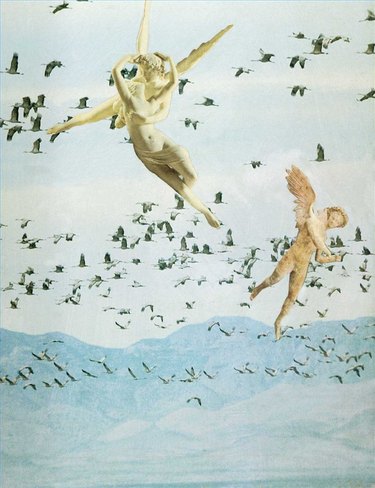
Surrealism is defined as psychic automatism in its pure state, which, in painting, is the depiction of real or imaginary objects juxtaposed with objects thought up by the artist that are not normally seen in the same context. During the 1920s, Andre Breton and Rene Magritte championed this technique. Some early surreal artists were Joan Miro, Max Ernst and Giorgio de Chirico. Then Salvador Dali became the rock star of the art world by painting melting clocks on beaches. With Dali's worldwide fame creating a demand for his fantasy-based work, surrealism was here to stay.
The Surrealistic Technique
Video of the Day
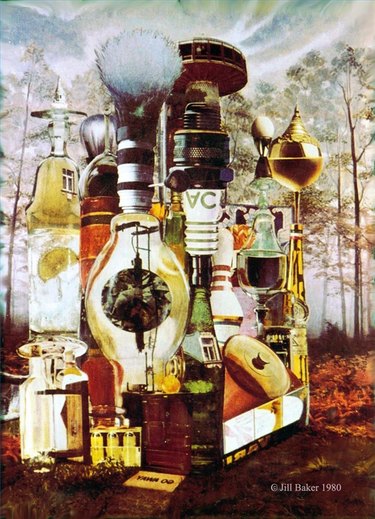
To create a surreal painting, you have to paint somewhat realistically so that at first glance the viewer thinks the painting shows real objects. Perhaps it is a painting of a real object, but upon closer inspection, the viewer realizes the situation depicted is impossible. The figure shows an oil-and-collage painting of a house in the woods, but it is made of glasses. Mystery is a big part of surreal painting. The artist keeps the viewer guessing.
Video of the Day
Why Paint in a Surreal Manner?
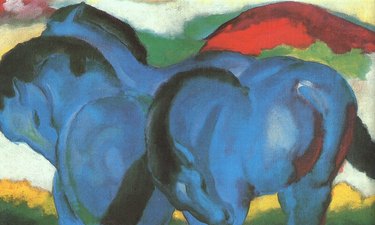
When the surrealists first exhibited their paintings, the public was outraged. They were used to seeing realistic depictions of everything. Before that time, paintings were used as cameras, and artists were considered talented if they depicted what they saw in highly realistic ways. The Brownie camera went on the market in 1900, and the first 35 mm camera was developed in 1913. Once the camera took away the task of realistically depicting subjects in the world, artists were free to paint whatever and however they wished. In 1911, Franz Marc painted pictures of horses, but his horses were blue. In 1924, surrealist Breton declared that the unconscious is the wellspring of the imagination and that artists were free to paint objects from their subconscious. That is what you will attempt to do when you begin a surreal painting.
What Is the Technique?
One way to evoke the subconscious is to tear out all kinds of pictures from magazines, and cut the subjects out. Place the images next to each other in random matches. The strange combinations evoke mysterious emotions and memories, and some seem to go with others. Glue them down, and you have the beginning of a surreal picture.
Another way to find subjects to paint is to recall your dreams. Dreams use the unconscious and put things together in strange ways. Everyone dreams, so any painter can be a surrealist.
Surreal painting can be done with oils, collage, pastels, watercolors or other media. The primary difference between surreal art and realistic or abstract art is that the surreal artist paints real objects in strange places or in unexpected juxtapositions or has changed the objects to be slightly abnormal, although recognizable.