Decay & Toxicity of Honeysuckle
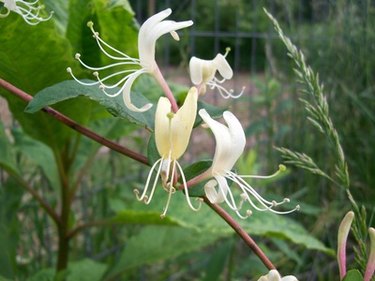
The honeysuckle vine twines around tree branches and climbs as high as 10 feet, but it also thrives as a low ground cover in the forest. Its trumpet-shaped blossoms produce a strong, sweet fragrance, often used in perfume. The nectar is treasured by bees and hummingbirds and the plant is often cultivated by beekeepers. Its clusters of creamy white, pink or yellow blossoms make it a favorite garden shrub. This sturdy vine does well on a lattice or climbing a trellis around a doorframe. Researchers are ambivalent about honeysuckle's toxic properties vs. its ancient medicinal uses. Does this Spark an idea?
-
History
-
Honeysuckle is a noxious weed in parts of United States. Honeysuckle is known as "woodbine" in England, with a botanical name of "Lonicera," after the 16th Century German botanist, Adam Lonicer. It is one of the oldest garden shrubs in Europe and its tough wood was used to make teeth for garden rakes, wooden pipes and walking sticks by Swedish farmers. Over the centuries, it has been used around the world to treat a wide variety of ailments.
Geography
-
Goat owners are divided about plant toxicity. The European Honeysuckle grows as far north as Sweden and Norway and is a tough, climbing vine. The Japanese Honeysuckle, native to Eastern Asia, Japan, Korea and China, has become naturalized to Europe and North America. In some areas, it is regarded as a pest, but it is difficult to eradicate because of its dense root system, which can spread as far out as 10 feet.
-
Considerations
-
Getting rid of honeysuckle is difficult. Honeysuckle has been valued through the centuries for medicinal use. The plant stems, leaves and seeds are used in different herbal remedies. It's believed to reduce blood pressure and to alleviate symptoms of arthritis, dysentery and respiratory infections. Topical applications have been used to reduce skin inflammations, rashes and infections. Recent studies show honeysuckle toxicity is rare and usually mild if it does occur.
Toxicity and Symptoms
-
Oval leaves may be toxic to horses. Honeysuckle contains cyanogenic glycosides which can be transposed during digestion to hydrogen cyanide, a poisonous chemical. Honeysuckle's saponic glycosides disrupt the red blood cells, affecting their ability to carry oxygen to vital organs. Children, pets and horses should not eat honeysuckle leaves or berries. Ingestion can cause gastrointestinal disturbances, including vomiting and diarrhea. Some horses can eat the sweet-tasting, bright red or black berries and leaves without any problems, but others develop diarrhea and colic. Dogs and cats, especially young ones, often become sickened after eating berries. Goat owners have divided opinions about toxicity.
Significance
-
Toddlers are attracted by plant's bright berries. Honeysuckle can be controlled by cutting, flaming or burning the plant down to ground level. This must be repeated at two-week intervals until the nutrient reserves stored in the roots are depleted. Annual applications of glyphosate may discourage the plant. Considered a noxious weed in some parts of the United States, the vines have crowded out native ground cover and killed trees by climbing into branches, cutting off sap and shading leaves. This has caused the slow decay of the trees and natural shrubs in Eastern woodlands.
-
References
- Photo Credit Honeysuckle image by StylezInk from Fotolia.com Wild Honeysuckle 1 image by DelB from Fotolia.com Chèvres image by Marie from Fotolia.com Chèvrefeuille image by lamax from Fotolia.com chèvrefeuille image by Geoffroy LEME from Fotolia.com Children's sight image by jura from Fotolia.com