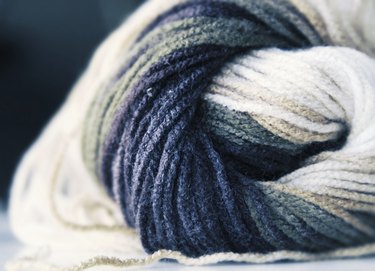
What Is a Staple Yarn?
Staple yarns, despite the name, are not basics to be kept on hand like staple foods would be in a pantry. Staple yarn is a type of yarn distinguished by the materials and method used to make it. Staple yarn may be called spun yarn or referred to by the fiber used to make it, rayon staple, for example.
-
Filament Fibers
-
Continuous filament fibers are long--measured in feet or meters--manufactured fibers squeezed from a spinneret much like pasta is made. Silk is the only natural filament fiber, all others are man-made. Man-made filament yarns can be made to almost any desired thickness with a wide range of characteristics--shiny, matte, smooth, textured, colorful or glow-in-the-dark.
Staple Fibers
-
Staple fibers are all natural fibers, except silk, used in producing yarn. The most common of these are wool and cotton; others include alpaca, mohair, angora and flax. Filament fibers cut into shorter lengths for spinning alone or in combination with natural fibers are also considered staple fibers. Staple fibers are either short staple, up to about 2 1/2 inches, or long staple, longer than 2 1/2 inches. For example, cotton is a short staple fiber ranging from roughly 1 inch to almost 2 inches in length, while wool is a long staple, ranging from about 2 1/2 to 6 inches. These fibers must be spun together to create a usable strand or ply of material.
-
Spun Yarn
-
Staple yarn is always spun. Yarn spinning actually refers to a multi-step process encompassing the mixing, blending, cleaning, separation, alignment, drafting and twisting of staple fibers. When fibers of the same type but different variety--Egyptian and American cotton, for example--are used, it is called mixing. When fibers of different origins, like wool and polyester, are combined, it is called blending. After the fibers are selected they are cleaned thoroughly and are separated into uniform groups. Drawing is the process of combining the cleaned and separated fibers into a single length of straight fiber. This is much like cotton candy fluff may be made into a long, fluffy snake before it is wound around a cone or stick. Drafting is the gentle thinning and stretching of the drawn fiber so that it is ready for twisting. Twisting is what most people probably think of as yarn spinning. The drafted fiber is twisted into a single-ply yarn which can be used on its own or twisted a second time with other strands to create a multi-ply yarn.
Characteristics
-
Most yarns available for purchase by the general public for uses like knitting, crocheting and other crafts are staple yarns. They tend to be bulkier and duller in appearance then continuous filament yarns. Texture is dictated by the fibers used in making the yarn. Softer yarns are often a combination of natural staple fibers spun around a filament core. Color is also dictated by the make-up of the yarn's fibers. Staple yarns are more likely to develop a fuzzy appearance or pilling over time.
Uses
-
Staple yarns are typically used in clothing construction, rug making, needle-crafting and hobbies, and weaving. Yarns spun from long staple fibers are ideal for heavy-use objects like coats, rugs, blankets and warp threads. Short staple fibers produce more delicate yarns better suited for light-weight garments.
-
References
- Photo Credit moonrat42/Flickr.com