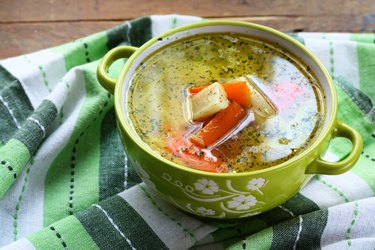
At its most basic, chicken bouillon is a clear liquid made from chicken, vegetables, spices and water. The broth can be used to flavor many foods, but bouillon is mostly used primarily as a base for soups and stews. Bouillon can also refer to a dehydrated product that comes in cube form or granules that when added to boiling water, produces a ready-made broth.
Bouillon Basics
Video of the Day
The word bouillon comes from the French verb, bouillir, which means "to boil." The reference comes from how chicken bouillon is made, by simmering a combination of chicken, vegetables, spices and water over a low heat until the liquid condenses into a flavorful broth. Bouillon is the French word for broth, and they are the same thing. In contrast, a stock generally has fewer flavorings and no added salt. There is no one recipe for bouillon and many cooks simply use chicken bones and a combination of vegetable scraps and spices to make their bouillon.
Video of the Day
Main Uses
Bouillon is used mainly as a beginning broth for soup, but you can also use it to flavor rice and pasta dishes, or as a base for sauces.
Varieties
In addition to chicken, you can also make bouillon from beef, fish, pork, veal and vegetables, and each has its specific uses. They are all made in the same way -- the only qualification as to what makes a bouillon is that it remains a clear broth.
Dehydrated Bouillons
Dehydrated bouillons can be either in either cubes or granule form. They are inexpensive and can be stored for several years. Dried chicken bouillon generally contains meat products, vegetables and spices, but it tends to have high sodium content and often has monosodium glutamate as a flavor enhancer. Look for low-sodium or MSG-free varieties, if that's your preference.
A Simple Recipe
To make a simple chicken bouillon, saute one diced onion in a little fat or oil in a large saucepan or stockpot. Place the bones and scraps of a chicken in the pot, along with whole or large diced carrots, potatoes, turnips or other root vegetables. Add a head of garlic, salt, pepper and an herb of your choice, either dried or fresh. Pour water into the pot until it covers everything. Bring the contents to a low boil and cover the pot. Simmer for at least one hour. The longer the bouillon cooks, the stronger its taste. Strain out the meat and vegetables, and use the bouillon whenever broth is called for in recipes. Bouillon freezes well, and you can freeze it in ice cube trays to have small quantities on hand.