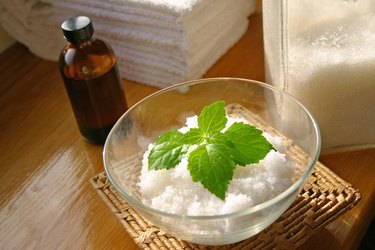
Patchouli is best known as an essential oil and perfume, but the patchouli plant (Pogostemon cablin, syn. Pogostemon patchouli) is less common in the herb garden. Anyone willing to give this fragrant perennial a try, however, is rewarded with fragrant leaves for potpourri and sachets, as well as a plant that requires only minimal basic care to flourish. Patchouli is hardy in U.S. Department of Agriculture plant hardiness zones 10 through 12 and grows well indoors in any zone.
Providing Water and Food
Video of the Day
Allowing the top 1 inch of patchouli's soil to dry out between watering sessions minimizes the risk of overwatering. Insert your index finger in the soil to test the moisture level. When watering a container-grown patchouli, add the water slowly and stop when excess water leaks out the pot's bottom drainage hole. Garden-planted patchouli should also be watered slowly, allowing moisture to penetrate the soil around the roots. Every two weeks, mix 1/2 teaspoon of soluble 10-20-10 or 8-16-8 fertilizer with 1 gallon of water and apply the fertilizer-enriched water in place of a regular watering session.
Video of the Day
Pruning Hard and Often
Patchouli responds to pruning by putting out vigorous, dense growth. Pinch or cut the stems back -- cutting just above a set of leaves -- through the growing season. If you want to maintain the plant's size, pinch back only the top set of leaves. If you want to reduce the size, cut each stem back to the desired height. Patchouli grows about 1 foot tall in containers and up to 4 feet tall in the ground and can take hard, frequent pruning. Before trimming patchouli plants, dip the blades of your pruning shears in a solution that is one part bleach and three parts water, and then dry them with a clean towel. Sanitize the tools again after trimming each plant.
Checking for Whiteflies
With the exception of a possible whitefly infestation, patchouli resists most insect and disease problems. Check for whiteflies weekly; they are tiny flying insects with white wings and white or off-white bodies, and they feed in clusters on leaves. If they are concentrated on one or two leaves, cut off the affected leaves. A strong jet of water also washes off mild infestations. When whiteflies persist, spray the patchouli with a ready-mixed insecticidal soap spray until the leaves are completely coated. Whiteflies don't generally respond well to pesticides, so reapply the spray whenever the whiteflies return until they're eradicated. Water the plant thoroughly the day before you spray and avoid using insecticidal soap sprays when temperatures reach 80 degrees Fahrenheit or above.
Overwintering Indoors
In climates with cold, frost-prone winters, the best way to grow this sensitive herb is in a container that's placed outdoors in summer and inside during winter. Set the potted patchouli in a semishaded spot when temperatures rise above 40 F in spring and take it indoors in fall before temperatures drop. In winter, keep the plants in a bright room that remains above 40 F and maintain a regular watering and pruning schedule.
- Logee's Tropical Plants: Cultural Information -- Pogostemon
- University of Illinois Extension: Successful Container Gardens -- Fertilizer Application
- Edwards Greenhouse: Herb List 2014
- University of California Integrated Pest Management Online: Whiteflies
- University of Florida IFAS Extension: Disinfecting Pruning Tools
- U.S. Department of Agriculture: USDA Plant Hardiness Zone Map