What Are Kids' Oobleck Science Activities?
Taking its name from a book by Dr. Seuss, Oobleck is an easy-to-make substance that demonstrates some unique properties, making it an ideal teaching tool for elementary-level science instructors. Kids' Oobleck science activities involve experimentation with this messy, gooey substance so students can learn about the science behind why Oobleck behaves the way it does.
-
Oobleck
-
Oobleck gets its name from the children's book "Bartholomew and the Oobleck" by Dr. Seuss, in which a king's proclamation that he's bored with the weather results in his magicians devising a sticky green substance called Oobleck that falls from the sky and makes a big mess. Oobleck itself is made by combining one part water with 1.5 to two parts corn starch and mixing vigorously for about 10 minutes, resulting in a gooey substance that exhibits some unique properties.
Oobleck as a Polymer
-
From a chemical perspective, Oobleck is the result of a polymer (in this case, the corn starch) added to liquid. In making Oobleck, one lesson that children can learn is that any time a polymer is added to a liquid, this makes it more difficult for the liquid to move. Often a polymer will slow a liquid so little that it's barely noticeable, but corn starch slows the movement enough that it's easy to see the effects of adding a polymer to a liquid.
-
Oobleck as a Non-Newtonian Fluid
-
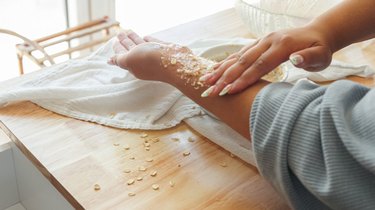
Perhaps the most notable property of Oobleck is that it is a non-Newtonian fluid, meaning that it acts like a liquid when poured and acts like a solid when force is exerted on it. Oobleck can be poured out of a bowl into another container, like a liquid, yet, when squeezed in the hands it will ooze out from between the fingers, like a solid. This is because a non-Newtonian fluid reacts in direct relation to the amount of force applied to it. When any force (such as poking, stirring or kneading) is applied, the fluid's viscosity (or resistance to flow) increases, meaning that exerting force on Oobleck makes the fluid behave like a solid. The more force that's exerted, the more solid the fluid becomes.
Oobleck Experiments
-
Due to the way it responds to the exertion of force, there are a number of experiments that children can perform using Oobleck. Two easy experiments, which both involve children observing the reaction of Oobleck, are to heat or freeze Oobleck (both of which will cause it to harden) or mold some Oobleck into a ball and throw it up in the air (which will cause the Oobleck to lose its shape and become flat in the air). Students will also observe that Oobleck does not bounce upon impact.
-
References
- Photo Credit Stockbyte/Stockbyte/Getty Images