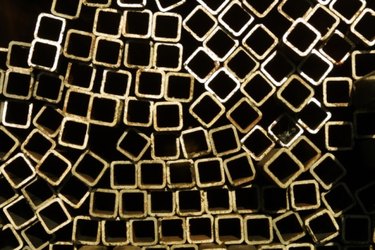
Square steel tubing comes in different sizes, specifications and wall thicknesses. Its uniformity makes it predictable to use and visually appealing. It has a high weight-to-strength ratio. It's easy to bend, and because square steel tubing is inexpensive, it's cost-effective -- even for large projects. Steel tubing is easily recyclable. Many projects take advantage of square steel tubing, including all types of buildings, highway guardrails and signage, support columns, trusses, bridges, heavy equipment, storage systems, and exercise equipment.
Nominal Size
Video of the Day
The Steel Tube Institute of North America specifies the measurement of square tubing by its outside width. For example, a tube with 2-inch wide sides calls out as 2 by 2 inches. Sizes range from 1-1/4 by 1-1/4 inch to 32 by 32 inch. From 1-1/4 inches to 2-1/2 inches, the sizing varies by a quarter-inch. For 2-1/2 to 5-1/2 inches, the sizing varies by a half-inch. Above that, the tubing only comes sized to every whole inch.
Video of the Day
Wall Thickness
Square steel tubing wall thickness ranges from 1/8 inch, also known as 11 gauge, to 5/8-inch thick. The thicker walls only come in larger sizes. For example, while 6 by 6 inch steel tubing comes in both 5/8 and 1/2 inch thickness, 5-1/2 by 5-1/2 does not.
Weight Per Foot
The weight-per-foot specification varies based on the wall thickness and nominal size. The Steel Institute of North America claims that using square steel tubing over other steel structures saves weight. Weight savings provides cost savings during transport to the job site.
Engineering Specifications
Standardized engineering specifications exist for square steel tubing. These include: torsional shear constant of cross-section, moment of inertia of cross-section, torsional stiffness constant of cross-section, governing radius of gyration, elastic section modulus and plastic section modulus. Some of these specifications are for both X-X and Y-Y axes. For exact specification for each nominal size and wall thickness, see the resources.