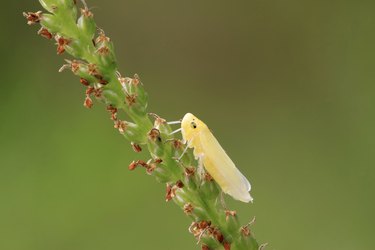
Small, fast-moving leafhoppers are hard to spot because they can quickly jump away in any direction whenever disturbed. The damage the sap-suckers leave behind lets you know they're definitely hanging around your yard, however. The pests feed on a wide range of outdoor plants, and the feeding activity causes affected foliage to develop small white or yellow dots, which sometimes merge into large white blotches as the leaves mature. Although leafhoppers are difficult to control, you can often reduce pest populations by using a combination of natural predators, mechanical control methods and insecticidal soap.
Attract Leafhopper Predators
Video of the Day
The leafhopper's natural enemies include ladybugs, spiders, parasitic wasps, minute pirate bugs and damsel bugs. Entice these beneficial insects to your home landscape with flowering and nectar-producing plants. Good lure plants include annual herbs, such as dill (Anethum graveolens) and coriander (Coriandrum sativum), as well as annuals that bear showy flowers. Cosmos (Cosmos bipinnatus) and marigolds (Calendula officinalis) are both good options for attracting beneficial insects while adding color to your yard. Beneficial insects can often handle small leafhopper problems for you, but avoid spraying your outdoor plants with broad-spectrum insecticides or you risk wiping out the good bugs along with the pests.
Video of the Day
Exclude the Leafhoppers
Draping floating row covers over vulnerable plants can keep leafhoppers out while still allowing water, sunlight and air to pass through. Place row covers over garden seedlings just after planting, but remove them once the plants start blooming so the pollinators can reach the flowers. Weigh down the edges with rocks or soil so the pests don't find a way to get in with your plants. Removing weeds and other garden debris helps control leafhopper numbers by reducing the number of potential overwintering and egg-laying spots in your landscape. Giving infested plants a strong blast of water from a garden hose often rinses the slow-moving nymphs off the foliage.
Place Sticky Traps
Yellow sticky traps attract leafhoppers, so setting them out near infested outdoor plants helps control pest populations. Buy commercial yellow sticky traps or make your own by cutting cardboard or heavy poster board into 5-by-7-inch pieces and paint them yellow. Coat traps with a thin layer of petroleum jelly or cooking oil. Attach the traps to plant stakes or sticks and drive them into the soil surrounding affected garden plants or small shrubs. Make holes near the top of traps and hang them from small branches to snare leafhoppers feeding on trees and large shrubs. Check the traps once a week, giving them a new coat of sticky substance or replacing them as needed.
Apply Insecticidal Soap
Although adult leafhoppers are usually too fast to squirt with chemicals, insecticidal soap sprays often eliminate the young nymphs. Start treating your outdoor plants when you first notice feeding damage, and repeat applications every four to seven days until you obtain control. Read and follow the mixing and application instructions on the product's label. Most products call for a 1 to 2 percent solution, or 2-1/2 to 5 tablespoons of concentrate for every gallon of water. Use a handheld garden sprayer to completely coat the foliage. Leafhopper nymphs like to hang out beneath the leaves, so make sure you cover the undersides as well as the tops.
Play It Safe
Insecticidal soaps aren't toxic to people, pets, birds and most beneficial insects, but the solution can still irritate your eyes and skin. Put on protective clothing, goggles and waterproof gloves before mixing and spraying soap solutions. Keep people and pets out of the treatment area until the spray thoroughly dries.
Some plants are sensitive to insecticidal soaps. Test for sensitivity by spraying a small, inconspicuous section of foliage and waiting about 24 hours to see if burning occurs. If the leaves suffer no damage, spray your entire plant. Rinse plants with water from a garden hose if the leaves start turning brown or wilting within the first three hours following a soap treatment. Don't spray soap on sunny days or if the temperature rises above 90 degrees Fahrenheit or you risk burning plant foliage.
- Missouri Botanical Garden: Leafhoppers and Planthoppers
- Clemson Cooperative Extension: Insecticidal Soaps for Garden Pest Control
- Floridata: Coriandrum Sativum
- UC Davis Good Life Garden: Fighting Pests With ... Pests!
- Ornamentals Northwest Archives: Use of Yellow Sticky Traps in Greenhouses
- Missouri Botanical Garden: Anethum Graveolen
- Missouri Botanical Garden: Cosmos Bipinnatus
- UC Davis College of Agricultural & Environmental Sciences: Leafhoppers
- Missouri Botanical Garden: Calendula Officinalis
- UC Statewide IPM Online: Leafhoppers
- Organic Gardening: Flowers for Borders