How to Heat Treat 440 Stainless

How to Heat Treat 440 Stainless thumbnail
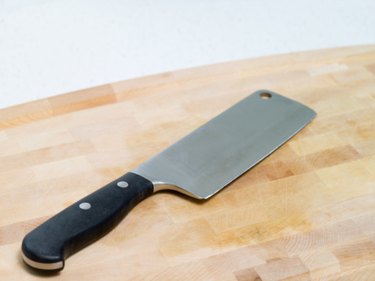
440 stainless is a common, modern knife steel.

The 440 series of stainless steels are a good choice for knife-making because they have reasonable resistance to stains and corrosion while retaining the hardness and toughness of carbon steels. The 440A, 440B and 440C steels are too difficult to form in their hardened state, so you will need to anneal the blank before you can form the blade. Fortunately, you do not have to quench 440 stainless when you heat treat it; it reaches full hardness of 55 to 57 on the Rockwell C scale with simple air cooling.

Things You'll Need

  • Heat treating oven
  • Tongs
Show More

Instructions

    • 1

      Place the blank, the unfinished piece that will become your knife blade, in the heat treating oven and heat slowly to between 1,550 and 1,650 degrees Fahrenheit to anneal it. This process removes any prior heat treatment and makes the metal soft enough to grind or otherwise shape. Do not heat faster than 400 degrees per hour. Hold the final temperature for one hour, then gradually reduce the temperature to 1,000 degrees Fahrenheit. Do not cool faster than 50 degrees per hour. Remove the blank from the oven and allow it to air cool in a draft-free area at normal room temperature. At this point, you may machine or grind the blank to its finished shape.

    • 2

      Harden the blade. Place it into the oven and heat slowly to between 1,400 and 1,450 degrees Fahrenheit. Do not allow the temperature to increase more than 400 degrees per hour. Hold the blade at 1,400 to 1,450 degrees for one hour and then heat the blade as quickly as possible to between 1,850 and 1,950 degrees Fahrenheit. Hold this temperature for 30 minutes.

    • 3

      Remove the blade from the oven and allow it to completely cool in still, room-temperature air.

    • 4

      As soon as the blade is cool, place it in the oven and heat it to 300 degrees Fahrenheit. Hold it at that temperature for one hour.

    • 5

      Remove the blade from the oven and allow it to cool completely in still, room temperature air.

Tips & Warnings

  • Always use tongs, heat-resistant gloves and eye protection when working with hot metal.

Related Searches:

References

  • Photo Credit Jupiterimages/Photos.com/Getty Images

Comments

You May Also Like

  • Solutions for Cleaning Heat Treated Stainless Steel

    Solutions for Cleaning Heat Treated Stainless Steel. Various specifications exist for cleaning heat-treated stainless steel. When the base metal gets welded, it...

  • Properties of 440 Steel

    Grade 440 stainless steels have very high carbon content, especially the types 440C and 440F. Grades 440A and 440B are almost identical...

  • How to Heat Treat Steel

    Many types of steel are too soft for certain applications. Very often it is necessary to harden a particular piece of steel....

  • How to Heat-Treat Knife Blades

    Heat treatment is a metal fortification technique that gives high carbon steel increased strength and durability. When subjected to extremely high temperatures...

  • How to Drill through Stainless Steel

    You've just purchased a new stainless steel shelf but the manufacturer somehow neglected to provide holes in the mounting brackets. You could...

  • How to Treat Stainless Steel Sinks

    Comments. You May Also Like. How to Heat Treat Steel. Many types of steel are too soft for certain applications. Very often...

  • How to Heat Treat 4140 Steel

    4140 steel is a high-strength alloy that is made up of iron, chromium, silicon and molybdenum. This material has excellent strength for...

  • The Properties of VG-5 Steel

    VG-5 is a high-carbon stainless steel with a carbon content of between .7 and .8 percent in comparison to the much more...

  • How to Polish 440 Stainless Steel

    440 stainless steel is a steel alloy that contains chromium and is typically used to make cutlery. 440 stainless steel is corrosion-resistant,...

  • Induction Heat Treating

    Induction heat treating is a process by which electrically conductive substances are exposed to heat to make them more stable. The most...

  • How to Make a Combat Knife

    Technically, a combat knife is defined as a large knife which can be used for military purposes. Many people think that this...

  • Properties of 440C Steel

    Properties of 440C Steel. Steel is a part of most people's daily lives, from their cooking utensils to support beams at office...

  • How to Prevent Heat Exhaustion With Food

    How to Prevent Heat Exhaustion With Food. Part of the series: Fitness & Nutrition. Certain foods can help prevent heat exhaustion by...

Related Ads

Featured