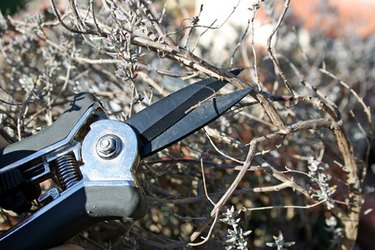
How to Prune Culinary Sage
Culinary sage is a flavorful herb that is straightforward to grow, maintain and harvest for even the most novice of herb gardeners year after year. The sage plant can reach an average of 2 feet tall when provided with full sun and planted in a well-drained, alkaline soil. While the flavor of different types of sage can vary, overall you will prune culinary sage in the same manner to achieve a hardy plant that produces lush leaves. Does this Spark an idea?
Instructions
-
-
1
Allow new plants to grow undisturbed until they reach 8 inches tall before performing any pruning or harvesting to allow the roots and base of the plant to become established.
-
2
Pull individual leaves from the plant over the course of the growing season for small collections of fresh sage. As you pull the leaves, pull them straight out from the plant's stems, not rip them off in a downward motion.
-
-
3
Clip off dead flowers from the ends of individual stems just above a set of leaves with a clean cut perpendicular to the stem. Sages should be done flowering by early to midsummer.
-
4
Cut off the tips of non-flowering stems to encourage branching just above a set of leaves as they grow longer than 2 feet tall. Maintain the sage by continually trimming off new tips of stems that extend beyond 2 feet tall.
-
5
Pull approximately half of the sage's leaves in late summer to dry for use over the winter and spring. Collect large amounts for dried sage by clipping the whole stems back to the old wood and hanging the stems upside down until the leaves dry.
-
6
Stop collecting leaves in early fall to allow plant to harden for winter
-
7
Prune back the woody stems of established sage plants hard -- by approximately half their size -- with bypass pruners in early spring to encourage a compact, bushy shape.
-
1
Tips & Warnings
Don't harvest leaves too heavily during the first year of a sage plant's life as it needs the leaves to perform photosynthesis and grow larger.
Yellow leaves on your sage can indicate the plants aren't spaced far enough apart. Standard spacing places each plant 18 to 24 inches apart.
References
- Photo Credit Medioimages/Photodisc/Photodisc/Getty Images