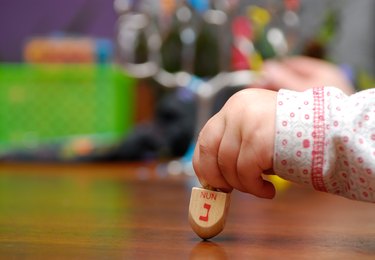
Jewish holidays are all-inclusive; everyone from grandparents to the youngest children participate. Many games and activities exist for each holiday. These games may seem simple, but children enjoy them and the legacy the games bring. The most well-known of these games is spinning the dreidel at Hanukkah, which originally was a gambling game for adults.
Dreidel Game
Video of the Day
The dreidel game, played during the eight nights of Hanukkah, can be modified for children to be an easy game for two or more players. The game is played with a dreidel, a spinning top. The players start with a pot with candy, pennies or pretzel sticks. Each of the dreidel's four sides has a Jewish letter on it, which determines the player's actions with the candies. The first player spins. Depending on the letter on which the dreidel lands, the spinner places something into the pot, takes the pot, takes half the pot or does nothing. Once all the other players have lost their items, the winner is declared.
Video of the Day
Find the Afikomen
During Passover, Jews eat unleavened bread called matzo. At dinner, guests participate in a ceremony called a seder, which uses three pieces of matzo. One sheet of matzo is broken in half and wrapped in a napkin or special dedicated cloth. Called the afikomen, this piece of matzo is hidden somewhere in the home. The children at the seder must find the afikomen; the winner usually receives a nominal prize such as a small amount of money or candy.
Haman's Gragger
At the holiday of Purim, children learn about a mischievous, trouble-causing man named Haman. Haman, who wore a three-pointed hat, caused much trouble for the Jews and serves as a learning point each year. When Haman's name was said to the Jews, they despised it so much that they made as much noise and ruckus as they could to drown it out. This has resulted in the production of graggers, small wind-up noise makers that children play with at Purim. The graggers come in all shapes and sizes. Some are decorated with images of Haman and his three-pointed hat; others have pictures of Jerusalem or "Happy Purim" messages on them.