Things You'll Need
Sandpaper, medium and fine grit
Putty, matching color
Putty knife
Tack-rag or damp cloth
Primer, not water based
Filler
Hand trowel
Paint
Angle paintbrush
Paint roller and tray
Drop-sheet protective plastic
Screwdriver
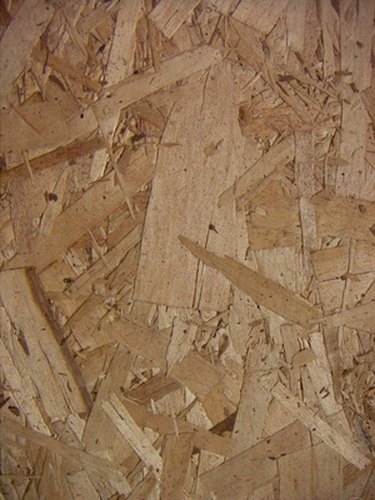
Particle board has a naturally decorative and porous surface requiring some basic finishing techniques. A one-part polyurethane protective sealer for a one-step, clear or tinted finish can be applied after puttying screw holes and sanding the walls. This finishing process will enhance the natural surface of the particle board, but because particle board is extremely porous, painting particle board walls will require a couple of extra steps for best results.
Step 1
Countersink any screws that sit above the particle board. Spread putty into all screw holes with a putty knife. Let the putty dry completely according to the instructions on the label.
Video of the Day
Step 2
Cover any floor surface or furniture with the drop-sheet plastic.
Step 3
Sand the walls and putty marks with the medium grit paper, then with the fine grit paper.
Step 4
Wipe the walls down with a tack-rag to remove all dust.
Step 5
Prime the walls with the primer. Use an angle paintbrush to get into corners along the roof line and floor. Use a roller for the larger areas. Let dry. Clean the brush and roller as instructed on the label, ready for the paint, or purchase a second set.
Step 6
Apply the filler with a hand trowel or brush as instructed on the label. Let dry. If you applied it with a hand trowel you may want to sand lightly and wipe the walls again before painting. Do not sand off too much of the filler.
Step 7
Paint the walls. Use an angle paintbrush to get into corners along the roof line and floor. Use a roller for the larger areas. Let dry between coats.
Warning
Open windows for ventilation. Leave windows open until all paints and fillers are dry. It can take up to one week for paint and paint products to cure fully. Open windows periodically or leave them cracked-open until the smell is gone.
Use protective gloves, goggles and masks if instructed on product labels or preferred.
Particle board can give off hazardous formaldehyde vapors.
Video of the Day