Things You'll Need
2 pulleys enclosed in wooden frames
2 screw-ended hooks
1 screw-ended eyehook
Rope
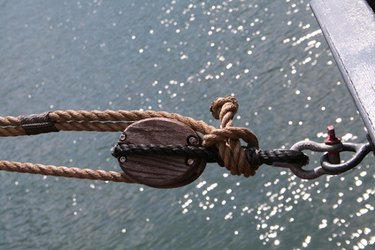
A "block and tackle" is system of pulleys for making lifting and pulling easier. A pulley system is made up of two or more pulleys connected together with rope in such a way as to provide mechanical advantage. Mechanical advantage means the ability to turn long, low-power pulling motions into short, high-power pulling motions. This allows you to lift heavier weights than you normally could. (See References 1 & 2)
Step 1
Screw one of the screw-ended hooks into one end of the frame of one of the pulleys. For the other pulley, screw one screw-ended hook into one end of the frame and the eyehook into the other end. (See References 1 & 2)
Video of the Day
Step 2
Feed the rope into the pulley with the eyehook in it. Pull half of the rope through this pulley, so that it does not accidentally fall out while you are handling it. (See References 1 & 2)
Step 3
Feed one end of the rope through the pulley with the one hook in it. Tie that end of the rope to the eyehook attached to the other pulley. (See References 1 & 2)
Step 4
Attach the top hook of the pulley with the eyehook to a support overhead. This support can be a tree branch, tripod, roof beam, or anything that is both high off the ground and sturdy. (See References 1 & 2)
Step 5
Attach the hook at the bottom of the lower pulley to whatever weight you want lifted. Pull on the free end of the rope. You will have to pull two feet of rope for every foot you want to lift the weight, but you will only use half of the energy that you would normally use in lifting that weight. (See References 1 & 2)
Tip
To attach the upper pulley to the overhead support, tie a rope around that support and hook those ropes with the pulley’s hook. If there is no way to tie a rope in place, try screwing another hook into the support.
As you haul on the pulley system’s rope, the tension is the same all along it. Therefore, the lower pulley is being lifted on both sides by the same tension you are putting on the rope. This effectively doubles your lifting capacity. If this is not enough mechanical advantage, then add other sets of paired pulleys to increase it further. (See References 1 & 2)
Warning
Make sure that both your rope and your pulleys are strong enough to support the weight you are trying to lift without breaking.
Video of the Day