How to Identify Nut-Bearing Trees in Kentucky

How to Identify Nut-Bearing Trees in Kentucky thumbnail
How to Identify Nut-Bearing Trees in Kentucky

Kentucky has no scarcity of nut-bearing trees. Several species occur throughout the entire state, according to the "National Audubon Society Field Guide to Trees." Among them are the butternut, black walnut and many types of hickories, including the pecan tree. The key to identifying these nut-bearing Kentucky species is to look for specific features on each tree, with very close attention being paid to the leaves and the nuts. Does this Spark an idea?

Instructions

    • 1

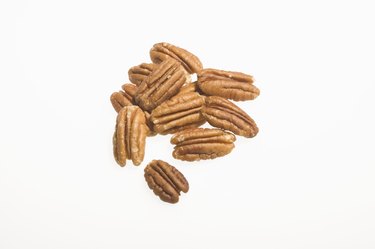
      Recognize the pecan tree by its height and by its leaf structure. The pecan can grow to heights in the 100 to 150 foot range. The tree only grows in the wild in western Kentucky, but cultivated forms occur throughout the state. Look at the compound leaves of the pecan and notice they are compound. The leaf consists of one long central axis stem (rachis), to which a variable number of leaflets attach by short stalks to form one leaf. Pecan leaves have from 11 to 17 leaflets, with the leaflet having a slightly curved look and possessing fine serrated teeth on its edge. The pecan nut comes in an oblong brownish husk.

    • 2

      Look at the many leaflets on a black walnut leaf to help you identify this Kentucky nut-bearing species. Each leaf contains about 16 separate leaflets, notes the University of Kentucky site. The nuts have a thickened green husk around them. Notice that when you handle the nuts, a brown-yellow dye will seep out and stain your hands. Black walnut trees can be as high as 100 feet, but most mature walnuts in Kentucky top out at about 60 feet tall.

    • 3

      Observe the form of the butternut trees in Kentucky. Butternuts have a short straight tree trunk and stout lower branches. Butternuts can grow to 70 feet in height and have leaves with from 11 to 17 leaflets. Examine the nuts growing in clusters of as many as five. You will see they are egg-shaped with pointed ends and that the nut inside the husk is very oily.

    • 4

      Identify the Kentucky hickory trees by their bark. Study the bark of the shellbark and shagbark hickories and look for thin, narrowed scales of bark with outward curving ends all over the trunk. Inspect the bark of the bitternut hickory, looking for gray bark with shallow furrows. Pignut bark is smoother than most Kentucky hickories, while mockernut hickory bark is grayish and features shallow ridges and furrows.

    • 5

      You can distinguish the Kentucky hickories by the size of their leaf rachis and the number of leaflets they have. Shagbark hickory has a rachis as long as 14 inches and typically has five leaflets on one leaf. Shellbark hickory leaves can be 24 inches in length, with the usual number of leaflets being seven. Mockernut hickory has a leaf as long as 1 foot, with from seven to nine leaflets attached to it. Pignut hickory has a 6 to 12 inch long rachis and normally has five leaflets per leaf. Bitternut hickory has a 6 to 9 inch rachis, reports "Trees of North America," with from seven to eleven individual leaflets on it.

Related Searches:

References

  • Photo Credit Jupiterimages/liquidlibrary/Getty Images

Comments

You May Also Like

  • How to Identify a Nut Tree

    Walnuts, pecans and hickories are just some of the many nut trees that grow in many parts of the United States. Nut...

  • Nut-bearing Trees in Pennsylvania

    Nut-bearing Trees in Pennsylvania. Among the 108 species of trees native to Pennsylvania are several that bear nuts, according to the Pennsylvania...

  • How to Identify Hickory Nuts in Kentucky

    Kentucky is home to a number of trees from the genus Carya---the hickories---with all of these trees producing an edible nut. Species...

  • Is a Pecan a Hickory Tree?

    The pecan and the hickory tree both belong to the Juglandaceae family, but the two trees are completely different. A tree created...

  • List of Nut Tree Diseases

    List of Nut Tree Diseases. Many nut trees grow and thrive as commercial crops in the United States. Almond, pistachio, and walnut...

  • How to Identify Kentucky Pine Trees

    Kentucky is known as the Bluegrass State, but it has plenty of larger flora in its native forests. The two native pines...

  • How to Grow Grass Under Walnut Trees

    Certain walnut trees, such as black walnuts, produce a chemical called juglone that is toxic to most grass and plants. Almost any...

  • Kentucky Tree Leaf Identification

    Located on the western slopes of the Appalachian Mountains along the Ohio River, Kentucky has a rich and varied flora, which includes...

  • How to Identify Nut Trees

    Throughout large portions of North America, various species of nut-producing trees grow in the wild. Some of the most common are the...

  • Hybrid Pecan Trees

    A hybrid between pecans (Carya illinoensis) and several types of hickories (Carya spp.), hicans (Carya illinoensis x ovata) combine qualities of both...

  • How to Identify Oak Trees in West Kentucky

    From the long-living white oak to the narrow, tapered leaves of the shingle oak, western Kentucky is home to a number of...

  • What Grows Under a Walnut Tree?

    Trees emit biochemicals into the soil around their roots as a way to stop other plants from growing and competing for nutrients....

  • How to Identify Hickory Trees

    Hickory trees (genus Carya) are of two groups, true hickories and pecan hickories. Both are medium sized deciduous trees, slow growing and...

  • Tropical Trees Bearing Nuts

    Tropical Trees Bearing Nuts. Many tropical trees bear nuts that can be prepared and eaten by humans. If you live in an...

  • Wild Fruit Trees in Kentucky

    Wild Fruit Trees in Kentucky. Different types of fruit trees grow wild in Kentucky. These wild Kentucky fruit trees produce fruit ranging...

  • Uses for a Hickory Tree

    The hickory is a nut-bearing, hardwood tree with a variety of uses. There are a number of species of hickory trees, ranging...

  • Pecan Tree Species

    The pecan tree is in the same family as hickory, walnut and black walnut trees. It is the largest of the hickories...

  • How to Identify Oak Trees

    The oak tree has approximately 450 species. This slow-growing tree lives around 500 years and some have lasted over 1,000 years. Oaks...

  • How to Grow a Kentucky Coffee Tree From Seed

    A tree native to the United States west of the Allegheny mountains, the Kentucky coffee tree is not actually a coffee bean-bearing...

Related Ads

Featured