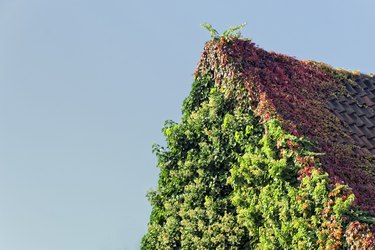
Climbing hydrangeas (Hydrangea spp.) scramble up walls and trees with the help of aerial rootlets. In late spring and early summer, they produce flat clusters of small cream or greenish-yellow blooms ringed by larger white flowers. Deciduous varieties need partial or full shade, while evergreen types tolerate more sun. All varieties prefer moist, humus-rich, well drained soil, and you can easily propagate climbing hydrangea from seeds or cuttings.
Choose Appropriate Climbing Hydrangeas
Video of the Day
The deciduous climbing hydrangea (Hydrangea anomala) boasts heart-shaped leaves up to 4 inches long and can reach a height of 40 feet in U.S. Department of Agriculture plant hardiness zones 5 through 8. It also has peeling, copper-colored bark and flower clusters as large as 8 inches across. Its bigger and slightly hardier subspecies, Hydrangea anomala subsp. petiolaris, grows to 60 feet with 6-inch leaves and 10-inch flower clusters in USDA zones 4 through 8.
Video of the Day
With oval and leathery leaves up to 6 inches long and flower clusters 6 inches in diameter, the evergreen climbing hydrangea (Hydrangea seamanii) clambers to 30 feet in USDA zones 8 through 10. It makes an always green alternative to deciduous hydrangeas in Southern states, where those types won't thrive. If you prefer a larger evergreen type, try Hydrangea integrifolia, which can grow about twice as tall as seamanii in USDA zones 7 through 9.
Harvest Climbing Hydrangea Seeds
Gather seeds from climbing hydrangea plants in September or October. Look for urn-shaped brown seed capsules, which are only about 1/10 to 1/5 inch long. After drying the seed pods for two weeks, crush them lightly with a rolling pin on white paper where the sand-like seeds will be easy to see. Pick out and discard as much of the chaff as you can, and store the seeds in paper or glassine envelopes -- fine seeds tend to stick to plastic packets.
Sow Climbing Hydrangea Seeds
In late winter, fill a container that has drainage holes with sterile seed-starting mix. Scatter the seeds thinly over the surface of the mix, and press them into it without covering them. After topping the container with plastic wrap, place it under a grow-light in a warm room with temperatures near 70 degrees Fahrenheit. The seeds should germinate within 18 days.
Thin the seedlings as necessary to allow them room to grow. Keep their mix damp, and feed them once every two weeks with a mild, organic fish and seaweed fertilizer such as 2-3-1, combining 2 tablespoons of it with 1 gallon of water. After the little plants are 1 inch tall, pinch back their tips, and give each one its own 4-inch pot of potting soil. Use seedling pots with drainage holes in the bottom. Move those pots to a partially shaded location outdoors during the summer, keeping them well-watered, and transplant the seedlings into the ground in early autumn.
Propagate Climbing Hydrangea From Cuttings
To propagate climbing hydrangea from a cutting, clean the blades of your pruning shears with rubbing alcohol first. Then locate a shoot that already has aerial rootlets growing on its stem under a leaf node that's 4 or 5 inches beneath the shoot's tip. Detach that shoot from the plant by cutting it just below the rootlets under the node.
After filling a pot that has drainage holes with potting soil, plant the shoot in its center with the rootlets and node below the surface of the soil. Place the pot in a protected, shady location and keep its soil damp until the shoot begins sending out new growth.