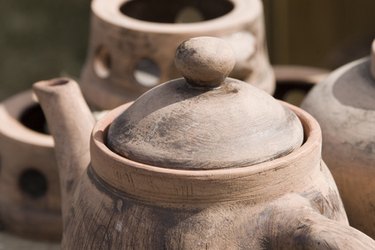
How to Make Primitive Pottery

The phrase "primitive pottery" refers to two art-forms. The first is a sheep-to-shawl process that begins with locating, digging, and tempering local clay to turn it into simple pots and dishes. Because local conditions differ widely, this article will focus on the techniques of making primitive pottery from already-available and conditioned clay (although links are provided below for full-process resources). What follows, therefore, are processes for creating primitive pottery through hand-forming methods, with links to several methods of firing.

Things You'll Need

  • Fireable pottery clay Water-protected work surface Small bowl of water Cutting or carving tools if desired (wood, metal or plastic) Long piece of thin, strong string Barbecue grill and charcoal OR wood fire with a rack over it to hold pots Small shovel and tongs, to manage fire and pots
Show More

Instructions

  1. How to Make Primitive Pottery

    • 1

      Cut a piece of clay from and set it on your work surface. Wet your hands lightly, and slam the clay hard several times on the work surface. Knead the clay for several minutes, wetting your hands again as needed, until the clay is smooth, flexible, and free of lumps or air bubbles. (Air bubbles trapped in raw clay will expand with the heat of firing and can cause pots to crack or shatter.)

    • 2

      METHOD 1: Pinch-potting or hand-building.
      Keeping clay in a single piece, stretch, pull and pinch it with your fingers to produce a smooth round or squarish shape of an even thinness (approximately 1/4 inch).
      Using fingers and the palms of your hands, leave the center of the shape flat and raise the sides. If your shape is squarish, pinch the corners of sides together to keep sides standing up.
      Resist the urge to flare sides out widely; they may collapse of their own weight while drying or firing. Your early efforts are likely to produce fairly small dishes with 3" to 5" of flat base and an inch of wall.

    • 3

      METHOD 2: Ball-building.
      Form your piece of clay into a firm, solid ball. Using one or more fingers, make a hollow in the center, stopping 1/4 inch before you hit the bottom of the ball.
      Using your fingers and hands, gradually enlarge the hole in the center until the sides of your bowl are of an even 1/4 inch thickness.
      This method can produce a round bowl with higher sides than Method 1.

    • 4

      METHOD 3: Coil pots.
      Roll pieces of clay into long ropes of even 1/4 inch thickness.
      Coil the first rope tightly to make the bottom of your dish, making sure all edges fit snugly.
      Smooth coils together with wet hands.
      Beginning with your second or third rope, gradually build the sides of your pot, fitting edges together snugly and smoothing with wet hands.
      This technique is easy to begin but challenging for beginners as pot sides get higher.

    • 5

      ALL METHODS: Let your pot dry for half an hour, then, using a wooden stick, metal or plastic knife, make shallow decorations on your pot if you wish. Keep marks shallow because you do not want to make your pot too fragile to get through firing.

    • 6

      ALL METHODS: Wrap the string around both hands, stretch it tight, and run it under the bottom of your pot. This is often the easiest way to remove the pot from your work surface. Set your pot aside to dry overnight. You are ready to fire your pot when the dry color is completely even over the whole surface and your pot feels slightly lighter in weight.

    • 7

      Place charcoal in the bottom of your barbecue grill, wait until the fire is hottest and, using tongs, place your pot on the grill to fire.
      One primitive experimenter reports plans to dig a fire-pit as an alternative to a modern kiln. Those who relied on local clay to make pots may have buried pots directly in fires or ash piles as well. You have entered experimental territory, where firing directions from your modern clay source and whatever fire-based technology you possess must be combined as best as is possible.
      When in doubt, keep feeding the fire and assess your results as you go (accounts of others' attempts are in links).

Tips & Warnings

  • Don't get discouraged if you are new to making pottery. Keep trying---and remember that primitive people who gave up easily went without stew pots and water cups until they got it right!

  • Working with pottery and open firing techniques presents some potential dangers. Consider safety-glasses, heavy oven mitts and a heavy apron when trying this experiment. Pots that are still damp or have lots of air bubbles can explode. Proceed with caution and care. Let the fire die before removing pots to lessen danger.

Related Searches:

References

Comments

You May Also Like

  • Primitive Pottery Making

    Makers of primitive pottery often formed their creations around baskets or other objects and then hardened them in a fire pit. According...

  • What Is Greenware Pottery?

    Greenware pottery is pottery that is awaiting firing. Pottery is the term for items made from clay. Greenware pottery is the name...

  • Primitive Cooking Tools

    The most primitive cooking tools consisted of a flame and a utensil to hold food over it. In simplest forms, this method...

  • Primitive Trim & Molding Ideas

    Primitive Trim & Molding Ideas. Primitive style decor is also known as country style, which is meant to make a home feel...

  • Clay Pottery History

    There are three types of pottery, earthenware, stoneware and porcelain. Pottery was hand-shaped at first, but evolved with the invention of the...

  • How to Decorate With Primitive & Rustic Crafts

    One-of-a-kind handcrafted items add personality to your home. A simple painting depicting a country scene can transport you to a bucolic meadow...

  • How to Make Primitive Glass Candle Jars

    Primitive glass jars are one of the most unique items you can make. Primitive jars can be decorated to match anyone's personal...

  • How to Fire Clay Pottery

    Working with clay pottery in a kiln must be completed very carefully with many safety precautions. Firing clay pottery is the most...

  • How to Make Pottery Glaze

    The Egyptians added ashes to pottery to generate a glossy sheen. Make your own pottery glaze by using common household goods. Modern...

Related Ads

Featured