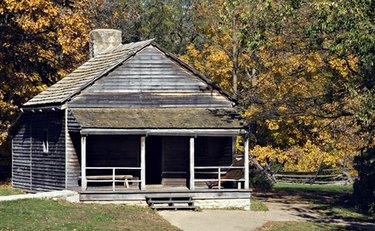
How to Make Pioneer Clothes
Whether your town has a heritage day celebration, your civic club is staffing a Pioneer Days float for this year's homecoming parade or your daughter wants to dress up like "Little House on the Prairie" for Halloween, pioneer costumes are, fortunately, easy and inexpensive to make. With a little time and quick trips to the thrift store and garden store for accessories, your entire family can be decked out in pioneer clothes in no time.
Things You'll Need
- Fabric
- Measuring tape
- Pins
- Scissors
- Sewing machine
- Thread
- Needle
- Bias tape
- 1/4-inch-wide elastic
- Muslin
- Chinese flats
- Straw hats
- Baggy pants
- Bone, wood or metal buttons
- Old shoes
Instructions
-
Pioneer Clothes for Women and Girls
-
1
Choose your dress fabric. Pioneers had access to gingham, calico prints and plain cotton fabric, not only before they left "civilization" for points west, but there were enough small towns with dry goods stores in the western states to supply them with any fabric they may need. Stay away from obvious contemporary prints, anything sparkly and neon colors.
To determine how much fabric you need, measure from the top of your shoulder to the floor. Double (one for front, one for back) and add 6 to 8 inches. Add a yard for the sleeves. You will also need about 1 1/2 yard of plain muslin to make an apron. Measure yourself from the waist down, and double it. You will need this extra muslin to make a petticoat. -
2
Sew the dress. Remove your 1 yard of sleeve fabric and set it aside. Cut a piece, 2 inches wide, off one end to make into a neck drawstring later. Fold the remaining fabric in half (corresponding with your height from the shoulder down, plus a bit) and cut into two pieces. These are the body of your dress. Take your yard of sleeve fabric and cut it so you have two pieces 22 inches wide and 36 inches long. You should have four rectangles.
Take one of the sleeves and pin it to the side of the body, right sides together, short end of the rectangles lined up, from the top to about 10 inches down. Sew. Repeat with the other sleeve. Repeat with the other side of the sleeve pieces and the other body piece. Now, sew up the sides of the body and the sleeve in one big seam. Do not turn right side out yet. -
-
3
Finish the dress. Fold over 1/4 inch all the way around the huge neck/sleeve opening and press. Fold over another 1 1/2 inches and press. Sew as close to the pressed side as possible, leaving 1 or 2 inches open in the front center. Make your drawstring out of the 2 inches of fabric you cut off earlier, and thread it through the "sleeve" you just made. If you don't want a matching drawstring, you can stitch up some double-folded bias tape and use that as your drawstring.
Hem the sleeves, and stitch some open bias tape, about 1 1/2 inches in from the hem, on both sides of the tape, as near the edge as possible. Leave 1 inch of tape unstitched on one side. Run a piece of 1/4-inch elastic, slightly larger than your wrist, through the bias tape sleeve. Stitch the ends together, and sew the opening in the bias tape closed. Hem the bottom to fit. -
4
Make the apron and petticoat. Take two lengths of muslin, measuring from your waist to the bottom of the dress. Cut a piece to make a drawstring or use bias tape as a drawstring, as above. Sew the selvage sides of the muslin pieces together, making a tube 90 inches wide by your required length. Make a "sleeve" for the drawstring, as above. Hem the bottom. This is your petticoat.
Cut two pieces, 3 inches by your waist circumference, plus enough to tie a bow, from the muslin to use as the waistband/bow. Determine how big and how full you want your apron to be, and cut a piece of muslin to that size. Hem three sides of the muslin. Pin the top of the apron to the waistband, and sew. If you have a big enough scrap of muslin left over, make a pocket.
Put on the petticoat, then the dress, then use the apron to define your waist, and tie. Add a plain straw hat from the gardening store and some black canvas "Chinese flats" to your feet and you are a pioneer girl or woman.
Pioneer Clothes for Men and Boys
-
5
Dress the men and boys. Fortunately, men's pants haven't changed much in the last 150 years. Find some men's pants that are slightly baggy in the leg. Navy, black or tan would all work.
Pioneer men and boys also wore gingham or striped shirts, and plain, unbleached muslin would work, too. -
6
Make the shirt. For the shirt body, you will need one rectangle (front and back) as long as twice the measurement from middle of the shoulder to the top of the thigh and 5 (for boys ) to 10 (for men) inches wider than the waist or chest measurement (whichever is bigger). Make rectangles for sleeves that go from just below the shoulder to the wrist, 20 inches wide for men, 10 for boys. Pioneer shirts were baggy.
Determine the center of the shoulder on the body fabric. Pin a short rectangle side of the sleeve piece to the body at that point, centered with the center of the shoulder. Stitch. Repeat on other side. Sew the long seam up the sides of the body and down the sleeve, stopping 2 to 3 inches from the end of the sleeve. Hem the bottom. Hem the sleeve-end slits.
Cut a circle out of the center top fold of the body, roughly corresponding to the wearer's neck measurement. Cut a slit in the front center of the neck, 3 inches (boys) to 5 inches (men) long. Make a rectangular placket with a matching slit and the sides pressed 1/4 inch and pin to the right side of the shirt, lining up the slits. Stitch around the neck slit, turn, press and stitch around the edge of the placket.
Make a no-collar by measuring around the neck hole (not including the slit) and cut a piece of shirt fabric 2 1/2 inches wide by the neck hole measurement, plus 1 inch. This is your "collar." Sew the right side to the right side of the neck hole, turn, press and stitch to the inside of the neck hole. Do the same for the shirt cuffs. Add a button hole and buttons to the cuffs. -
7
Accessorize the guys. Old leather shoes or work boots will complete the outfit (try to stay away from rubber soles). The menfolk will also need simple straw hats.
-
1
Tips & Warnings
Machine wash and dry and iron all fabric before you begin to sew. Pioneer children basically wore miniature versions of adult clothing. All adult clothing steps and tips will apply (only smaller) to your kids' costumes. Press all seams open as you go.