eHow launches Android app: Get the best of eHow on the go.

Click Here
How To

How to Set Up a Home Theater Projector

Contributor
By eHow Contributing Writer
(0 Ratings)

While the thought of creating your own home movie theater may seem like a fantasy, the wider availability and dropping prices of home theater components are putting it in reach of many multimedia enthusiasts. Setting up a home theater projector is a great way to get that big movie-like picture that you desire. Get it done right and you'll never feel the need to pay $10 for a movie ticket again.

Difficulty: Moderate
Instructions

Things You'll Need:

  • Video cable Mounting hardware Drill Tape Measure
  1. Step 1

    Turn projector and video components off.

  2. Step 2

    Determine where you're going to place the projector. Projectors are generally designed to be mounted on the ceiling or placed on a stand or table. You want your projector to be centered in relation to the screen that you're using. It should also be set at the proper throwing distance to provide the optimal size and resolution that you need for your given screen. You could refer to the user manual for suggested set-up distances, but since you're reading this you probably don't have access to the manual. In that case, connect a DVD player or similar video component and physically test out distances to determine the best place to mount. Step 5 describes video connection.

  3. Step 3

    Ensure that the projector is centered. Don't simply eyeball it. Measure the center of the screen using a tape measure. Use a straight marker like a ruler or tape measure and run it to the area where you'll be setting up the projector, keeping it perpendicular to the the wall or screen. If mounting on the ceiling use a plumb to determine the spot on the ceiling where your projector needs to be centered. Mark with a pencil. Remember the lens needs to be centered, not the casing, so if your lens is offset, calculate and adjust accordingly.

  4. Step 4

    If your projector is designed to be mounted to the ceiling, find the appropriate joists. You'll want to mount the projector securely to a joist or joists so that it does not pull out of the ceiling and injure someone or cause damage. Locate the joists and mount the projector using the mounting hardware that came with your projector.

  5. Step 5

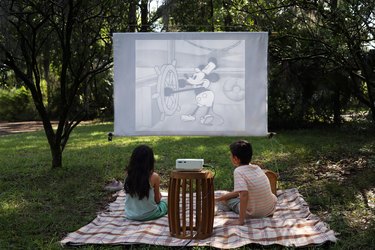
    Set the projector on a table or stand. This option is much easier both in terms of set-up and adjustment. If your mounting is slightly off, it will be easy to move the projector into place. It will also be easier to transport your projector should you want to use it outside of your viewing room.

  6. Step 6

    Make your video connections. Depending upon what hardware you'll be connecting, you'll need to run the appropriate cables. Consider running under the carpet or using cable raceways for a cleaner look. A simple example is to use component video cable to connect your DVD player to the projector. Connect each individual cable (red, green and blue) to the color-coded component outputs on your DVD player and to the inputs on your home theater projector.

  7. Step 7

    Measure your cable. If the cable that you have is not long enough for the run that you need between your video components and projector, be sure to carefully measure out the length of cable you'll need. Measure the path along which the cable will run and purchase the appropriate size cable.

  8. Step 8

    Connect television. If you intend to use your home theater projector for television programming as well as movies, you'll probably need an external tuner, like a cable box, because your home theater projector isn't likely equipped with one. Connect your incoming cable or antenna to the tuner and then use available output (component video, composite video, S-video, HDMI) to connect with your projector.

  9. Step 9

    Fine tune your set-up. With a component playing, make adjustments like focus, brightness and picture height to establish the optimal picture.

Tips & Warnings
  • If it's simply not possible to mount the projector directly to ceiling joists, secure a piece of wood firmly to two joists and then mount projector to the wood. This will provide a bit more flexibility for mounting. Consider the amount of space you have, how much brightness that you'll need for your given room and how you'll be mounting the projector when shopping for a home theater projector so that you get the right equipment to begin with. This will make set-up and use easier. Audio should be connected separately directly from each component to a home theater receiver.
Subscribe

Post a Comment

Post a Comment

Related Ads

  • Have you done this? Click here to let us know.
I Did This
Get Free Electronics Newsletters

Copyright © 1999-2009 eHow, Inc. Use of this web site constitutes acceptance of the eHow Terms of Use and Privacy Policy .   en-US Portions of this page are modifications based on work created and shared by Google and used according to terms described in the Creative Commons 3.0 Attribution License. † requires javascript

eHow Electronics
eHow_eHow Technology and Electronics